
Loading, please wait...
LOT 1511
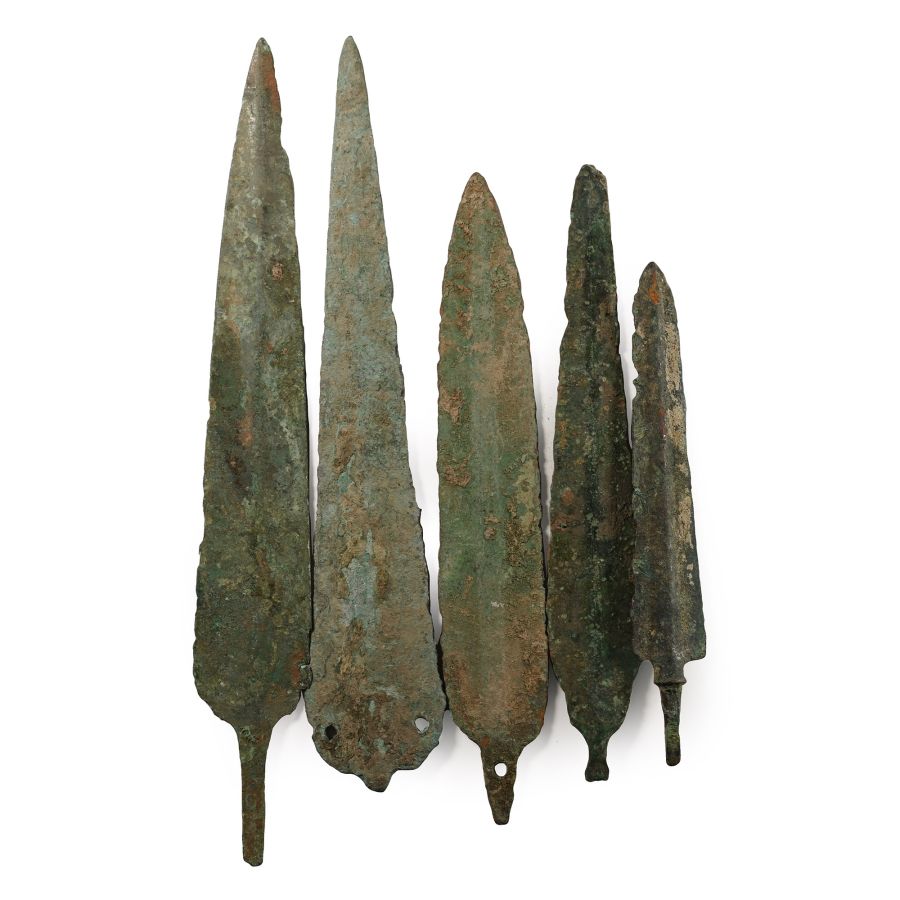
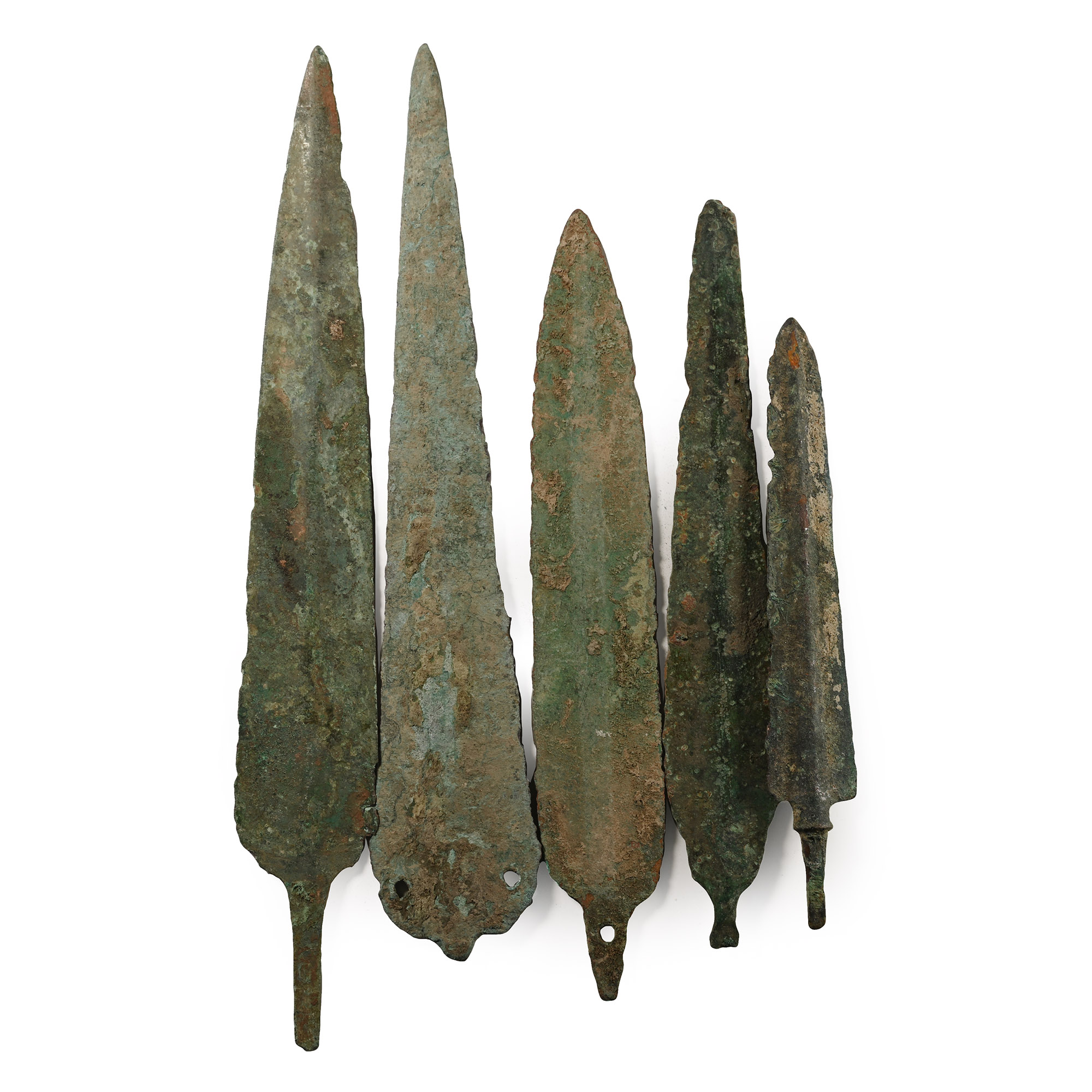
Western Asiatic Bronze Dagger Blade Collection
2200-600 CENTURY B.C.
6 - 9 5/8 in. (321 grams total, 15-24.5 cm).
Comprising four triangular and leaf-shaped blades, one with pierced tang with rivet hole and one pierced through the shoulders with two rivet holes; an arrowhead with strong mid-rib, short tang and narrow foliate blade. [5]
ProvenanceEx London art market, 1980-1990s.
This lot is accompanied by an illustrated lot declaration signed by the Head of the Antiquities Department, Dr Raffaele D'Amato.
See Muscarella, O.W., Bronze and Iron Ancient Near Eastern Artifacts in the Metropolitan Museum of Art, New York, 1988, pp.289ff, for similar arrowhead; for the daggers see Maxwell-Hyslop, R., 'Daggers and swords in Western Asia: a Study from Prehistoric Times to 600BC,' in Iraq, Volume 8, 1946, pp.1-65, pl.III, types 16,27.
FootnotesSome of the daggers represent one of the earliest form of the tangless round-heeled dagger, and the smaller examples were used as knives. Small tanged blades without a rivet, which have sometimes been identified as spearheads, are knives, while the riveted form could be used as a dagger or for domestic purposes.
CONDITIONTimeLine Auctions follows a vetting process to ensure the authenticity and legality of all items, reinforcing our commitment to integrity and responsible trading. Each antiquity, antique, and coin lot undergoes thorough examination by a vetting committee of at least ten external specialists, professional trade association members, scientists, and archaeologists: Our Vetting Process
AUCTIONS:
TimeLine is a leading auction house specialising in antiquities, ancient art, collectables, natural history, coins, medals, and books. Our auctions offer museums, collectors, historians, and enthusiasts the opportunity to acquire unique and historically significant pieces.
-
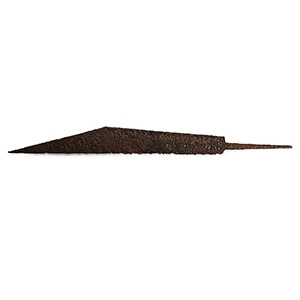
Large Viking Age Iron Broken-Backed Knife 'Seax' Blade
8th-10th century A.D.Sold for (Inc. bp): £117
With scooped forward edge, straight single edge and arched triangular back; transverse mounting tang. 208 grams, 37.5 cm
From a North American collection formed in the 1970s-1990s. This lot is accompanied by an illustrated lot declaration signed by the Head of the Antiquities Department, Dr Raffaele D'Amato.
This knife seems to be of type IV, like the one found in the Thames at Wandsworth. Based on its similarities with a specimen from Canterbury, it could be dated to the 8th century A.D. Underwood classifies these kind of knives under the typology C (angled back-curved cutting edge) dating them from the mid 6th to early 8th century A.D. -
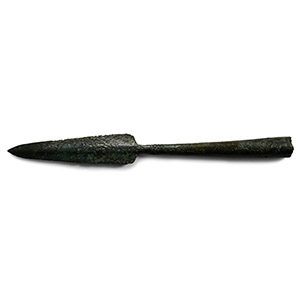
Luristan Bronze Spearhead
13th-7th century B.C.Sold for (Inc. bp): £195
Composed of a leaf-shaped blade with tapering socket. 161 grams, 31.5 cm
Acquired 1980-2015. Ex Abelita family collection. This lot is accompanied by an illustrated lot declaration signed by the Head of the Antiquities Department, Dr Raffaele D’Amato. This lot is accompanied by an illustrated lot declaration signed by the Head of the Antiquities Department, Dr Raffaele D'Amato. -
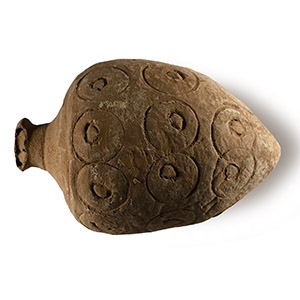
Byzantine 'Greek Fire' Ceramic Fire Bomb or Hand Grenade
9th-11th century A.D.Sold for (Inc. bp): £72
Piriform in profile with narrow point and domed mouth; the body decorated with impressed concentric circles; intended to be filled with explosive liquid and wick, used as a hand grenade. 510 grams, 13.3 cm
From an important specialist collection, London, UK, 1990s onwards. Accompanied by an academic paper by military specialist Dr Raffaele D'Amato, dated 15 July 2019 and titled 'Eastern Roman Empire - Greek Fire Bomb or Hand Grenade (μεσαίον kακάβιον) 9th-11th century AD'. This lot is accompanied by an illustrated lot declaration signed by the Head of the Antiquities Department, Dr Raffaele D'Amato.
Apart from the use of siphons or manual flame-throwers called cheirosiphona, special corps of Roman soldiers employed terracotta grenades, in the form of small jars, abundantly evidenced in archaeological excavations. They were called μεσαία kακαβιά or κυτροκακάβια where the former had a bulbous shape and the latter a more cylindrical form.
