
Loading, please wait...

LOT 1487
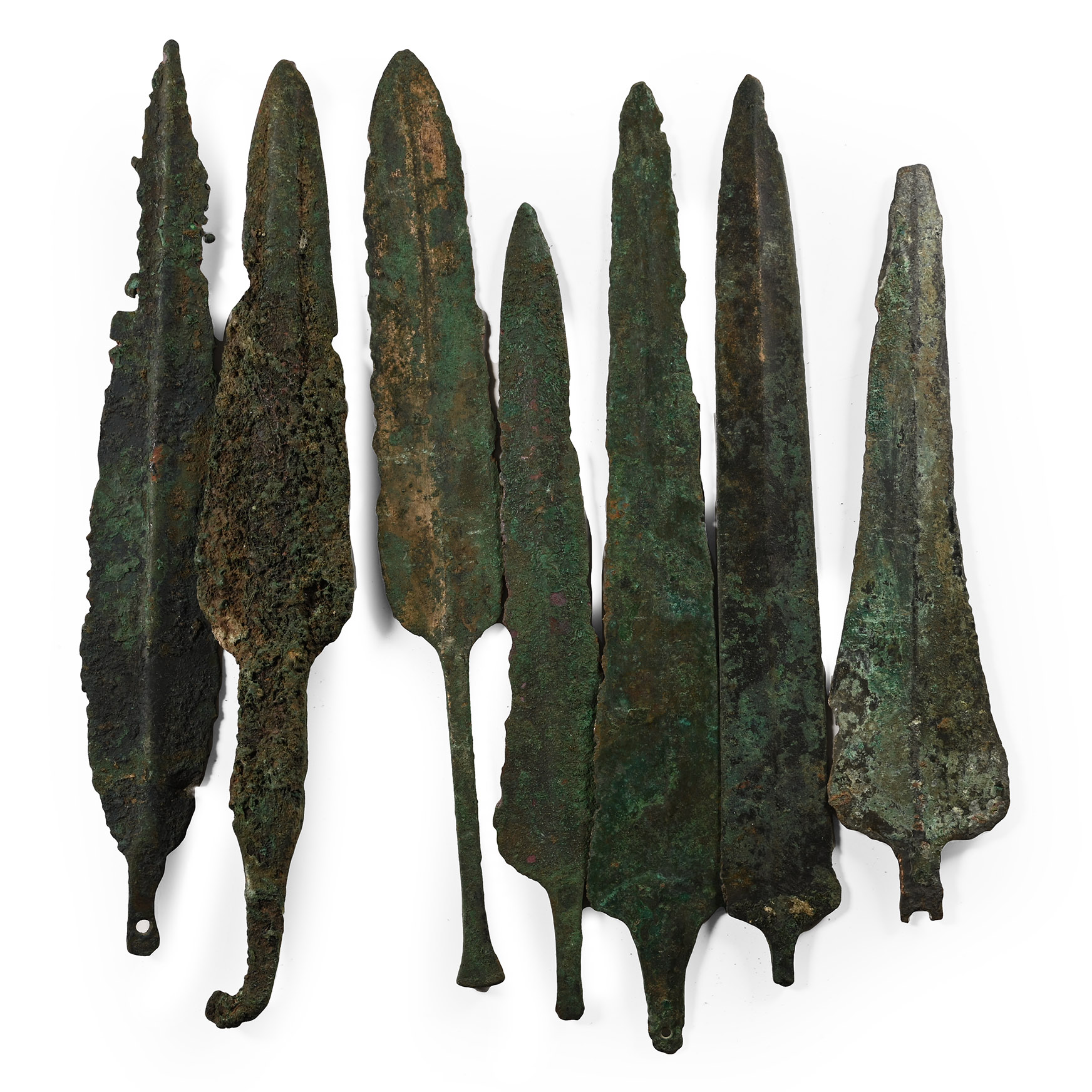
Western Asiatic Bronze Blade Collection
EARLY 1ST MILLENNIUM B.C.
6 7/8 - 8 7/8 in. (528 grams total, 17.5-22.6 cm).
Including four with tapering blades with broad flattened mid-ribs and rounded shoulders, tapered squared section tangs, two with tang pierced at tip; a similar blade with the tang bent at the tip; one spearhead with foliate blade and raised mid-rib; a short dagger with leaf-shaped blade and long rectangular-section tang. [7]
ProvenanceEx London collection, formed 1990-2000.
LiteratureCf. Christie's, The Axel Guttmann Collection of Ancient Arms and Armour, part 1, London, 2002, items 31, p.34, for similar blades.
FootnotesMoorey, Gordon and Khorasani created a classification of bladed weapons, according to which daggers are edged weapons no greater than 36cm in length, dirks (short swords) are between 36cm and 50cm in length, and swords are edged weapons greater than 50cm in length.
CONDITIONTimeLine Auctions follows a vetting process to ensure the authenticity and legality of all items, reinforcing our commitment to integrity and responsible trading. Each antiquity, antique, and coin lot undergoes thorough examination by a vetting committee of at least ten external specialists, professional trade association members, scientists, and archaeologists: Our Vetting Process
AUCTIONS:
TimeLine is a leading auction house specialising in antiquities, ancient art, collectables, natural history, coins, medals, and books. Our auctions offer museums, collectors, historians, and enthusiasts the opportunity to acquire unique and historically significant pieces.
-
.jpg)
Carolingian Iron Spur with Silver Studs
Circa 8th century A.D.Sold for (Inc. bp): £312
With D-section arms, attachment loop, prick spur with two bands of applied studs. 150 grams, 18 cm
Ex B Posey collection, 1990s. Ex Den of Antiquity, Cambridgeshire, UK. Accompanied by a dealer's catalogue information card. -
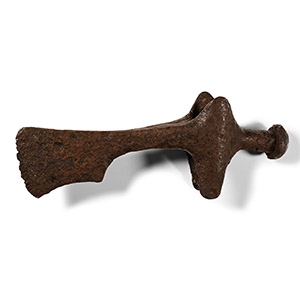
Viking Age Ugro-Finnian Battle Axehead
11th-12th century A.D.Sold for (Inc. bp): £117
A hand-forged iron axehead with square chin to the blade, flanges raised to the socket, rear round hammer-head. 200 grams, 15.5 cm
From the private collection of a London gentleman, from his grandfather's collection formed before the early 1970s.
The more commonly used weapons of the Finno-Ugrian people were axes, commonly found in all Finnic areas, as well as spears. Iron axeheads of this typology show a sub-trapezoidal asymmetrical blade. -
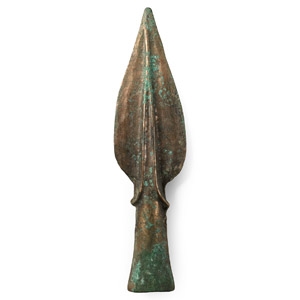
Bronze Age Spearhead
11th-10th century B.C.Sold for (Inc. bp): £390
Of 'pegged leaf-shaped' type with tapering socket and gusseted midrib, rounded shoulders to the blade, narrow point, two opposed holes for the insertion of attachment rivets. 76 grams, 13.5 cm
Acquired in Germany in 2000. Acquired by the present owner from the above.
