
Loading, please wait...
_900x900.jpg "Western Asiatic Bronze Arrowheads, Javelin Heads and Daggers")
_200x200.jpg "Western Asiatic Bronze Arrowheads, Javelin Heads and Daggers")
.jpg "Western Asiatic Bronze Arrowheads, Javelin Heads and Daggers")
LOT 1350
Western Asiatic Bronze Arrowheads, Javelin Heads and Daggers
3RD MILLENNIUM-7TH CENTURY B.C.
5 1/2 - 8 1/2 in. (329 grams total, 14-21.5 cm).
Comprising ten slender tanged arrowheads, javelin heads and daggers, some lozenge-section and some with raised midribs. [10]
ProvenanceAcquired 1980-2015.
Ex Abelita family collection.
For similar examples of arrowheads see Gorelik, M., Weapons of Ancient East, IV millennium BC-IV century BC, Saint Petersburg (2003), pl.XLIII, nos.257 (Luristan); 261-262 (from Karkemish); for the daggers Christie's, The Axel Guttmann Collection of Ancient Arms and Armour, part 1, London, 2002, items 31; for the Javelinheads, s.Gernez, G., L’armament en métal au Proche et Moyen-Orient: des origines a 1750 av. J.C., Paris, 2007, fig.2.93, subtypes L3 B.a-b; fig.2.94 variant L3.C.a., for the type.
FootnotesMost of these blades are bipartite, but the definition of the bipartite type is not absolute as it brings together weapons of very different and unrelated designs. In fact, some weapons do not have a sufficiently characteristic shape to be interpreted as a spear, dagger, or long arrowhead. The javelin heads classified by Gernez as type Type L 3 are characterized by the simplicity of their design. They have a sharp and/or pointed active part, a flat, elliptical or rhomboidal cross-section and an elongated tang with a rectangular, square or circular section, ending in a pointed, widened, curved or folded blade.
CONDITIONTimeLine Auctions follows a vetting process to ensure the authenticity and legality of all items, reinforcing our commitment to integrity and responsible trading. Each antiquity, antique, and coin lot undergoes thorough examination by a vetting committee of at least ten external specialists, professional trade association members, scientists, and archaeologists: Our Vetting Process
AUCTIONS:
TimeLine is a leading auction house specialising in antiquities, ancient art, collectables, natural history, coins, medals, and books. Our auctions offer museums, collectors, historians, and enthusiasts the opportunity to acquire unique and historically significant pieces.
LOT 1350
Western Asiatic Bronze Arrowheads, Javelin Heads and Daggers
Sold for (Inc. bp): £195
-
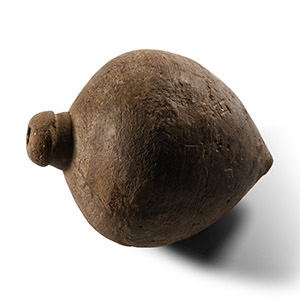
Byzantine 'Greek Fire' Ceramic Fire Bomb or Hand Grenade
9th-11th century A.D.Sold for (Inc. bp): £143
Piriform body with domed filler-hole; intended to be filled with explosive liquid and wick, used as a hand grenade. 580 grams, 12.5 cm
From a collection acquired on the UK art market from various auction houses and collections mostly before 2000. From an important Cambridgeshire estate; thence by descent. Accompanied by an academic paper by military specialist Dr Raffaele D'Amato, dated 15 July 2019 and titled 'Eastern Roman Empire - Greek Fire Bomb or Hand Grenade (μεσαίον kακάβιον) 9th-11th century AD'.
Apart from the use of siphons or manual flame-throwers called cheirosiphona, special corps of Roman soldiers employed terracotta grenades, in the form of small jars, abundantly evidenced in archaeological excavations. Such were the γανωτα, vessels (sometimes also of bronze) used for Greek fire. They were called μεσαία kακαβιά or κυτροκακάβια where the former had a bulbous shape and the latter a more cylindrical form. -
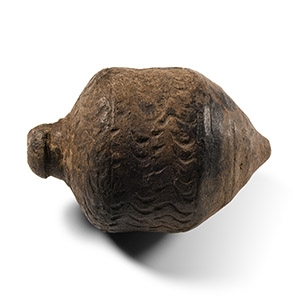
Byzantine 'Greek Fire' Ceramic Fire Bomb or Hand Grenade
9th-11th century A.D.Sold for (Inc. bp): £286
With domed filler-hole, broad shoulder, alternating bands of crescent impressed detailing; intended to be filled with explosive liquid and wick, used as a hand grenade. 242 grams, 10.1 cm
From a collection acquired on the UK art market from various auction houses and collections mostly before 2000. From an important Cambridgeshire estate; thence by descent. Accompanied by an academic paper by military specialist Dr Raffaele D'Amato, dated 15 July 2019 and titled 'Eastern Roman Empire - Greek Fire Bomb or Hand Grenade (μεσαίον kακάβιον) 9th-11th century AD'.
Apart from the use of siphons or manual flame-throwers called cheirosiphona, special corps of Roman soldiers employed terracotta grenades, in the form of small jars, abundantly evidenced in archaeological excavations. Such were the γανωτα, vessels (sometimes also of bronze) used for Greek fire. They were called μεσαία kακαβιά or κυτροκακάβια where the former had a bulbous shape and the latter a more cylindrical form. -
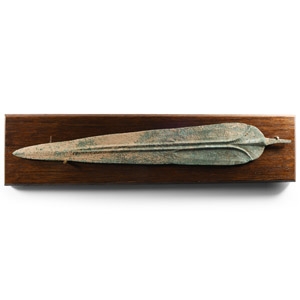
North West Persian Short Sword with Blood Channels
2nd-1st millennium B.C.Estimate: £250 - 350 (+bp*)
Opening Bid: £125
With short tang for an organic hilt, the blade showing multiple grooves forming a pronounced mid-rib spanning roughly more than three-quarters of the blade; accompanied by a custom-made display stand. 1.18 kg total, 45.5 cm (49 cm including stand)
Ex P.A., Hertfordshire, UK, specialist collection of Greek art, 1980-1990s.
Luristan was hardly an ethnic or political entity, but the people of Luri had relations through warfare and traded with Sumerians, Lullubi, Assyrians, Babylonians and Elamites over a long period of time, spanning from the 3rd to the 2nd millennium B.C. The ruling elites of warrior horsemen were buried with their weapons and horses.
