
Loading, please wait...
LOT 1235
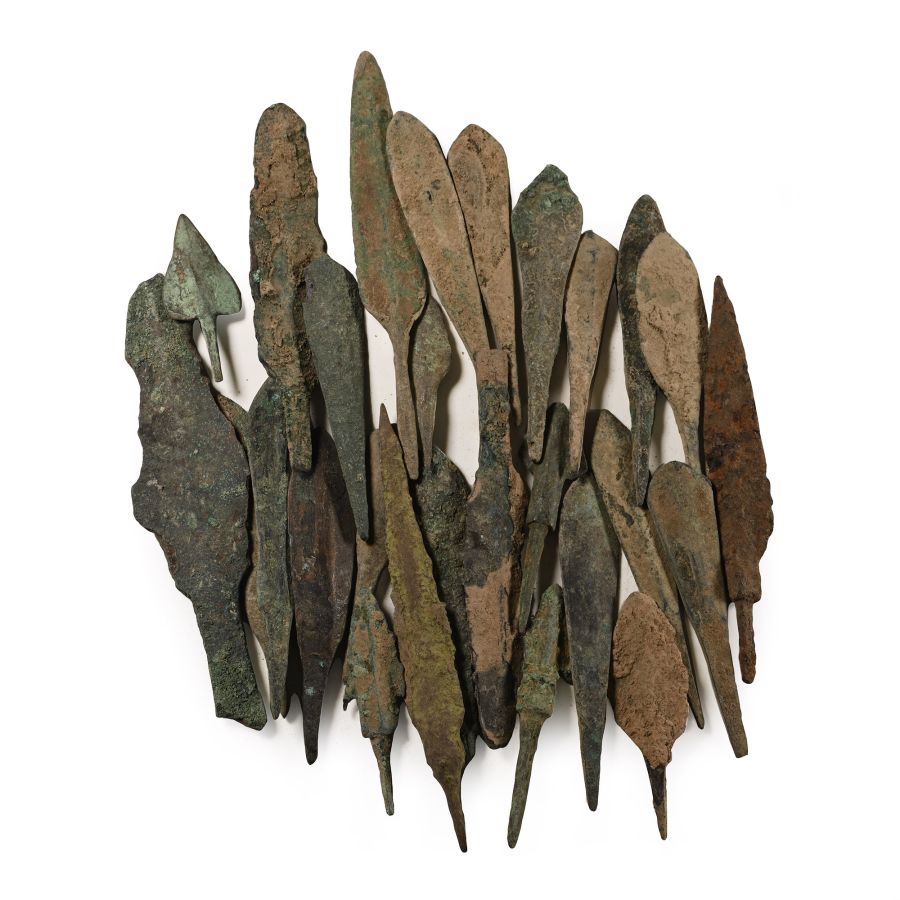
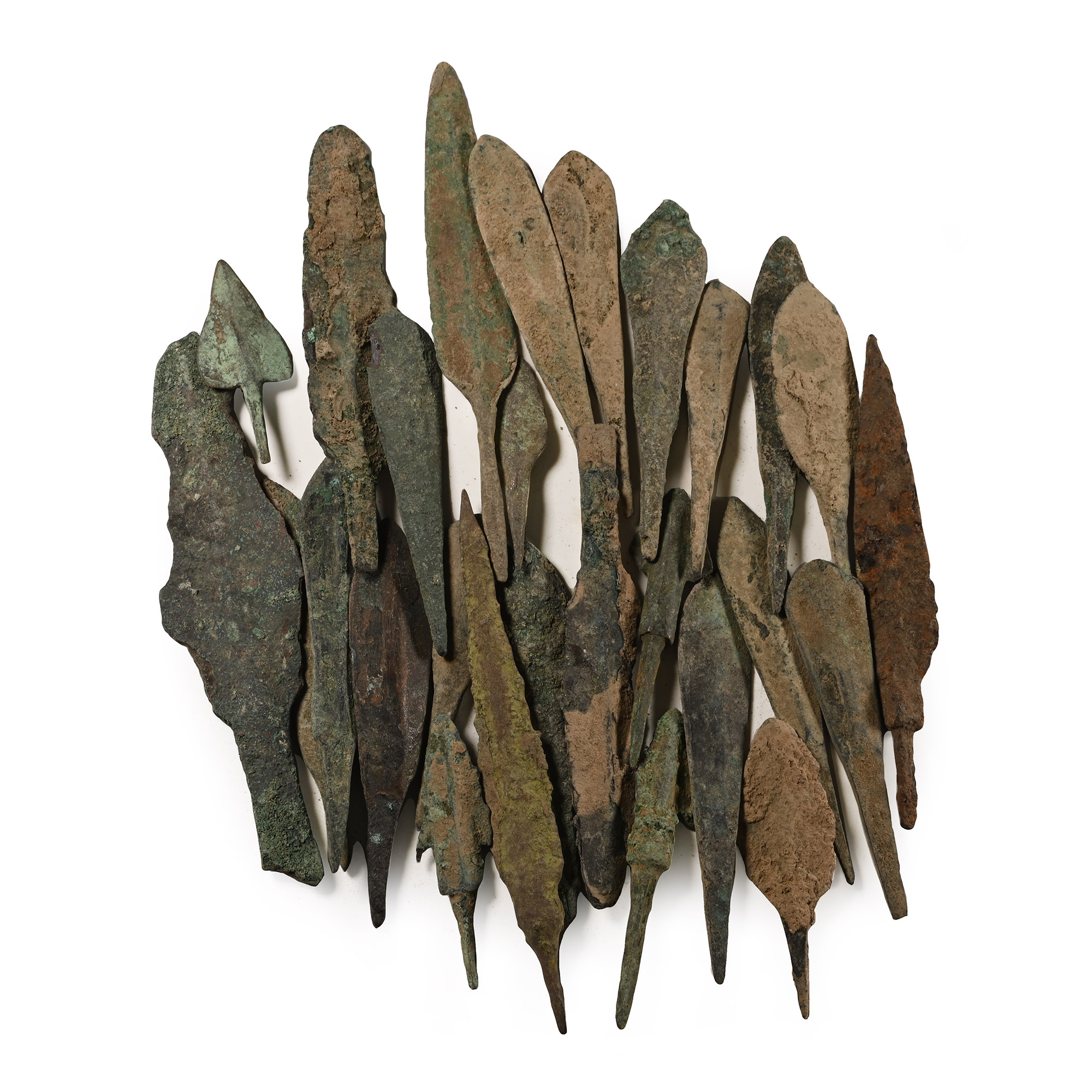
Western Asiatic Bronze Arrowhead Collection
18TH-7TH CENTURY B.C.
1 1/2 - 3 5/8 in. (205 grams total, 37-93 mm).
Including triangular, leaf-shaped, barbed, paddle-shaped arrowheads with a flat, comparatively wide mid-rib, and others. [27]
ProvenanceEx London art market, 1980-1990s.
This lot has been cleared against the Art Loss Register database, and is accompanied by an illustrated lot declaration signed by the Head of the Antiquities Department, Dr Raffaele D'Amato.
Cf. for similar arrow-points Gorelik, M., Weapons of Ancient East, IV millennium BC-IV century BC, Saint Petersburg, 2003, in Russian, (plate XLIII, nos.26-27, 92-93).
FootnotesFourteen arrowheads of this group were typical of the Old Babylonian Empire. The shoulders were pronounced and the arrowhead had a rectangular-section tapering tang. This simple form was popular throughout and show comparative common finds in the Holy Land.
CONDITIONTimeLine Auctions follows a vetting process to ensure the authenticity and legality of all items, reinforcing our commitment to integrity and responsible trading. Each antiquity, antique, and coin lot undergoes thorough examination by a vetting committee of at least ten external specialists, professional trade association members, scientists, and archaeologists: Our Vetting Process
AUCTIONS:
TimeLine is a leading auction house specialising in antiquities, ancient art, collectables, natural history, coins, medals, and books. Our auctions offer museums, collectors, historians, and enthusiasts the opportunity to acquire unique and historically significant pieces.
LOT 1235
Western Asiatic Bronze Arrowhead Collection
Estimate £100 - 140€120 - 160 (for guidance only)$140 - 190 (for guidance only)
-
Western Asiatic Terracotta Figural Plaque
1st millennium B.C.Sold for (Inc. bp): £312
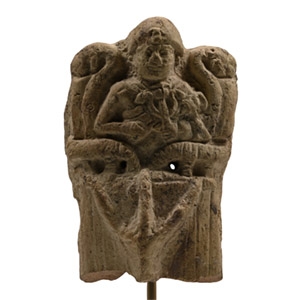
A roughly rectangular plaque showing the upper body of a man holding a three-pronged object in his left hand, fronted by a striated low wall (a chariot?) with a large three-toed bird's claw at the front, two mounting holes to the centre; mounted on a custom-made display stand. 98 grams total, 10.1 cm including stand
with Galerie Rhéa, Zurich, Switzerland. This lot has been cleared against the Art Loss Register database, and is accompanied by an illustrated lot declaration signed by the Head of the Antiquities Department, Dr Raffaele D'Amato. -
.jpg)
Achaemenid Silver Bowl with Royal Egyptian Inscription for Darius the Great
6th-5th century B.C.Sold for (Inc. bp): £13,000
Bowl fragment including section of the carinated rim, radiating repoussé teardrop bosses with interstitial lotus-flowers motifs and radiating rosette motif below; incised Egyptian hieroglyphic legend below the rim transliterated as 'ı͗nṯry(p sic )wš pr-ꜤꜢ pꜢ ꜤꜢ' (Darius, the Great Pharaoh); mounted on a custom-made stand. 1.23 kg total, 26.7 cm wide including stand
Previously in the private collection of Mr S.A, acquired on the London art market in the 1960s. Accompanied by a copy of a previous illustrated three page cataloguing/report. Accompanied by a copy of an IADAA Interpol search certificate. This lot has been checked against the Interpol Database of stolen works of art and is accompanied by a search certificate number no.12709-235450. This lot has been cleared against the Art Loss Register database, and is accompanied by an illustrated lot declaration signed by the Head of the Antiquities Department, Dr Raffaele D'Amato.
Egyptologist Paul Whelan writes: "The inscription reads: ı͗nṯry(p sic )wš pr-ꜤꜢ pꜢ ꜤꜢ (Darius, the Great Pharaoh). The ancient Egyptians encountered difficulties in rendering the name Darius in hieroglyphs, with at least seventeen known variants. This version differs slightly from those, as it also includes an erroneous ‘p’ hieroglyph. The presence of several cuneiform signs following the hieroglyphs indicates that the phiale likely once featured multilingual versions of the inscription - a practice more commonly found on stone vessels. The epithet ‘the Great Pharaoh’ on this fragment represents one of the earliest examples, appearing more frequently in inscriptions from the reign of Xerxes." A hieroglyphic inscription on an Achaemenid item is very rare, although examples on stone vessels are known. Darius I 'the Great' ruled from 522 to 486 B.C. His predecessor, Cambyses II, conquered Egypt in 525 B.C. and the presence of this inscription is probably linked to the subsequent rule of the dynasty over Egypt and its influence on the Egyptian priestly caste. -
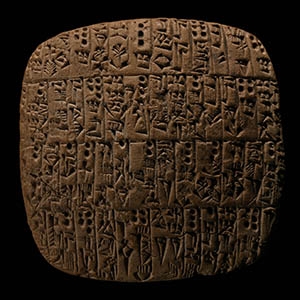
Early Dynastic Terracotta Administrative Cuneiform Tablet Recording Livestock and their Owners
IIIb, 2400-2340 B.C.Estimate: £15,000 - 20,000 (‡+bp*)
Opening Bid: £7,500
Pillow-shaped tablet with dense cuneiform text to two broad faces and one edge, concerning the listing of 146 sheep and their owners or shepherds:
202 grams, 78 mmColumn I Column II Column III 5 sheep, Pirigni, Kor 2?
6 male sheep, Ur-ur of Umma
3 sheep, Zag-mu, ki ni mu zu
5 sheep, x x-gi
4 male sheep …
Ur-Ishkur, herder of Abdu
4 sheep, Urgu (of) E-RU
2 … , herder IL, scribe
3 Gimni, herder chief galla-official
5 male sheep, Ur-lu, ..
2 sheep Lu-ra, herder…
…, herder
2 male sheep, Akadu, son of Lugal-sanga
2 Shesh-zimu
3 Zagmu,
Akadu
2 Ekalsi
1 Gimdu, son of Ekal
2 Mashda
1 … Guzi…
2 …kam … NA
Column IV Reverse Column V Column VI 2 Ur-…dua
6 Zagmu, herder of Mesanne
1 Urtul
3 GISH.MI, herder of Ilum-su?ni
4 Lugal-shalasu
Adda, singer?
5 Almu
2 Ur-Ezida
IGI MI ZI SI
3 Lueshla
2 Ur-… NE-RA
8 Azuzu
2 Adda, captain
1 En…du, nuesh-officiant
3 Sheshpadda, overseer
2 … ki-bi
…
…
6 E…
1 Ur…
…
1 Ur …
1 …
3 Dingir-urmu
1 Pirigni
Da…
1 Ur-Ninshaza, wife of U-u
4 Lugallu, herder of Lugalla…, majordomo
5 …igi-en …
1 Lugal-E…nisi
Column VII Column VIII Total 4 E-gish MI bi?, .., farmer
1 Ur-dingir, …si-TExESZ3
1 …
1 Lugal-nuduga
1 Aba-Enlil
1 Lugal …
2 Urmes
1 Urdam
1 Akadu, Adda…
1 U-u, …
Umunene
2 … -niE-u?
(space)
Its total: 146 sheep,
…
Pirigni (is) kush-official.
with Laemmle Gallery, San Vicente Boulevard, Los Angeles, USA. Acquired from the above in the early 1970s. with Bonhams, London, 13 April 2011, no.133. Private central European collection. Accompanied by copies of the relevant Bonhams catalogue pages. Accompanied by a copy of the translation for this tablet. This lot has been checked against the Interpol Database of stolen works of art and is accompanied by a search certificate number no.12121-218147. This lot has been cleared against the Art Loss Register database, and is accompanied by an illustrated lot declaration signed by the Head of the Antiquities Department, Dr Raffaele D'Amato.
