
Loading, please wait...
LOT 1473
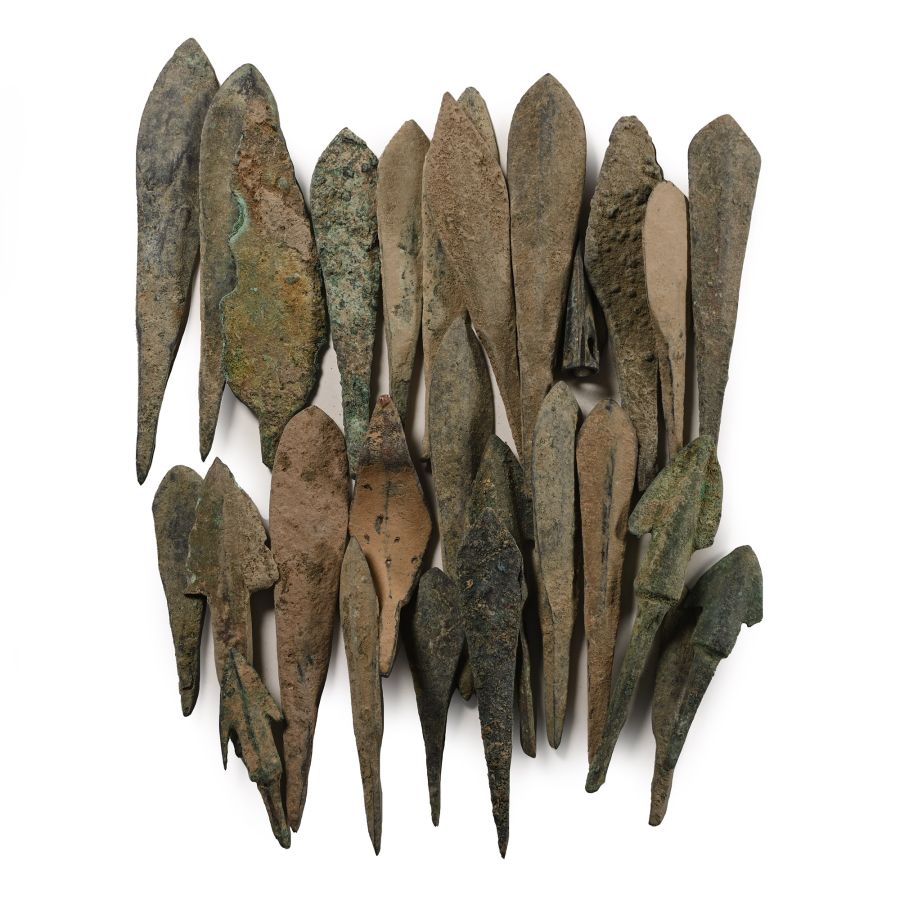
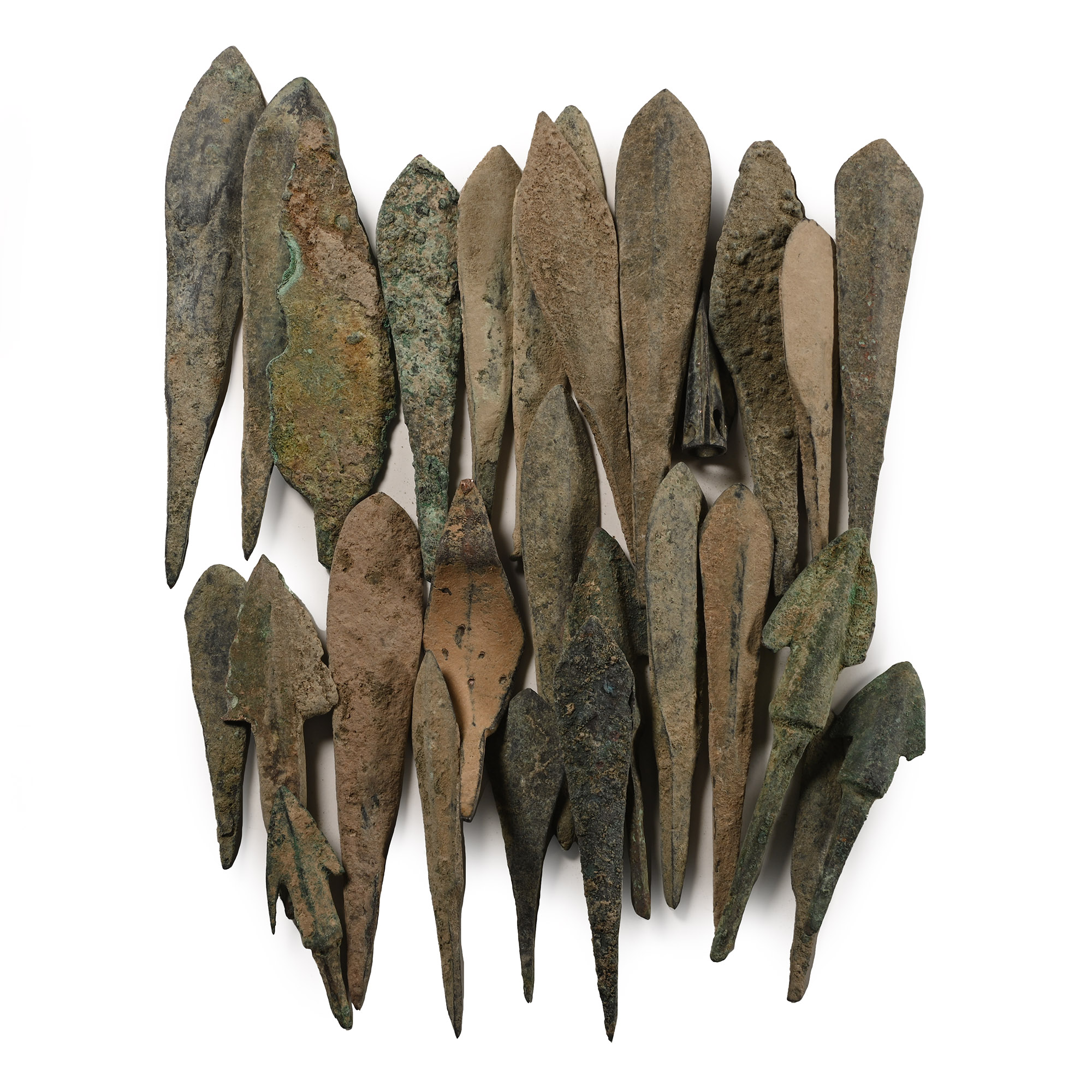
Western Asiatic Bronze Arrowhead Collection
19TH-6TH CENTURY B.C.
1 - 3 in. (176 grams total, 25-77 mm).
Including triangular, leaf-shaped, barbed, paddle-shaped with a flat, comparatively wide mid-rib, and others. [27]
ProvenanceEx London art market, 1980-1990s.
This lot is accompanied by an illustrated lot declaration signed by the Head of the Antiquities Department, Dr Raffaele D'Amato.
Cf. for similar arrow-points Gorelik, M., Weapons of Ancient East, IV millennium BC-IV century BC, Saint Petersburg, 2003, in Russian, (plate XLIII, nos.26-27, 92-93).
FootnotesSome of the represented arrowheads (paddle-shaped) were typical of the Old Babylonian Empire. The shoulders were pronounced and the arrowhead had a rectangular-section tapering tang. This simple form was popular throughout and are comparatively common finds in the Holy Land.
CONDITIONTimeLine Auctions follows a vetting process to ensure the authenticity and legality of all items, reinforcing our commitment to integrity and responsible trading. Each antiquity, antique, and coin lot undergoes thorough examination by a vetting committee of at least ten external specialists, professional trade association members, scientists, and archaeologists: Our Vetting Process
AUCTIONS:
TimeLine is a leading auction house specialising in antiquities, ancient art, collectables, natural history, coins, medals, and books. Our auctions offer museums, collectors, historians, and enthusiasts the opportunity to acquire unique and historically significant pieces.
LOT 1473
Western Asiatic Bronze Arrowhead Collection
Estimate £100 - 140€120 - 160 (for guidance only)$140 - 190 (for guidance only)
-
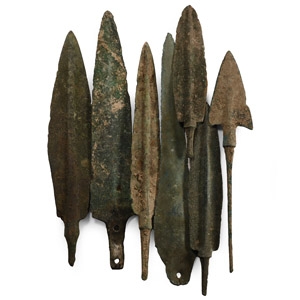
Large Western Asiatic Bronze Arrowhead and Dagger Collection
1800-700 B.C.Sold for (Inc. bp): £156
Including mainly triangular and leaf-shaped types of arrowheads, and two small daggers with pierced tang. 251 grams total, 10.5-17 cm
Ex London art market, 1980-1990s. This lot is accompanied by an illustrated lot declaration signed by the Head of the Antiquities Department, Dr Raffaele D'Amato.
Small tanged blades without a rivet, which have sometimes been identified as spearheads, are knives, while the rivetted form could have been used as a dagger or for domestic purposes. Both forms are characteristic of the Hyksos period in Palestine. A curious blade from Byblos (Level 19) represents the earlier form of this type. -
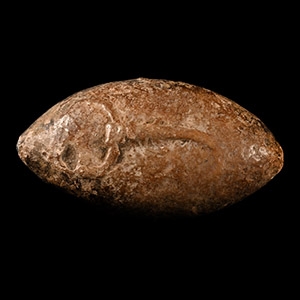
Hellenistic Rhodian Lead Slingshot with Scorpion
3rd century B.C.Sold for (Inc. bp): £598
Lentoid-section and depicting a stylised scorpion to one side, a type sometimes known to have the Rhodian legend ΚΑΛΑ to verso. 29.6 grams, 29 mm
From a Manchester, UK, collection, 1990s. This lot is accompanied by an illustrated lot declaration signed by the Head of the Antiquities Department, Dr Raffaele D'Amato.
Together with the Balearic slingers, Rhodian slingers were considered to be the best of the Hellenistic world, and they were also used in the Roman army. The slingshots with an image of a scorpion on one side and with an inscription ΚΑΛΑ on the other are believed to originate from the Island of Rhodes. On these sling bullets ΚΑΛΑ should be translated as “nice things.” Of course, ironically, these “nice things” were designed to kill enemies and to sting like a scorpion, and the message of those with the image of a scorpion could be understood, as proposed by M. Manov and N. Torbov, as: “nice things sting like a scorpion.” -
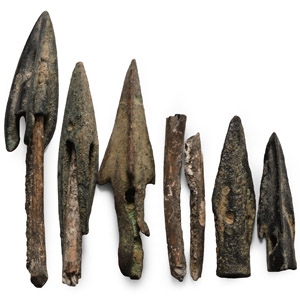
Greek Bronze Arrowheads with Original Shafts
Circa 5th-3rd century B.C.Sold for (Inc. bp): £111
Comprising four triangular tanged types and one leaf-shaped socketted type, four with original wooden shafts; rare. 19.9 grams total, 45-57 mm
Ex Robin Symes Gallery, Mayfair, pre 1999. From a London, UK, collection. This lot is accompanied by an illustrated lot declaration signed by the Head of the Antiquities Department, Dr Raffaele D'Amato.
Missile troops were not neglected in ancient Greece. In the mid-4th century B.C. Athens, inscriptions list boxes of arrows; in 282, a Cretan coach is recorded as being employed to train Athenian archers, and Sparta too had long since employed Cretan archers. Bow and quiver of great value were often the prize of sport competitions.
