
Loading, please wait...
LOT 1471
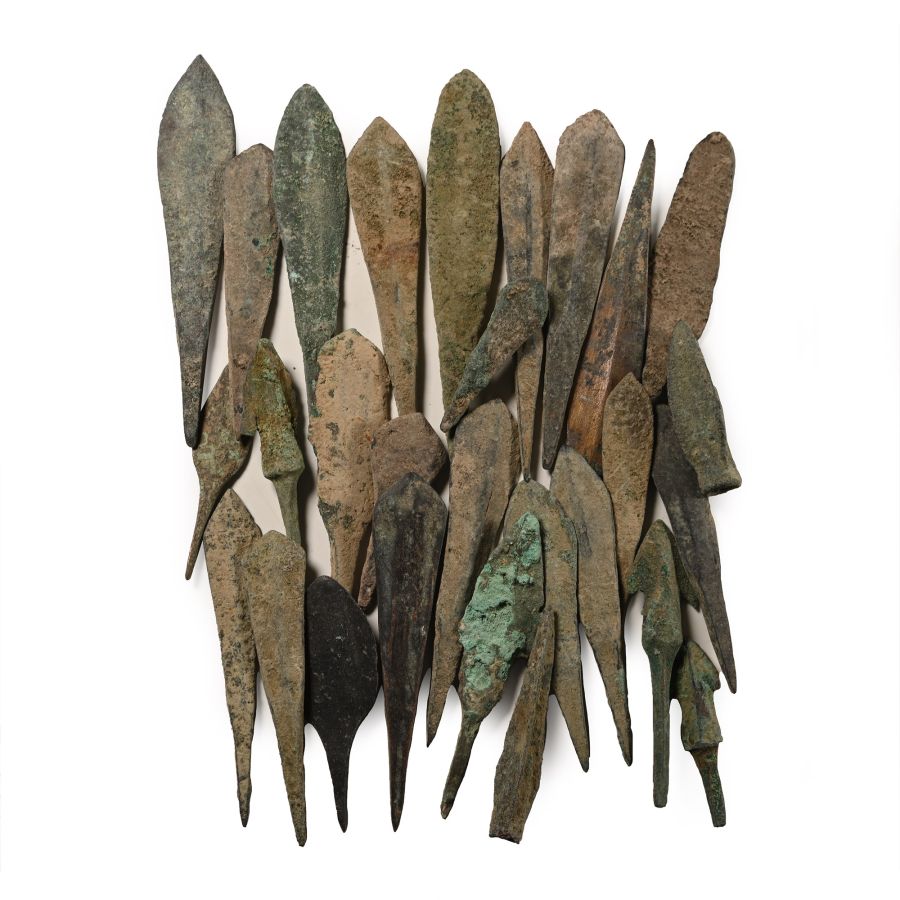
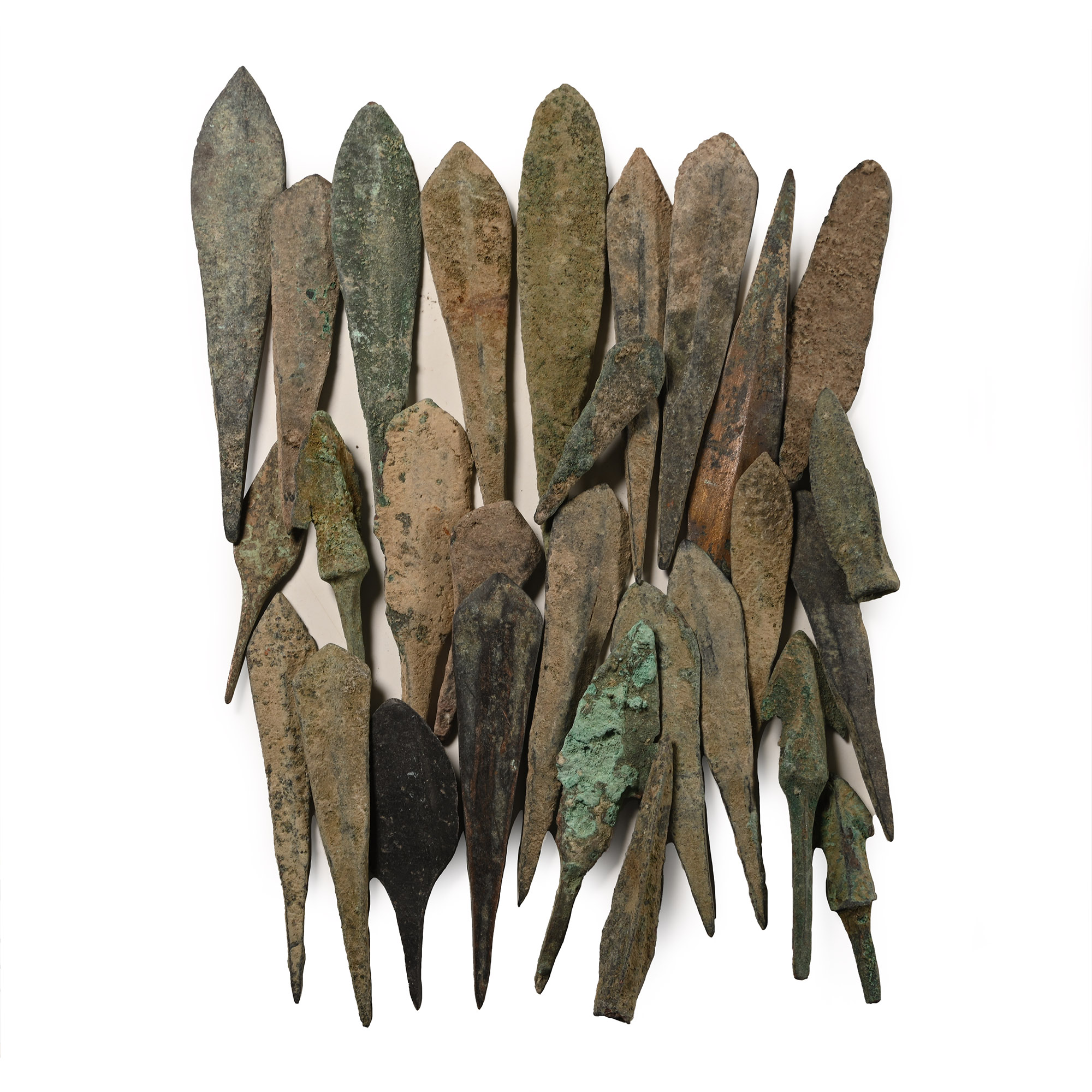
Western Asiatic Bronze Arrowhead Collection
18TH-7TH CENTURY B.C.
1 1/2 - 3 in. (176 grams total, 33-77 mm).
Including triangular, leaf-shaped, barbed, paddle-shaped with a flat, comparatively wide mid-rib, and others. [28]
ProvenanceEx London art market, 1980-1990s.
This lot is accompanied by an illustrated lot declaration signed by the Head of the Antiquities Department, Dr Raffaele D'Amato.
Cf. for similar arrow-points Gorelik, M., Weapons of Ancient East, IV millennium BC-IV century BC, Saint Petersburg, 2003, in Russian, (plate XLIII, nos.26-27, 92-93).
FootnotesSome of the represented arrowheads (paddle-shaped) were typical of the Old Babylonian Empire. The shoulders were pronounced and the arrowhead had a rectangular-section tapering tang. This simple form was popular throughout and are comparatively common finds in the Holy Land.
CONDITIONTimeLine Auctions follows a vetting process to ensure the authenticity and legality of all items, reinforcing our commitment to integrity and responsible trading. Each antiquity, antique, and coin lot undergoes thorough examination by a vetting committee of at least ten external specialists, professional trade association members, scientists, and archaeologists: Our Vetting Process
AUCTIONS:
TimeLine is a leading auction house specialising in antiquities, ancient art, collectables, natural history, coins, medals, and books. Our auctions offer museums, collectors, historians, and enthusiasts the opportunity to acquire unique and historically significant pieces.
-
.jpg)
Large Levantine Crescentic 'Anchor' Axehead
Middle Bronze Age, late 3rd-early 2nd millennium B.C.Sold for (Inc. bp): £1,560
An anchor-shaped semi-circular blade, semi-elliptical in section, narrow socket with a long extension to the rear. 557 grams, 11.1 cm
Previously in a London, UK, collection, 1970s. Ex Rabi Gallery 1991. This lot is accompanied by an illustrated lot declaration signed by the Head of the Antiquities Department, Dr Raffaele D'Amato.
The ‘anchor’ axes belonged to a homogeneous type of axe, similar to the fenestrated axes, but displaying a different hafting method. The handle was inserted into a short cylindrical collar except at the back, where it extended to a width roughly equivalent to that of the blade. The two ends of the blade widened to form a concave face resting against the handle, thus ensuring a firm support. The edges of the fenestrelles were prominent and sometimes have decoration. At the back of the collar, there was always a spherical or flattened knob. The function of this knob can only be conjectured: it seems too small to serve as a counterweight, hence it was probably an element used to wind the handle's attachment cord. -
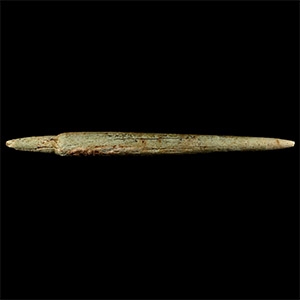
Chinese Liao Bone Arrowhead
Liao Dynasty, 907-1125 A.D.Sold for (Inc. bp): £7
Conical with a tapering, short tang. 9.3 grams, 11.4 cm
Ex property of a UK gallery, early 2000s. This lot is accompanied by an illustrated lot declaration signed by the Head of the Antiquities Department, Dr Raffaele D'Amato. -
.jpg)
Large Medieval Silver Inlaid Iron Spearhead
15th-16th century A.D.Sold for (Inc. bp): £1,300
Comprising: a hexagonal-section tapering socket, lentoid-section neck and leaf-shaped blade; inlaid silver-wire scrolled tendril detailing to the socket and neck. 693 grams, 42 cm
Private collection formed in Europe in the 1980s. Westminster collection, central London, UK. This lot has been cleared against the Art Loss Register database, and is accompanied by an illustrated lot declaration signed by the Head of the Antiquities Department, Dr Raffaele D'Amato.
The spearhead likely belonged to a family fighting in the Balkanic wars among Christian and Ottomans in the late 15th century A.D. Spears with such shape are dated to the 16th century and are defined by specialists as ‘schefflin’ type. The ornament of the blade imitates Ottoman decorative models.
