Loading, please wait...
LOT 1171
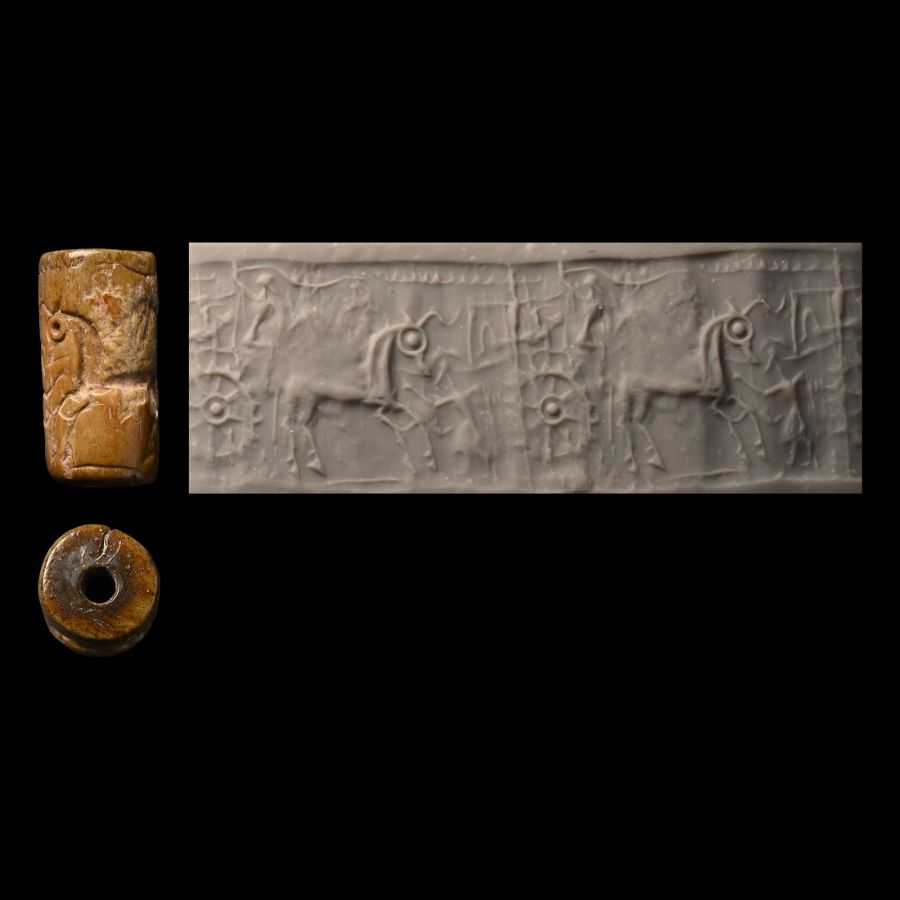
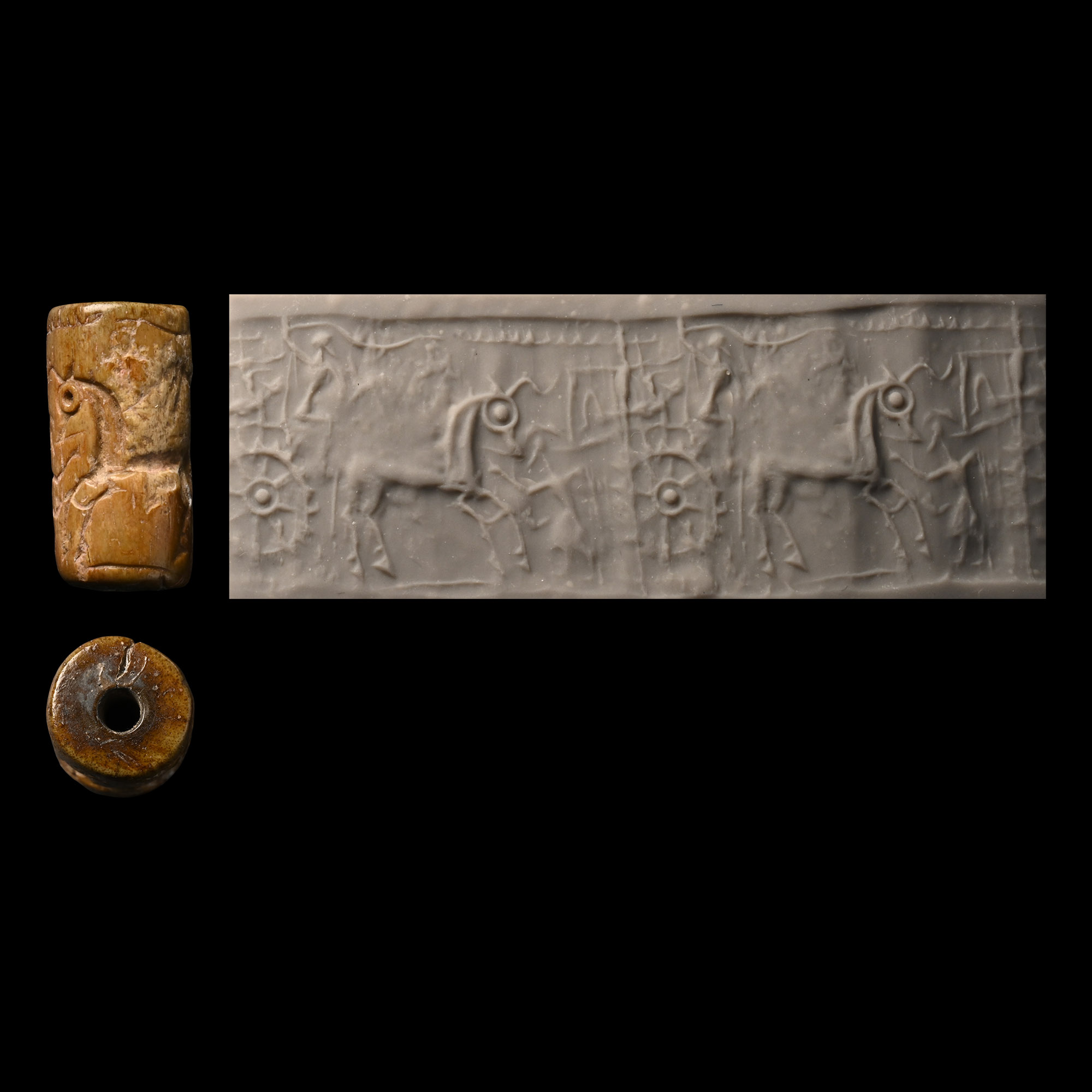
Western Asiatic Bone Cylinder Seal with Chariot
2ND MILLENNIUM B.C.
3/4 in. (2.3 grams, 19 mm).
With incuse frieze of a horse in profile pulling a chariot with driver and large spoked wheel, small standing figure before the horse's chest; accompanied by a museum-quality impression. [No Reserve]
ProvenanceAcquired in the 1980s-2000s.
From an important London, UK, collection.
TimeLine Auctions follows a vetting process to ensure the authenticity and legality of all items, reinforcing our commitment to integrity and responsible trading. Each antiquity, antique, and coin lot undergoes thorough examination by a vetting committee of at least ten external specialists, professional trade association members, scientists, and archaeologists: Our Vetting Process
AUCTIONS:
TimeLine is a leading auction house specialising in antiquities, ancient art, collectables, natural history, coins, medals, and books. Our auctions offer museums, collectors, historians, and enthusiasts the opportunity to acquire unique and historically significant pieces.
-
Large Sogdian Silver-Gilt Wild Boar Rhyton
5th-6th century A.D.Sold for (Inc. bp): £65,000
A Sogdian or Sasanian head of a wild boar with detailed facial features including large snout, curled tusks, alert eyes with heavy eyelids, erect ears, the animal's mane framing the head and back; a series of small circles decorating the cheeks; an oval vessel mouth emerging from the mane and the spout formed as a pierced stud at the centre of the boar's chest. 1.3 kg, 21.5 cm long
with a New York gallery, 1970s. Private collection, London. Accompanied by three black-and-white photographs taken prior to cleaning, believed to date from the 1970s. Accompanied by an academic report by Dr Raffaele D’Amato. This lot has been checked against the Interpol Database of stolen works of art and is accompanied by search certificate number no.12979-246395.
The production of silver vessels and dinner objects for the court was highly centralised within the Sasanian Empire. In the 5th and 6th century AD, the production of silver vessels expanded, creating new shapes, such as pitchers, elliptical bowls and high-footed bowls. If the iconography included both Dionysian and Christian imagery, the subjects linked with royal power were the favourites, and among them, the boar. The boar was, in fact, the animal associated with the Zoroastrian Izad Vahram, the epitome of victory. It was not a coincidence that one of the usurpers of the Persian throne, the general Farrukhān, took the title of Shahrbaraz (reigning in 630 AD), whose name means ‘The Boar of the Empire’, attesting to his dexterity in military command and warlike personality. Shahrwarāz derived in fact from the middle-Persian word shahr (country) and warāz (boar). -
Sumerian Cream Stone Cylinder Seal with Contest Scene
Circa 2500 B.C.Sold for (Inc. bp): £624
Divided into two registers, both showing a contest scene with a horned hero grappling with horned beasts; accompanied by a museum quality impression and a copy of an old scholarly note, typed and signed by W.G. Lambert, late Professor of Assyriology, University of Birmingham, 1970-1993, which states: 'Cylinder Seal of Cream Stone, 28.5 x 12 mm. The engraved sides of this seal are divided into two registers by a single horizontal line. In both registers there is a contest scene. In the upper a standing hero with double belt around his waist succours a bovine on the right and an upended gpat on the left, both of which are being attacked by a lion. The body of the lion on the right crosses the body of a second bovine. In the lower register a standing nude hero succours two differentiated bovines, one of each side, which are being attacked each by a lion, but in this case each lion's body crosses that of a third and fourth bovine. This is a seal in the Sumerian tradition, c. 2500 B.C., from the Third Phrase [sic] of the Early Dynastic periods, and may come from Sumer itself, north Mesopotamia or south-east Iran. It is in good state of preservation and a nice example of its kind.' 8.83 grams, 28 mm
UK private collection, acquired 1990-1993.
Seals were the working signatures of the ancient Near East. Pressed or rolled into wet clay, they secured jars, bags, doors and tablets, and left a distinct impression that identified the owner, authorised a transaction, and showed whether a container had been opened. Stamp seals (pressed once to leave a single emblem) appear from the 7th–4th millennia BC and continue throughout later periods; cylinder seals (rolled to create a repeating frieze) developed in Mesopotamia in the late 4th millennium BC and are used into the 1st millennium BC. Beyond administration, seals were miniature artworks and amulets. Their images—gods and worshippers, royal hunts, banquets, heroes and mythic beasts—broadcast rank, piety and profession, and were believed to protect the owner. Materials range from soft stones to hard chalcedonies, haematite and lapis, worked with drills and abrasives to achieve crisp intaglio cutting. Many were worn on cords or rings and followed their owners through life, sometimes into the grave. Seals matter because they underpin the earliest systems of record-keeping and trade. Impressions on tablets and bullae are primary documents for ancient law, economy and religion; the seals themselves preserve that imagery in the round. For collectors, well-cut examples with sharp impressions, good polish and honest ancient wear are especially desirable, and pieces with early collection histories are keenly sought. -
Western Asiatic Agate Bull's Head Pendant
1st millennium B.C.Sold for (Inc. bp): £208
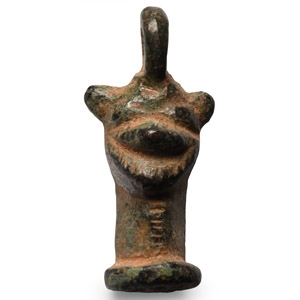
Finely carved as a stylised bull's head with short horns and bulbous eyes, incised nostrils and mouth, perforated at the back of the neck for suspension. 28.9 grams, 40 mm
Ex property of the late Mr S.M., London, UK, 1969-1999, thence by descent. Accompanied by a previous typed cataloguing card. This lot has been cleared against the Art Loss Register database, and is accompanied by an illustrated lot declaration signed by the Head of the Antiquities Department, Dr Raffaele D'Amato.