
Loading, please wait...
LOT 1097
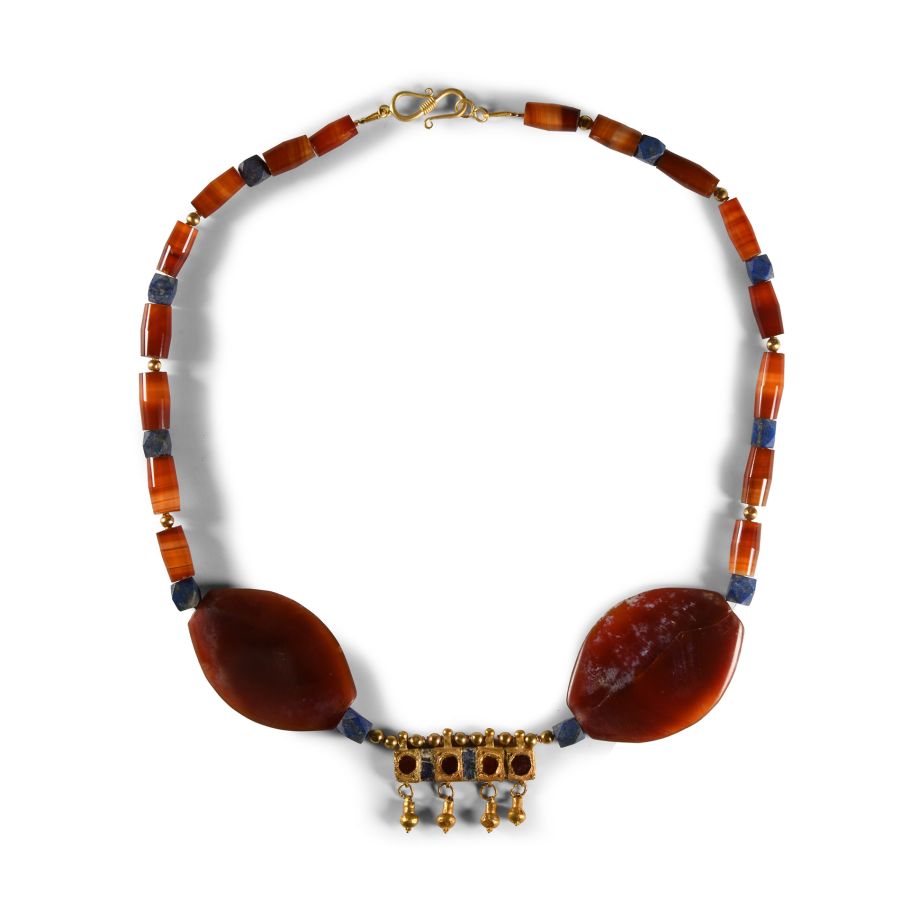
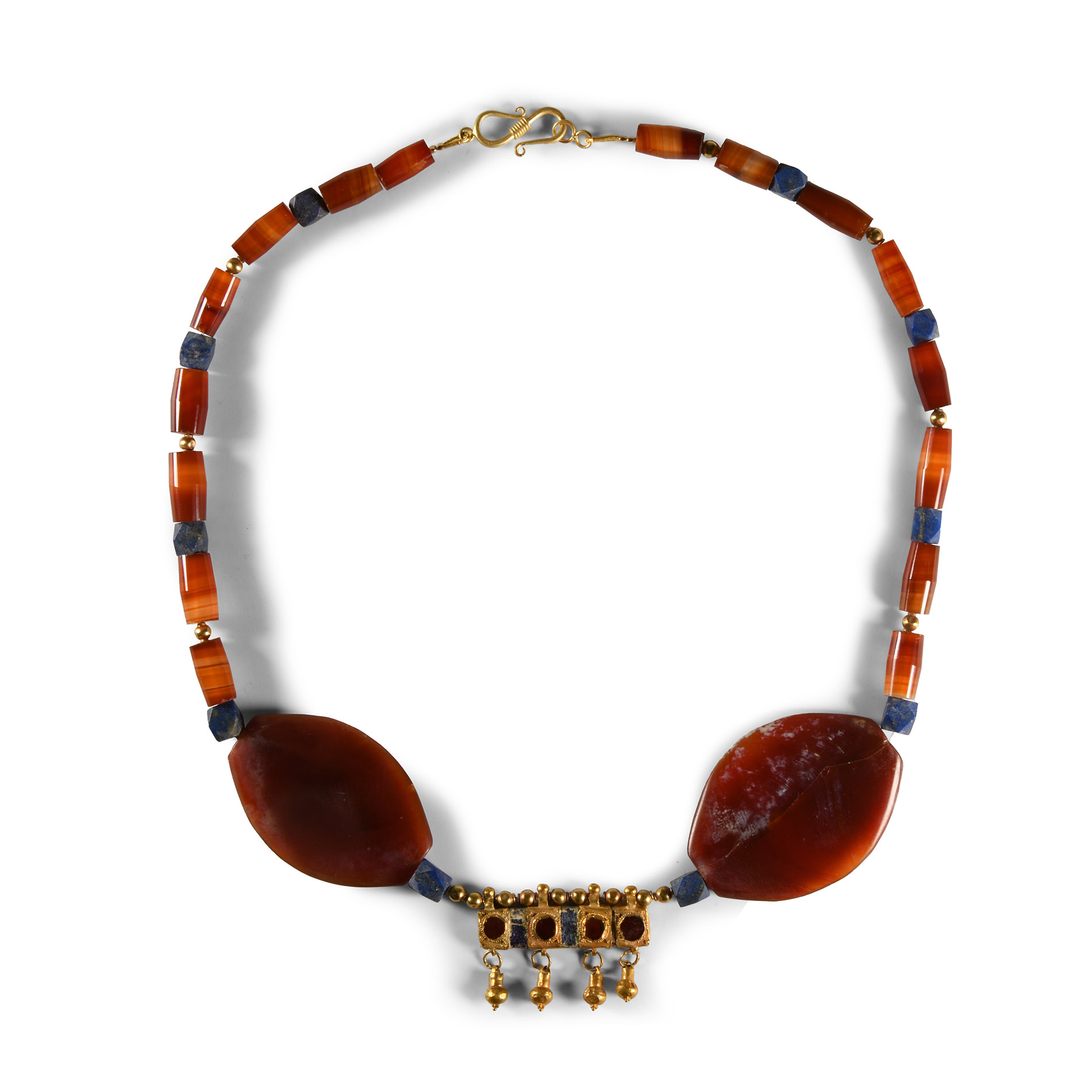
Western Asiatic Bead Necklace with Gold Pendant
1ST CENTURY B.C. AND LATER
19 1/2 in. (51 grams, 49.5 cm).
Composed of barrel-shaped carnelian beads interspersed with corner-less cubed lapis lazuli beads and spherical gold beads; central feature comprising two large delicate flattish oval-shaped carnelian beads flanking a rectangular gold-clad pendant set with four garnets, the core made of deep blue glass, four pendants below; a restrung designer necklace with a modern clasp.
ProvenanceLondon art market before 2000.
Private collection.
This lot has been checked against the Interpol Database of stolen works of art and is accompanied by search certificate no.12064-214177.
TimeLine Auctions follows a vetting process to ensure the authenticity and legality of all items, reinforcing our commitment to integrity and responsible trading. Each antiquity, antique, and coin lot undergoes thorough examination by a vetting committee of at least ten external specialists, professional trade association members, scientists, and archaeologists: Our Vetting Process
AUCTIONS:
TimeLine is a leading auction house specialising in antiquities, ancient art, collectables, natural history, coins, medals, and books. Our auctions offer museums, collectors, historians, and enthusiasts the opportunity to acquire unique and historically significant pieces.
LOT 1097
Western Asiatic Bead Necklace with Gold Pendant
Estimate £2,000 - 3,000€2,320 - 3,480 (for guidance only)$2,700 - 4,050 (for guidance only)
-
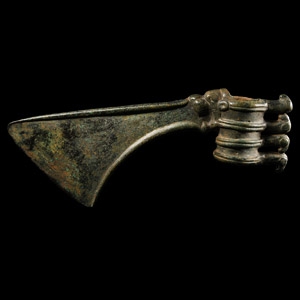
Luristan Bronze Spike-Butted Axehead
11th-8th century B.C.Estimate: £3,500 - 4,500 (‡+bp*)
Opening Bid: £1,750
Blade with folded upper and lower edge, cylindrical socket with projecting ribs formed as the necks and heads of birds, blace 'projecting' from the mouth of a roaring lion at the neck. 478 grams, 22.5 cm
Ex Parisian private collection. with Cuvreau Expertises Enchères S.A., sale 60, 21 June 2009, lot 105. This lot has been checked against the Interpol Database of stolen works of art and is accompanied by search certificate number no.11876-206787. -

Mesopotamian Alabaster Lenticular Necklace Bead Group
Circa 3rd millennium B.C.Sold for (Inc. bp): £59
Comprising a quantity of disc-shaped beads, each pierced for stringing. 53 grams total, 3-10 cm
UK gallery, early 2000s.
While slaves and the poorest people wore simple, functional clothes, the wealthiest classes of Mesopotamia could afford beautifully made jewellery. The royal tombs from Sumeria dating from around 2500 B.C. included an abundance of beaded necklaces, rings, bracelets for the wrist and ankles, stickpins, and other jewellery, made of gold and silver set with decorative gemstones such as deep blue lapis lazuli, red carnelian, white alabaster, and sparkling crystals. In the Lugale-Mythos the Alabaster is personified like a hero: ‘(And) the hero Alabaster, these heroes plundered the cities for him (= Asag)’. The hematite and the limestone/alabaster, two stones with a light and dark base colour, were used as aids in a divinatory ritual in which they were probably connected with the favourable and unfavourable answers to oracle inquiries. -
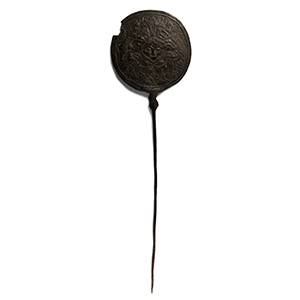
Large Neo-Elamite Decorated Bronze Pin
Circa 1200-800 B.C.Estimate: £800 - 1,000 (+bp*)
Opening Bid: £400
Comprising a large circular finial with symmetrical repoussé design and a long tapering shank; the finial with a large central head with hatched hair and beard, possibly representing a mask of a deity; two addorsed ibexes below, each with a rosette above and foliage in front; at the top, two rampant lions flanking the 'Master of Animals' motif; the motif with pricked ears and wearing a two-tiered headpiece, a pair of zoomorphic figure emerging from his cheeks and grasp onto the flanking lions; mounted on a custom-made fabric-covered backing. 228 grams total, 43 cm long
Ex Rabi Gallery 1980-1990. From an important London, UK, collection.
