
Loading, please wait...
_900x900.jpg "Western Asiatic Banded Agate Bead Necklace String")
_200x200.jpg "Western Asiatic Banded Agate Bead Necklace String")
.jpg "Western Asiatic Banded Agate Bead Necklace String")
LOT 1233
Western Asiatic Banded Agate Bead Necklace String
1ST MILLENNIUM B.C. AND LATER
14 1/4 in. (62.9 grams, 36 cm).
Restrung on a cotton thread, composed mainly of cylindrical, biconical and tabular beads. [No Reserve]
ProvenanceFrom the family collection of a Hampstead gentleman; formerly acquired in the 1980s.
CONDITIONTimeLine Auctions follows a vetting process to ensure the authenticity and legality of all items, reinforcing our commitment to integrity and responsible trading. Each antiquity, antique, and coin lot undergoes thorough examination by a vetting committee of at least ten external specialists, professional trade association members, scientists, and archaeologists: Our Vetting Process
AUCTIONS:
TimeLine is a leading auction house specialising in antiquities, ancient art, collectables, natural history, coins, medals, and books. Our auctions offer museums, collectors, historians, and enthusiasts the opportunity to acquire unique and historically significant pieces.
-
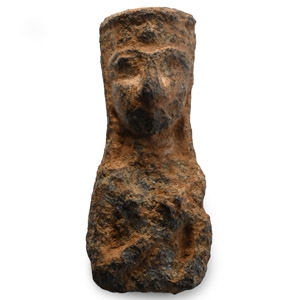
Northern Syrian Bronze Female Figure
Early 1st millennium B.C.Estimate: £150 - 200 (+bp*)
Opening Bid: £75
The upper part of a flat-backed female figurine, her arms crossed at the chest and wearing a conical headdress. 44.7 grams, 55 mm
From the collection of a gentleman, acquired on the London art market in the 1990s. -
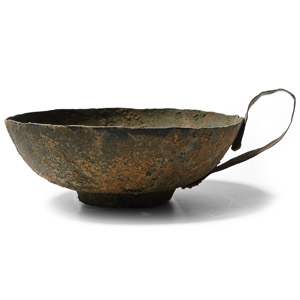
Achaemenid Bronze Handled Cup
6th-4th century B.C.Sold for (Inc. bp): £91
Comprising a wide shallow body with repoussé foot and separately applied strap handle. 50 grams, 12.6 cm
Acquired 1980-2015. Ex Abelita family collection. This lot has been cleared against the Art Loss Register database, and is accompanied by an illustrated lot declaration signed by the Head of the Antiquities Department, Dr Raffaele D'Amato. -
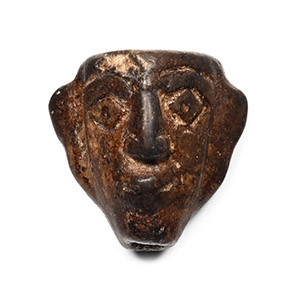
Sumerian Black Stone Face Amulet
Uruk/Jemdet Nasr Period, circa 3500-2900 B.C. or laterEstimate: £200 - 300 (+bp*)
Opening Bid: £110
Carved in the half-round with large eyes and ears; drilled depression above the head and beneath the chin. 4.6 grams, 19 mm
From the 'S' collection, acquired 1970-1990s. Accompanied by a description from Peter Gert Van der Veen, senior lecturer of Levantine Archaeology, Johannes Gutenberg-Universität, Mainz. This lot has been cleared against the Art Loss Register database, and is accompanied by an illustrated lot declaration signed by the Head of the Antiquities Department, Dr Raffaele D'Amato.
