Loading, please wait...

Use mousewheel to zoom in and out, click to enlarge

Details

LOT 0662

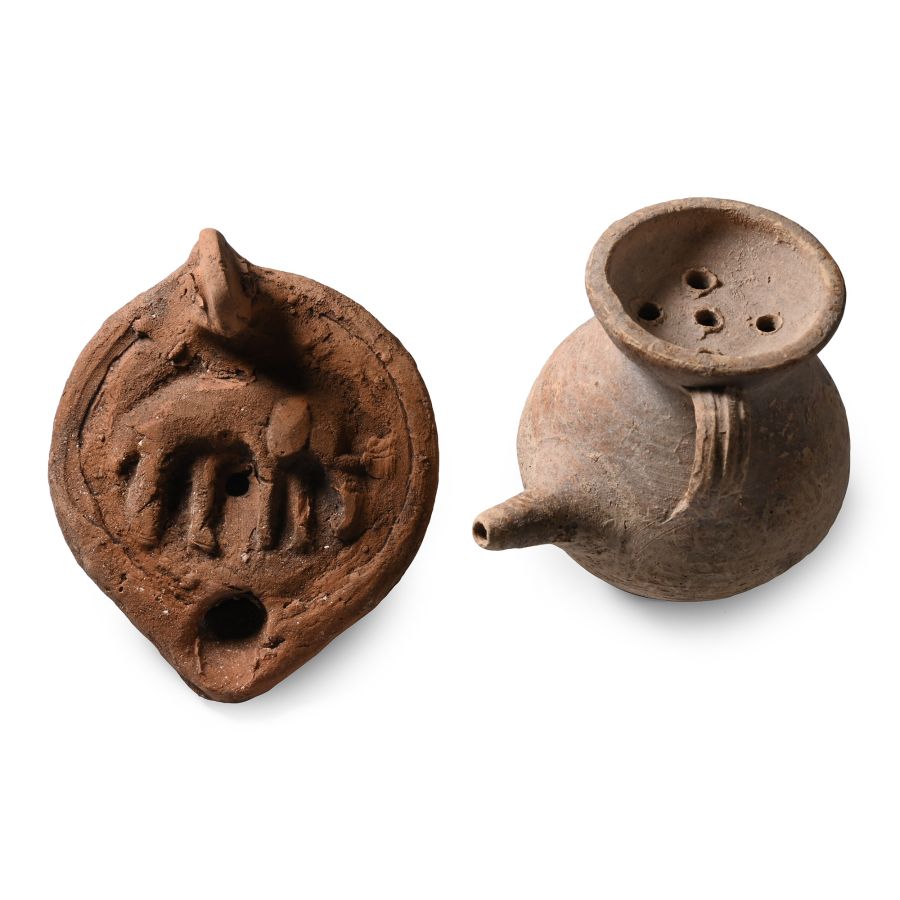
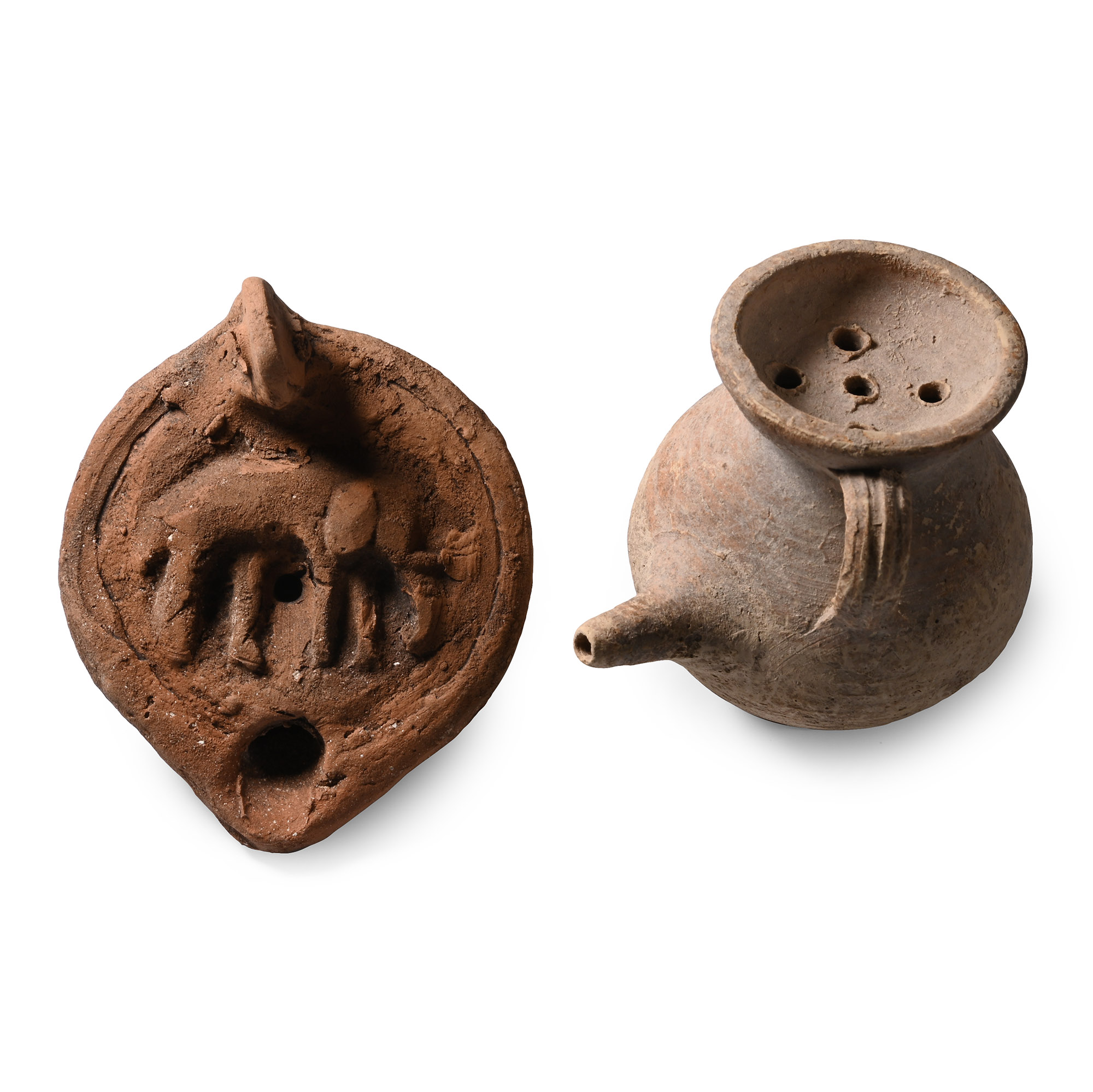
Western Asiatic and Roman Ceramic Vessel Group

3RD CENTURY B.C.-4TH CENTURY A.D.

3 3/4 - 4 3/8 in. (312 grams total, 9.6-11.1 cm).

Comprising: a small strainer or feeding vessel with bulbous body and everted neck, the top pierced with five holes, strap handle and a small tubular spout; a discoid oil lamp in coarseware with a stylised elephant above a small filler hole.

Provenance

with Galerie Rhéa, Zurich, Switzerland.
This lot is accompanied by an illustrated lot declaration signed by the Head of the Antiquities Department, Dr Raffaele D'Amato.

CONDITION

VETTING:

TimeLine Auctions follows a vetting process to ensure the authenticity and legality of all items, reinforcing our commitment to integrity and responsible trading. Each antiquity, antique, and coin lot undergoes thorough examination by a vetting committee of at least ten external specialists, professional trade association members, scientists, and archaeologists: Our Vetting Process


AUCTIONS:

TimeLine is a leading auction house specialising in antiquities, ancient art, collectables, natural history, coins, medals, and books. Our auctions offer museums, collectors, historians, and enthusiasts the opportunity to acquire unique and historically significant pieces.

LOT 0662

Western Asiatic and Roman Ceramic Vessel Group

Sold for (Inc. bp): £117

Print page

RELATED LOTS

  • Life-Size Roman Bronze Head of an Empress
    Executed in Hellenistic Style
    Life-Size Roman Bronze Head of an Empress
    Mid-3rd century A.D.

    Estimate: £60,000 - 80,000 (+bp*)

    Opening Bid: £27,500

    A member of the Imperial family, possibly an empress, depicted with an elaborate coiffure, the hair at the back of the head parted in the middle and the two strands folded over each other, then pulled to the front to form a looped horizontal layer parted in the middle of the smooth forehead and drawn back, individual curls represented as vertical lines along the forehead hairline up to the exposed ears, two locks hanging down the sides behind the ears, extending to the upper part of the neck; beautiful facial rendering with stoic expression, exquisite detailing to the eyebrows, eyelids and pupils; snub-nose, closed lips, thin and graceful neck; mounted on a custom-made display stand. 4.07 kg, 40.5 cm high including stand


    Acquired on the German art market, early 1970s. German private family collection; by gift to the owner's son in 2015. Private collection, London. Accompanied by an academic report by Dr Raffele D'Amato, and Dr Marina Mattei, former curator of the Capitoline Museums for over 40 years. This lot has been checked against the Interpol Database of stolen works of art and is accompanied by a search certificate number no.12607-234556. This lot has been cleared against the Art Loss Register database, and is accompanied by an illustrated lot declaration signed by the Head of the Antiquities Department, Dr Raffaele D'Amato.

    The mature age of the woman depicted in the portrait is revealed by the oval gaunt, deep-set eyes and the folds at the sides of the nose and mouth. The woman’s head shows the typical traits of the full and mature 3rd century A.D., executed in a Hellenistic style tradition. Our sculpture is well inserted in the imperial portrait type, bearing technical and aesthetical parallels to portraits in bronze. The hairstyle could be Scheitelzopf (or reverse plait), tightened by a hairnet, pinned to the top of the head. The same type of hairstyle, albeit with variations in the details (decorative curls and position of the hair loop), is found on a few other portraits of women that were dated to the Period of Gallienus by Marianne Bergmann. Some of the portraits in this typologically related group are likely to be private portraits. Hereby physiognomic features and especially imperial coin portraits need to be taken into account. In this context, it is important to compare the portrait with that of Trebonianus Gallus in the MET. Like the sculpture of Trebonianus Gallus, the head fits stylistically with Roman provincial bronzes from the Eastern Mediterranean or North Africa, possibly from workshops of Asia Minor or from the great metropolis of Alexandria, where bronze statuary was more common and Hellenistic influences remained strong.

    Lot Details

  • Roman Mixed Orange Bead Necklace String
    Roman Mixed Orange Bead Necklace String
    1st-4th century A.D. and later

    Sold for (Inc. bp): £46

    Restrung group of tubular, annular and other beads. 8.79 grams, 22.5 cm


    Ex London, UK, collection, 1990s. This lot is accompanied by an illustrated lot declaration signed by the Head of the Antiquities Department, Dr Raffaele D'Amato.

    Lot Details

  • Roman Life-Size Marble Statue of an Important Magistrate
    A High-Ranking Politician
    Roman Life-Size Marble Statue of an Important Magistrate
    Late 3rd-early 4th century A.D.

    Estimate: £180,000 - 240,000 (+bp*)

    Opening Bid: £100,000

    Clad in a symmetrically incised late Roman toga, which was originally painted; the right hand covered by the robe and resting against his chest, the now lost left hand probably held a rank symbol or a scroll; short hair, cut according to the style of the Tetrarchy, wide eyes and pronounced lips; beard extended under the chin and on the throat; crepida sandal of Greek typology still visible on the right foot. 700+ kg, 206 cm including base

    Fine condition. An impressive museum-quality display piece.

    Acquired by L.H., Munich, Germany, prior to 1982. with H.v.C., Munich, Germany, in 1982, forming a central part of their family collection during the 1980s. Thence by descent to his son, C.M., Switzerland. Accompanied by a copy of a German cultural export licence. Accompanied by an academic report by Dr Raffaele D’Amato. Accompanied by a geological report No. TL3253 by geology consultant Dr R. L. Bonewitz. This lot has been checked against the Interpol Database of stolen works of art and is accompanied by search certificate no.12089-211955. This lot has been cleared against the Art Loss Register database, and is accompanied by an illustrated lot declaration signed by the Head of the Antiquities Department, Dr Raffaele D'Amato.

    This statue of a Roman magistrate represents a high-ranking citizen with political and ritual responsibilities. The stylised facial features date it to the period of the Tetrachy under the Emperor Diocletian (284-305 A.D.), when representation of the human form began to show a concern for geometry and symmetry. A similar style can be seen in official portraits of Diocletian, Galerius, Constantinus Chlorus, and Maximianus Herculius. Despite the stylisation typical of the era, however, the sculptor of this lot has taken pains to add personal details, such as the dimpled chin and creased forehead. Its powerful resemblance to Imperial portraiture stems from the desire of magistrates to emulate emperors in the way they represented themselves. This is a piece of outstanding quality, and unlike other Late Roman sculptures, in which a portrait head is often attached to an earlier body, it appears to have been created as a whole. It shows exceptional attention to detail, including in the magistrate’s beautifully carved footwear. It is likely to represent an official of an Eastern Empire city, either in Greece or Illyria.

    Lot Details

Stay up-to-date with the latest from TimeLine Auctions by joining our mailing list