
Loading, please wait...
_900x900.jpg "Watercolour Painting Group")
_200x200.jpg "Watercolour Painting Group")
_900x900.jpg "Watercolour Painting Group")
_200x200.jpg "Watercolour Painting Group")
.jpg "Watercolour Painting Group")
.jpg "Watercolour Painting Group")
LOT 2083
Watercolour Painting Group
PERSIA, 19TH CENTURY A.D.
5 3/4 x 3 3/4 in. (4 grams, 15 x 10 cm).
Three bifacial pages, each with recto with multiple lines of text and verso with watercolour painting between panels of text, including mounted riders in hunting, sports and battle scenes. [3]
ProvenanceAcquired on the UK art market, 1980s-1990s.
The Woodbridge collection of Indo-Persian art.
TimeLine Auctions follows a vetting process to ensure the authenticity and legality of all items, reinforcing our commitment to integrity and responsible trading. Each antiquity, antique, and coin lot undergoes thorough examination by a vetting committee of at least ten external specialists, professional trade association members, scientists, and archaeologists: Our Vetting Process
AUCTIONS:
TimeLine is a leading auction house specialising in antiquities, ancient art, collectables, natural history, coins, medals, and books. Our auctions offer museums, collectors, historians, and enthusiasts the opportunity to acquire unique and historically significant pieces.
LOT 2083
Watercolour Painting Group
Estimate £80 - 100€93 - 116 (for guidance only)$108 - 135 (for guidance only)
-
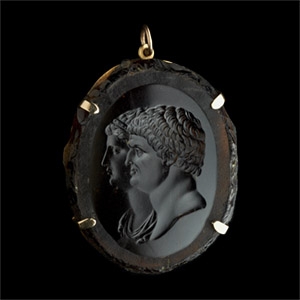
Neoclassical Glass Oval with Jugate Busts in Gold Pendant
Circa 1800 A.D.Sold for (Inc. bp): £182
The oval with pounced surface, slightly domed panel with profile male and female busts; set in a gold frame with suspension loop. 36.8 grams, 61 mm
Private collection, England. -
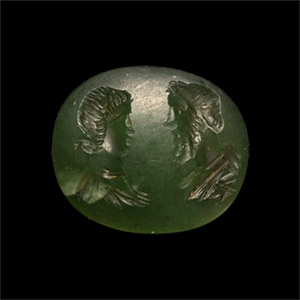
Gemstone with Facing Busts
20th century A.D.Sold for (Inc. bp): £72
With domed obverse face and intaglio opposed busts of a man with beard and cap, woman with braided hair; supplied with a museum-quality impression. 2.21 grams, 18 mm
Private collection, England. -
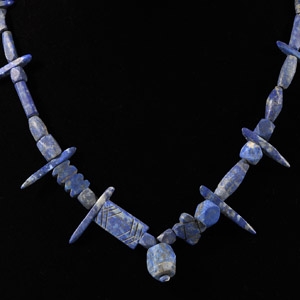
Bactrian Style Lapis Lazuli Bead Necklace String
20th century A.D.Sold for (Inc. bp): £26
Restrung group of beads, mainly tubular, polyhedral and square-section types transverse triangular types. 41.63 grams, 42 cm
London, UK, art market, 1980-2000s.
