
Loading, please wait...
LOT 1145
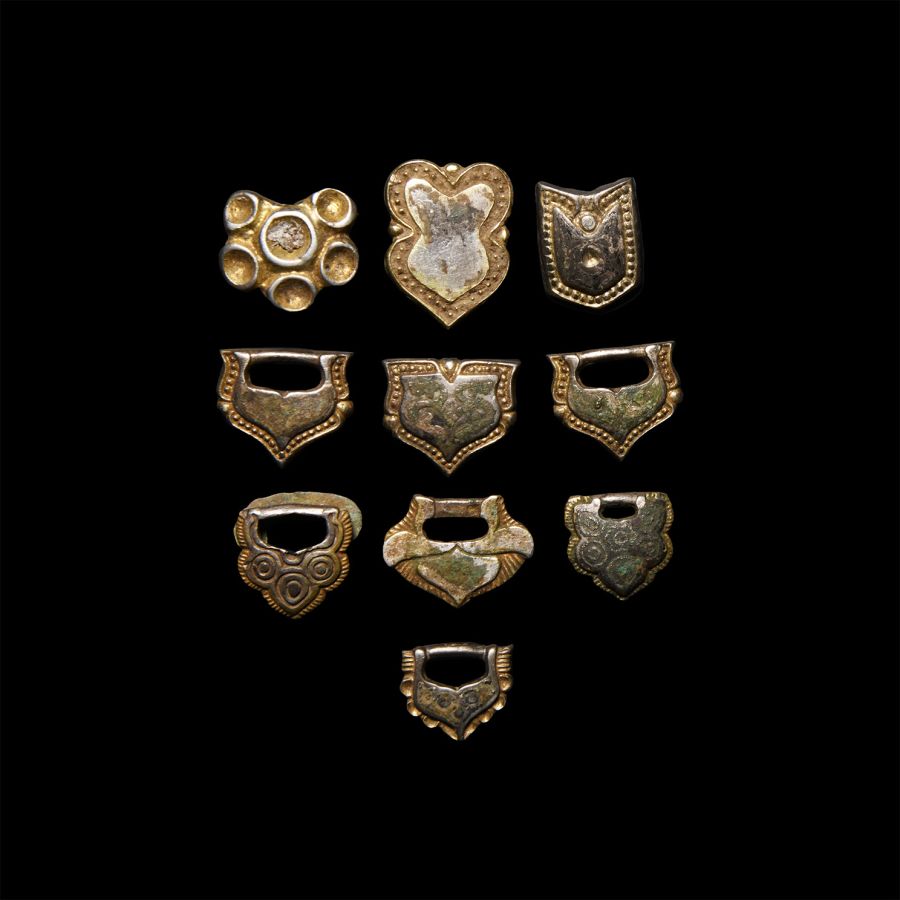
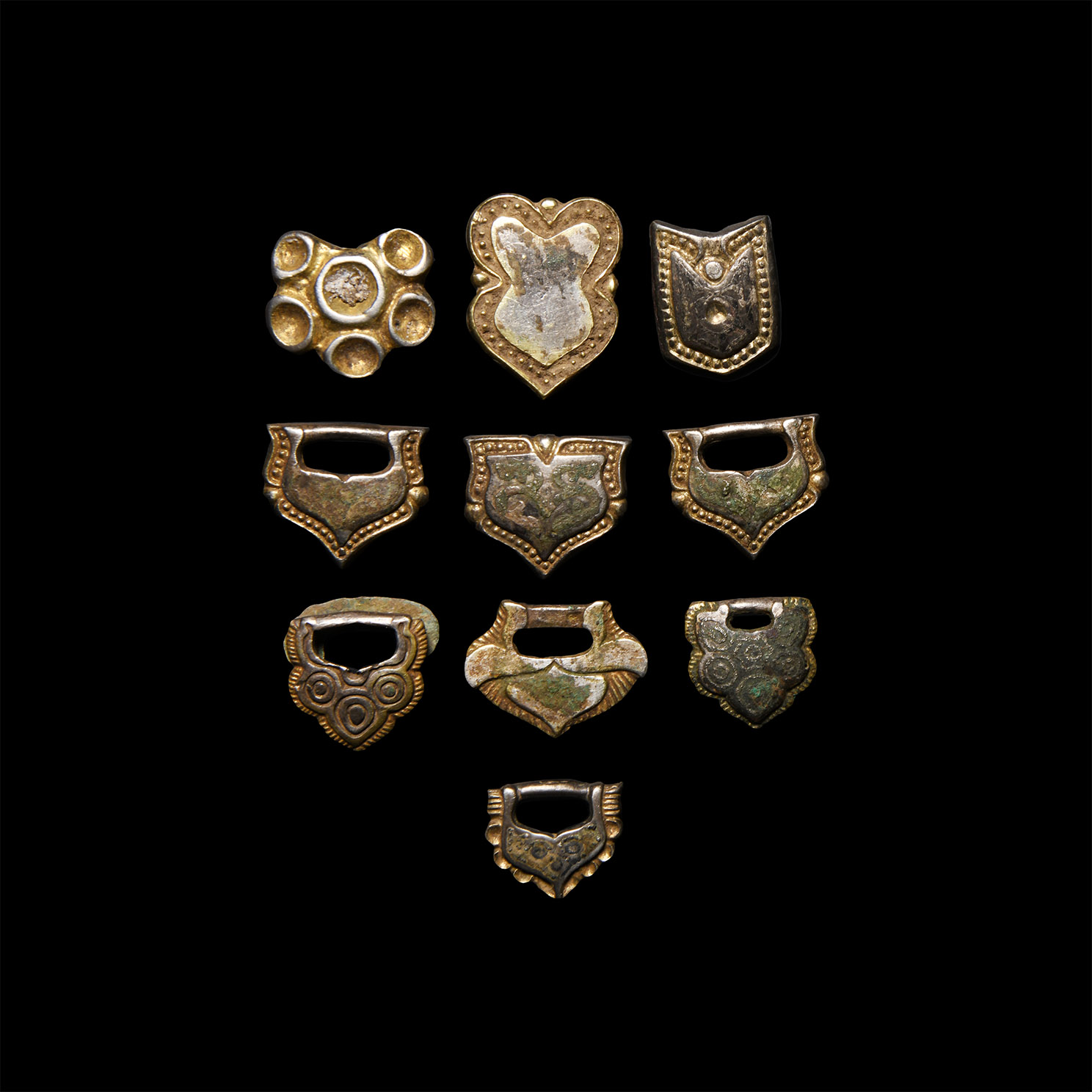
Volga Silver-Gilt Sword Belt Mount Group
11TH-12TH CENTURY A.D.
5/8 - 1 in. (31.8 grams total, 17-26 mm).
Comprising: two matching ogival plates with pellet borders; a trefoil plate with border of radiating lines framing three concentric circle and oval motifs; a plate with five lobes decorated with dashed lines and six concentric oval motifs at the centre; ogival plate with scalloped border, trefoil motif at centre; ogival plate with pellet border divided into three 'petals' by larger single pellets, scrolling vegetal motif; a floral style plate composed of discoid dimples; irregular hexagonal plate, the shape repeated at the centre, pellet border; trilobate plate with three single pellets to the perimeter and pellet border; ogival plate with expanded waist, raised 'wings' and rounded lozenge against a background of radiating lines; nine with three attachment lugs to reverse, one with two lugs. [10]
ProvenanceAcquired in the 1980s-1990s.
Ex an important central London gallery, London W1.
Cf. Руденко, К.А., История археологического изучения Волжской Булгарии (X - начало XIII в.), History of the archaeological study of the Volga Bulgarians (10th - beginning of the 13th century, in Russian), Kazan, 2014, figs.179, 759.
FootnotesThe belt fittings find various comparisons with non-ferrous belt appliqués found in the territories of the Volga Bulgars, like specimens from the Semenovsky village. These items were parts of long warrior belts, the leather surfaces decorated all over with such bronze and silver appliqués. Symbols of ranks and elite warrior aristocracy, these belts also served a utilitarian purpose of suspending weapons such as a bow, quiver or a sabre.
CONDITIONTimeLine Auctions follows a vetting process to ensure the authenticity and legality of all items, reinforcing our commitment to integrity and responsible trading. Each antiquity, antique, and coin lot undergoes thorough examination by a vetting committee of at least ten external specialists, professional trade association members, scientists, and archaeologists: Our Vetting Process
AUCTIONS:
TimeLine is a leading auction house specialising in antiquities, ancient art, collectables, natural history, coins, medals, and books. Our auctions offer museums, collectors, historians, and enthusiasts the opportunity to acquire unique and historically significant pieces.
-
.jpg)
Post Medieval Horseman's Axe
Late 17th century A.D. or laterSold for (Inc. bp): £546
Featuring an openwork blade stamped with maker's marks on both faces: three punched starburst marks to one face, starburst and cross with two pellets to the reverse; later wooden shaft, collar and rivet. 740 grams, 67 cm
Acquired 1990s-early 2000s. East Anglian private collection. -
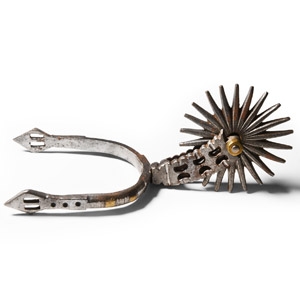
Mexican Iron and Brass Rowel Spur
19th century A.D.Sold for (Inc. bp): £20
With pierced crescent motifs to the shank, free-running star-shaped rowel and geometric engraving to heelband with lozengiform terminals. 349 grams, 22 cm
Acquired from Czerny's Auctions, Italy, 2016, lot 390. The Kusmirek Collection, UK. Accompanied by copy of Czerny's invoice and lot details. -
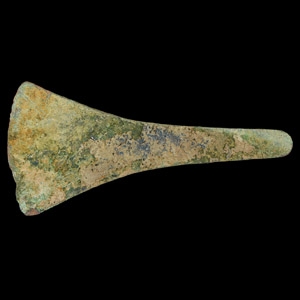
Western Asiatic Copper Flat Axehead
2nd-1st millennium B.C.Sold for (Inc. bp): £78
Curved cutting edge and tongue-shaped mounting blade to the rear. 180 grams, 18.1 cm
English collection, 1990s. Ex North London gallery.
