
Loading, please wait...
LOT 1172
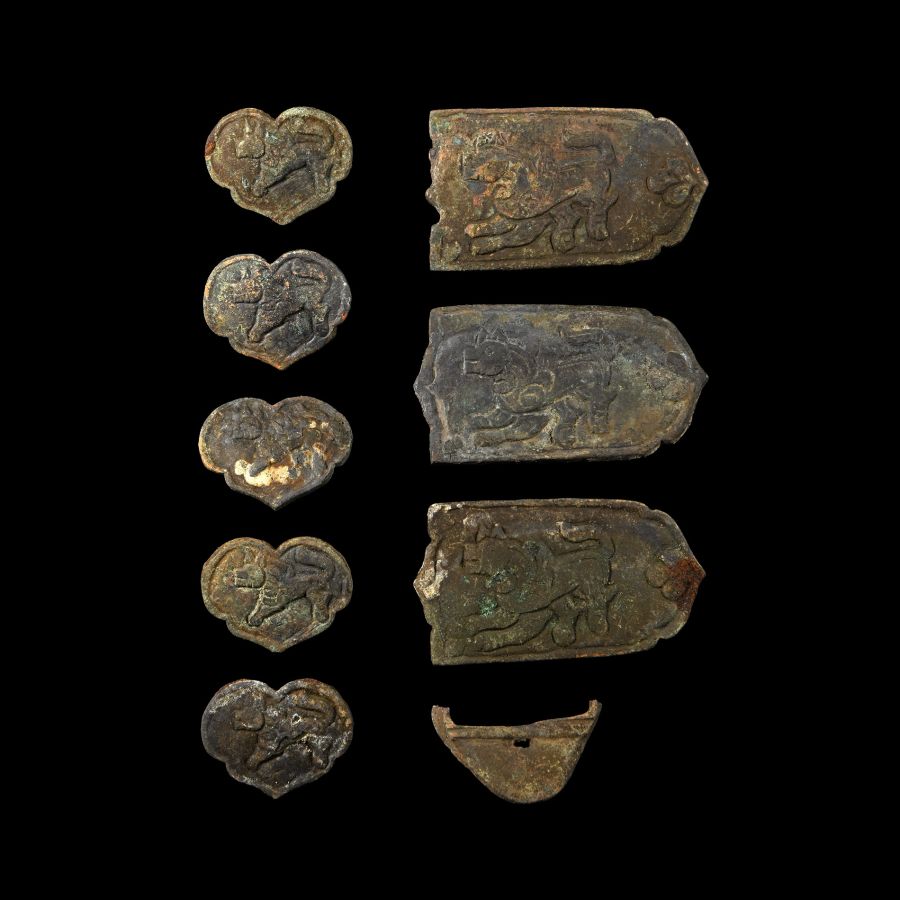
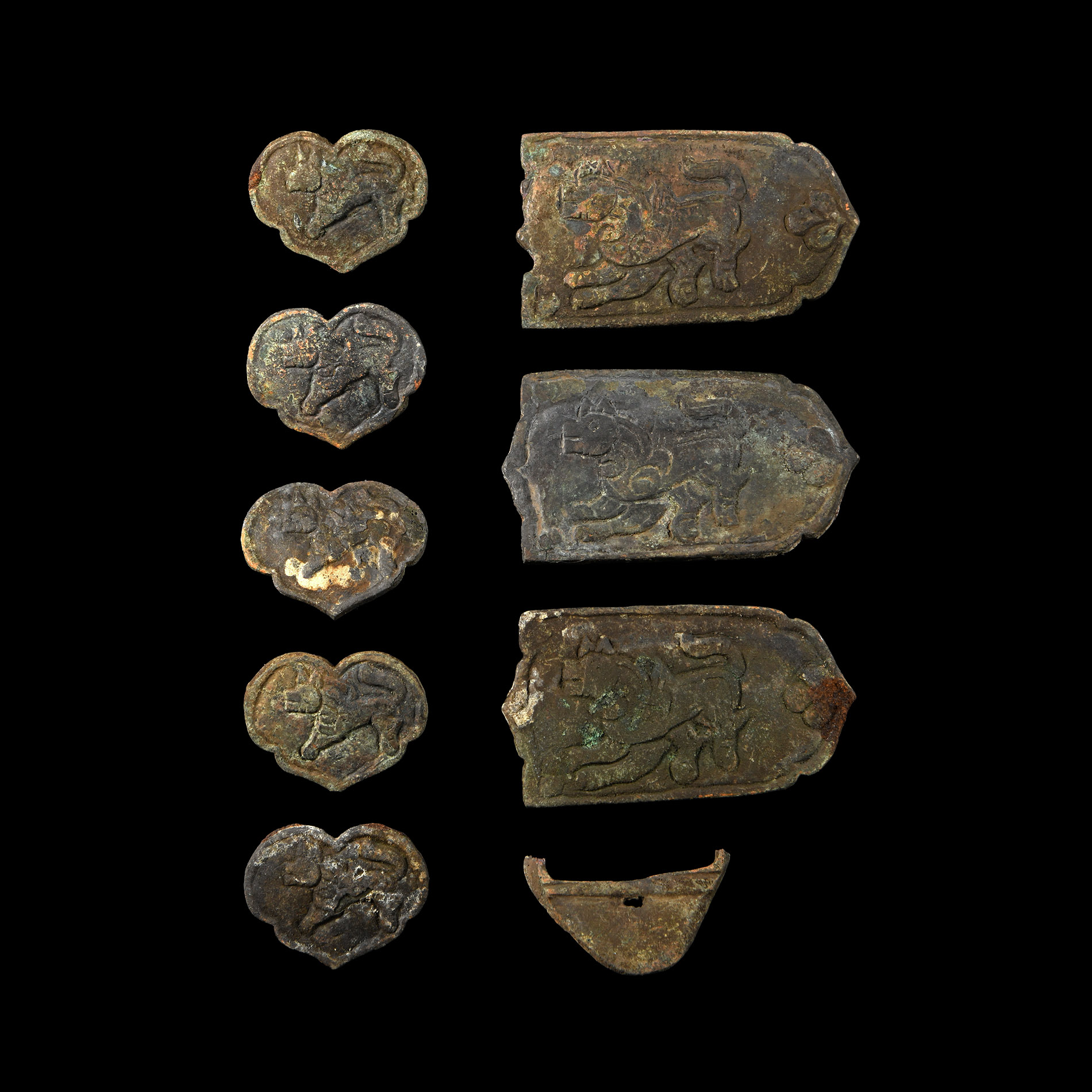
Volga Bulgar Bronze Lion Belt Mount Group
10TH-12TH CENTURY A.D.
1 - 2 in. (67 grams total, 27-52 mm).
Comprising three mounts with bounding lion motifs, five heart-shaped mounts also showing leaping lions and a plain semi-circular mount; all with mounting lugs to reverse. [9, No Reserve]
ProvenanceFrom the collection of a North American gentleman, formed in the 1990s.
LiteratureCf. Baranov, V.S., Izmaylov, I.L., 'On attribution of a signet ring from Bolgar excavations of 2010' in Archaeology of the Eurasian steppes, no.6, 2019, pp.269-276, for iconography.
CONDITIONTimeLine Auctions follows a vetting process to ensure the authenticity and legality of all items, reinforcing our commitment to integrity and responsible trading. Each antiquity, antique, and coin lot undergoes thorough examination by a vetting committee of at least ten external specialists, professional trade association members, scientists, and archaeologists: Our Vetting Process
AUCTIONS:
TimeLine is a leading auction house specialising in antiquities, ancient art, collectables, natural history, coins, medals, and books. Our auctions offer museums, collectors, historians, and enthusiasts the opportunity to acquire unique and historically significant pieces.
-
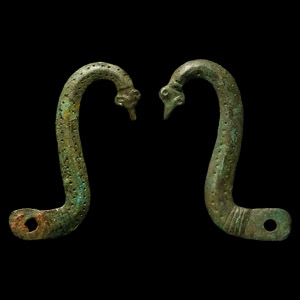
Roman Bronze Armour Double Fastening Hooks
1st century A.D.Sold for (Inc. bp): £221
Each a scrolled bar with gently carinated upper face, formed as serpents or other animals with stylised geometric detailing; attachment perforations to one terminal. 16.5 grams total, 65 mm each
Acquired on the London art market, 1980s-1990s.
In the 1st century B.C.-1st century A.D., the Celtic fastening system of the ring mail armour (gallica, lorica ferro aspera) became the standard in the Imperial Roman army, with a pivot attached to the breast and hinged to the edges of the humeralia (shoulder guards). The chest fastener had various different designs. The double hooks, S-shaped and usually with snake-head terminals, were secured by a central rivet on the chest. The system allowed excellent freedom of movement, giving greater protection to the shoulders and the arms. Similar fasteners for infantry mail have been found on the Kalkriese battlefield, some of them also decorated with niello and inscribed with the name of the soldier. -
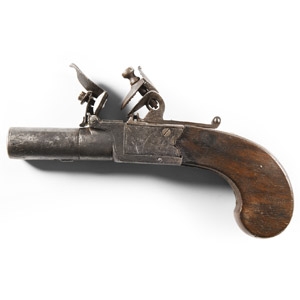
Flintlock Pocket Pistol
18th century A.D.Estimate: £400 - 600 (+bp*)
Opening Bid: £150
With 40mm (1½") turn-off barrel, box-lock with sliding safety marked 'CLARK' left and 'LONDON' right; fitted with plain wood butt and octagonal escutcheon; action working. 280 grams, 16 cm
Acquired on the UK market. Property of a Kent collector.
Sold as an exempt item under Section 58 (2) of the Firearms Act, 1968, to be held as a curiosity or ornament. No license required but buyer must be over 18 years of age. Overseas bidders should note that, due to UK regulations governing export of all firearms, overseas buyers will need to make arrangements for shipping this lot out of the UK directly, by air freight, with a specialist company or agent. -
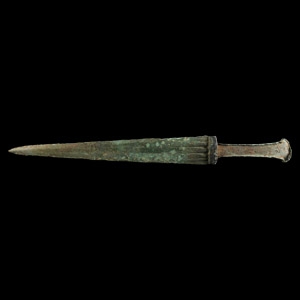
Luristan Bronze Dirk
Circa 1000 B.C.Sold for (Inc. bp): £234
Cast in one piece, with narrow blade having almost parallel edges, flanged hilt with narrow grip widening slightly towards the ricasso, decorated from five parallel grooves, and running smoothly into the blade. 188 grams, 33 cm
Ex German collection, Cologne, 1980-1990s.
The dirk belongs to the type III in the Medvedskaya classification, but with a smallest hand guard at the base. The dating of type III to the 12th century B.C., suggested by Medvedskaya and confirmed by Khorasani, was based on the series of dirks with an inscription of the Babylonian King Nebuchadnezzar I and of the name of Marduk Nadin Ahhe on similar types of daggers.
