
Loading, please wait...
_900x900.jpg "Villanovan Impasto Biconical Urn")
_200x200.jpg "Villanovan Impasto Biconical Urn")
.jpg "Villanovan Impasto Biconical Urn")
LOT 0039
Villanovan Impasto Biconical Urn
CIRCA 8TH CENTURY B.C.
9 7/8 in. (2 kg, 25 cm high).
Black burnished ceramic urn with conical lower body, two flared loop handles, bell-shaped upper body and flat everted rim; band of incised chevrons to the equator, horizontal linear bands and ropework key patterns; one handle restored.
ProvenanceEx private Orange Country collection.
with Ancient Resources Auctions, Auction 34, 14 September 2014, lot 246.
Accompanied by a detailed collector's catalogue pages including description and photograph.
Cf. Morandi, L., Early Iron Age Finds from the Villanovan cemetery of Colle Baroncio: remarks on early Vetulonia and its connections, in Mediterranean Archaeology, 2013.
FootnotesSuch urns were often deposited with the cremated remains inside, one handle broken off (perhaps part of the funerary rites) and in some case a bronze crested helmet placed over the top of the urn.
CONDITIONTimeLine Auctions follows a vetting process to ensure the authenticity and legality of all items, reinforcing our commitment to integrity and responsible trading. Each antiquity, antique, and coin lot undergoes thorough examination by a vetting committee of at least ten external specialists, professional trade association members, scientists, and archaeologists: Our Vetting Process
AUCTIONS:
TimeLine is a leading auction house specialising in antiquities, ancient art, collectables, natural history, coins, medals, and books. Our auctions offer museums, collectors, historians, and enthusiasts the opportunity to acquire unique and historically significant pieces.
LOT 0039
Villanovan Impasto Biconical Urn
Estimate £700 - 900€810 - 1,040 (for guidance only)$950 - 1,220 (for guidance only)
-
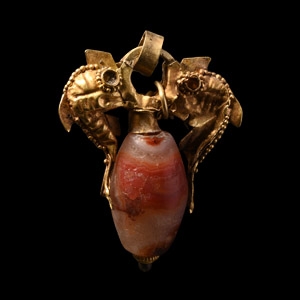
Large Greek Gold Dolphin Pendant
4th-2nd century B.C.Sold for (Inc. bp): £585
The leaping dolphins forming the handles of an amphora-shaped pendant with an agate body; free-running suspension loop; bifacial detailing to the animals. 5.81 grams, 36 mm
Acquired 1970-2010. Collection of a late Japanese gentleman. -
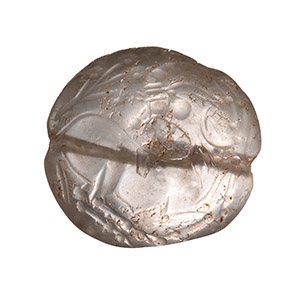
Minoan Lentoid Rock Crystal Seal
Circa 1450-1375 B.C.Sold for (Inc. bp): £2,470
Displaying an incuse bull or other horned quadruped looking backwards; drilled for suspension. 3.63 grams, 18 mm
Acquired in 1970. with Coins and Antiquities, formerly known as D.J. Crowther Ltd, Mayfair, London, UK. Private collection of a London antiquarian.
The style of the lentoid seal has similarities with an agate lentoid seal from Fourni, Archanes, dated to the last period of the Cretan Palace in Knossos, before the island was occupied by the Achaeans. On the Cretan lentoid seals, single animals or a group of animals are plentiful. One of the most common motifs is that of a reclining or standing animal. Single animals are sometimes depicted with contorted bodies. -
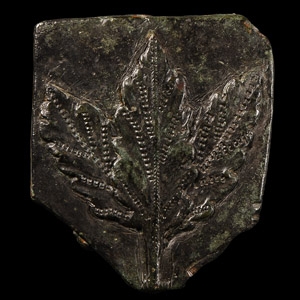
Hellenistic Bronze Acanthus Jewellery Matrix
4th-2nd century B.C.Estimate: £100 - 140 (+bp*)
Opening Bid: £56
Likely for jewellery production, bearing an acanthus leaf motif in relief to one face, with delicate detailing. 78 grams, 57 mm
German collection before 2000. Collection of Mr.D.H., formed in UK, from the EU art market. Property of a Surrey gentleman.
In antiquity, matrices for raising jewellery elements, ornaments and plaques were made of bronze, stone or reinforced terracotta. Matrices with designs in relief were used as an alternative to matrices with hollow designs or intaglio matrices.
