
Loading, please wait...
LOT 0351
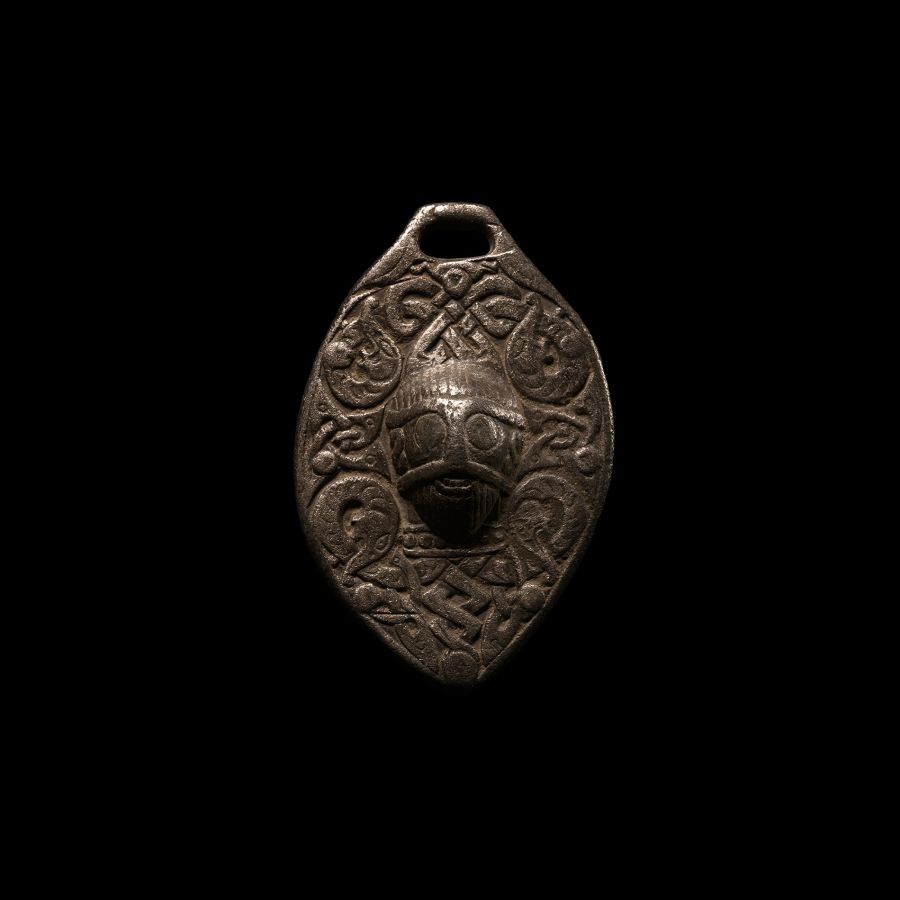
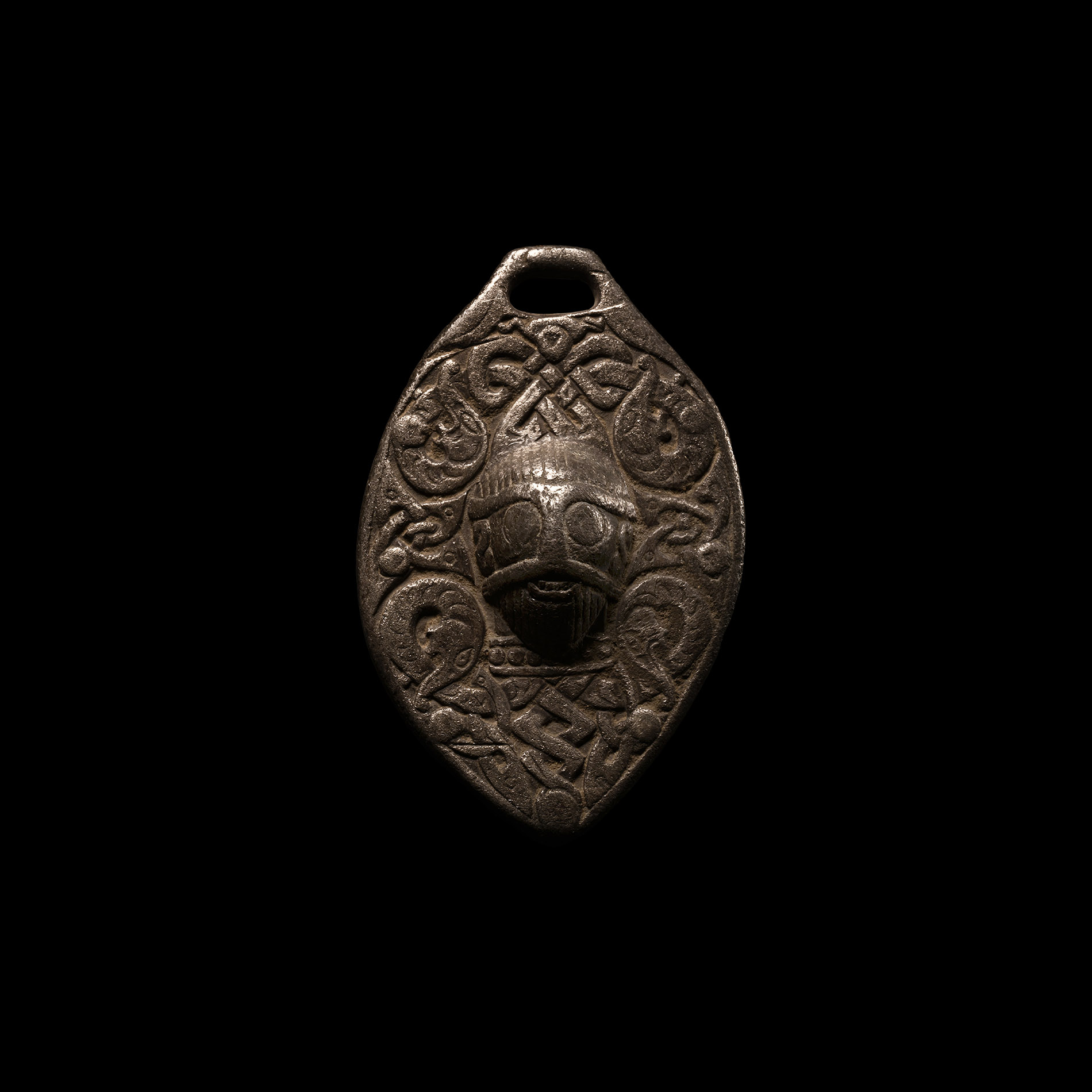
Viking Silver Urnes Style Rattle Pendant
9TH CENTURY A.D.
3 in. (67 grams, 73 mm).
Formed from a hollow vesica-shaped silver mount which rattles when shaken, probably a horse-harness fitting; with Urnes style interlaced dragons in low relief surrounding a facing bearded mask with large staring eyes (Thor?).
ProvenanceFormerly acquired on the German art market in the early 1980s.
Previously in a European collection in the 1990s.
From an important central London collection.
This lot has been checked against the Interpol Database of stolen works of art and is accompanied by searcher certificate no. 200377.
Cf. Owen, O.A., A catalogue and re-evaluation of the Urnes style in England, Durham, 1979, pls.39, 54, 55, for similar interlaces in Urnes style.
FootnotesThe last phase of Viking art is the Urnes style from about 1050-1150. The Urnes style has gracefully curved lines of different width - swelling, tapering - but always in a curve. The tendril clusters from the Ringerike style are abandoned. The Urnes style developed shortly before the middle of the 11th century.
CONDITIONTimeLine Auctions follows a vetting process to ensure the authenticity and legality of all items, reinforcing our commitment to integrity and responsible trading. Each antiquity, antique, and coin lot undergoes thorough examination by a vetting committee of at least ten external specialists, professional trade association members, scientists, and archaeologists: Our Vetting Process
AUCTIONS:
TimeLine is a leading auction house specialising in antiquities, ancient art, collectables, natural history, coins, medals, and books. Our auctions offer museums, collectors, historians, and enthusiasts the opportunity to acquire unique and historically significant pieces.
-
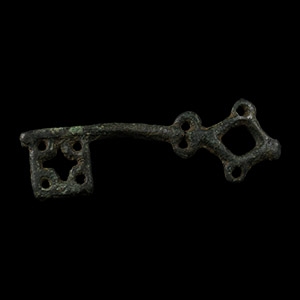
Viking Age Bronze Key with Quatrefoil-Shaped Handle
9th-13th century A.D.Sold for (Inc. bp): £160
In openwork, circular lugs to the bow and stem, cruciform and circular motifs to the bit. 15.3 grams, 77 mm
From the collection of a North American gentleman, formed in the 1990s. -
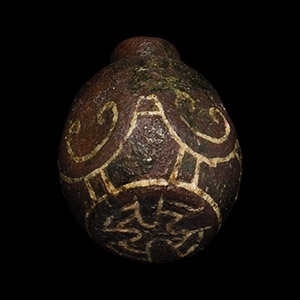
Viking Age Bronze Dagger Pommel with Expanding Cross
Circa 11th century A.D.Sold for (Inc. bp): £46
The side faces with geometric motifs, attachment lug to one face; pommel with facetted body. 21.7 grams, 20 mm
From the collection of a North American gentleman, formed in the 1990s. -
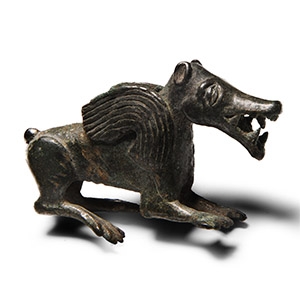
Viking Age 'Great Beast' Weather Vane Terminal
11th century A.D.Sold for (Inc. bp): £2,340
Formed as a crouching beast modelled in the round with hollow slot to the underside; elongated head with raised lentoid eyes and ellipsoid ears, ribbed wings to the shoulders, knop tail and splayed claws to the feet; mouth open with detailed fangs. 84.9 grams, 66 mm
From the collection of a North American gentleman, formed in the 1990s. This lot has been checked against the Interpol Database of stolen works of art and is accompanied by search certificate no. 200289.
The navigation techniques in use in Iron Age Northern Europe were very sophisticated, as would be expected from people bordering the Baltic, North Sea and North Atlantic where boat- and ship-building traditions have been perfected over more than a thousand years. A carved wooden panel from Bergen, Norway, shows a number of Viking longships at sea, some with weathervanes mounted on the stempost. They are mounted vertically with the beast on the outer end. Gilded bronze weathervanes appear on the roofs of medieval churches in Sweden, Norway and Finland where they are often regarded as ornamental: symbols of access to resources and craftsmanship for the important families who endowed such buildings. These weathervanes in many cases originally adorned ships and were used as part of the navigational equipment. They may have inspired the medieval Norman custom of attaching a gilded weathervane or cock to church roofs, which eventually spread to secular buildings such as castles in France and Italy where their use was restricted to certain ranks of nobility (Lindgrén, 1983).
