Loading, please wait...

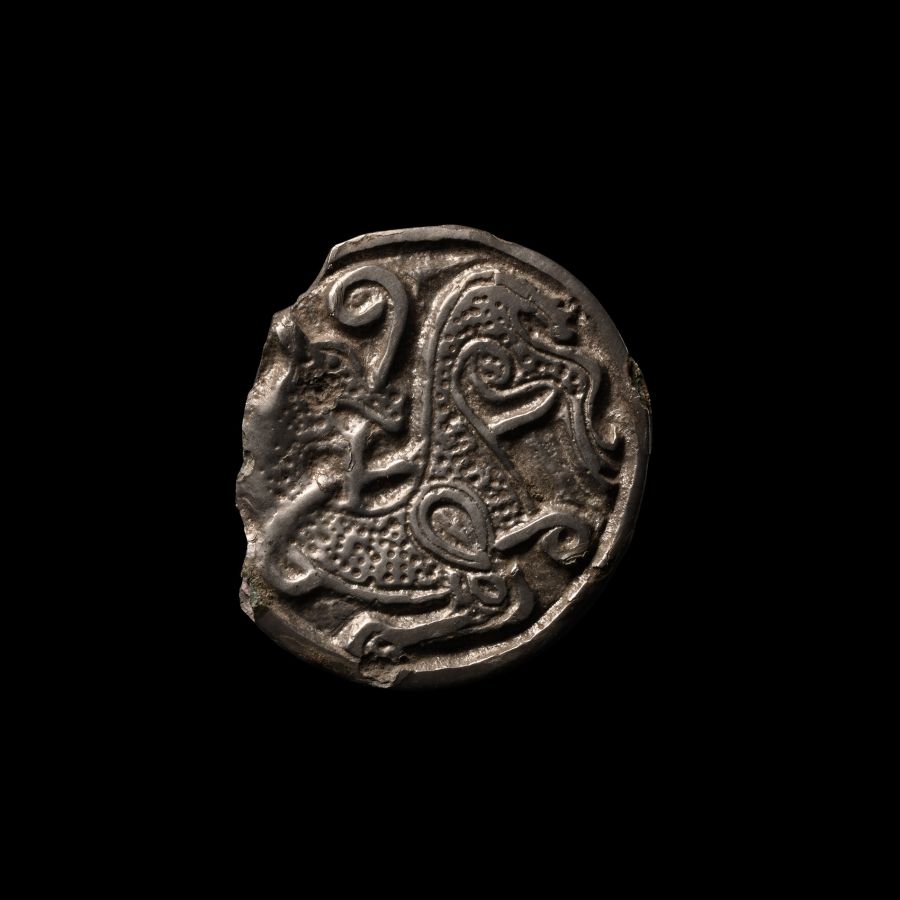
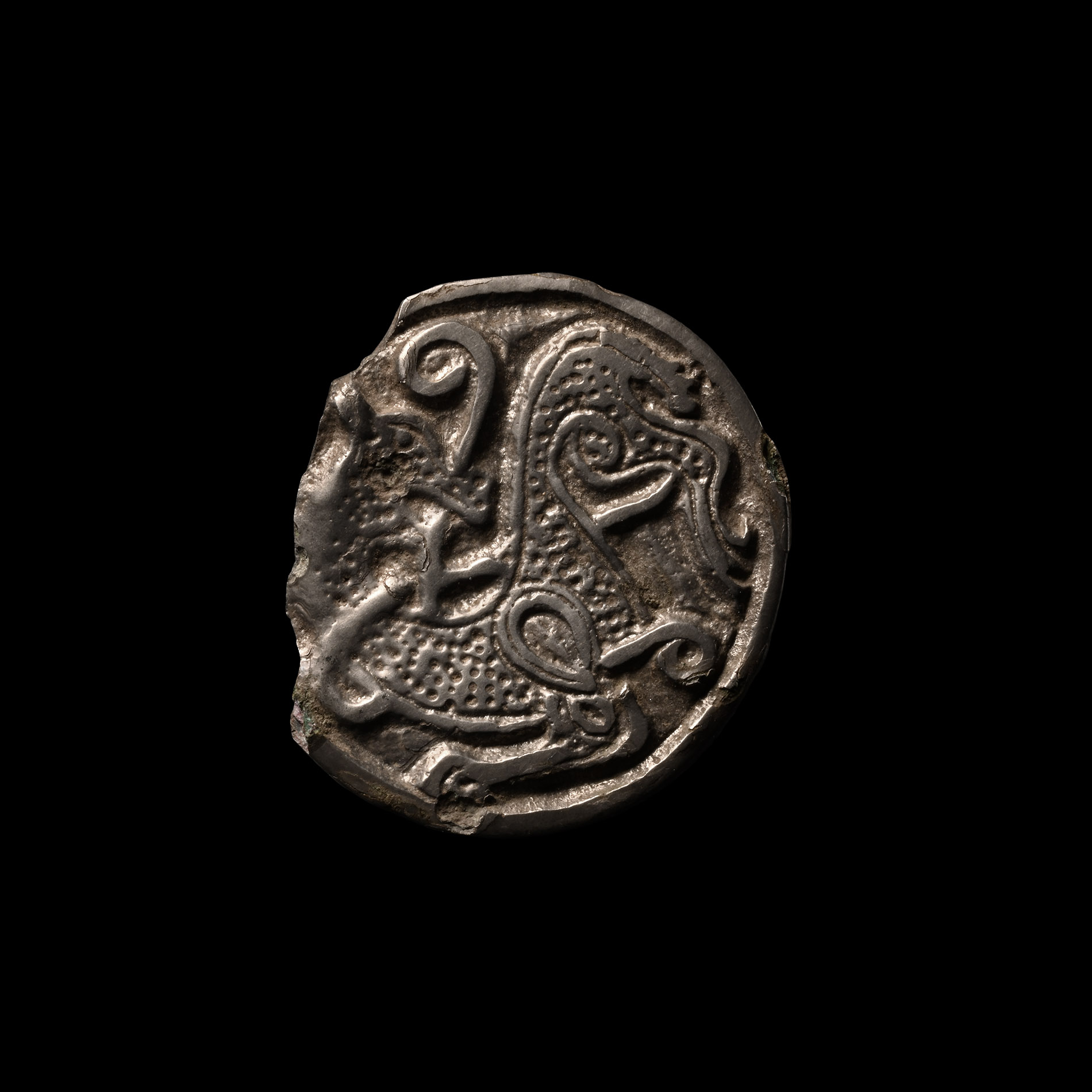
Viking Silver Mammen Style Dragon Pendant Viking Silver Mammen Style Dragon Pendant Viking Silver Mammen Style Dragon Pendant
Use mousewheel to zoom in and out, click to enlarge
Details

LOT 1520

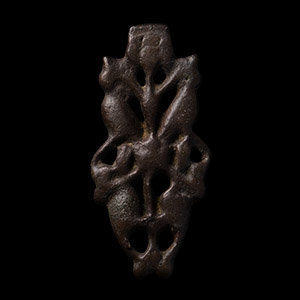
Viking Silver Mammen Style Dragon Pendant

10TH-EARLY 11TH CENTURY A.D.

1 3/8 in. (9.1 grams, 35 mm).

Of discoid form with central motif of a low-relief regardant beast with piriform shoulder and punced body, looped tendrils enmeshing the body. [No Reserve]

Provenance

From the collection of a North American gentleman, formed in the 1990s.

Literature

See Korshyn, V.E., Yazicheskiye Priveski Drevniye Rysi X-XIV, Vekov, Moscow, 2013, pl.71, for comparable objects.

CONDITION
VETTING:

TimeLine Auctions follows a vetting process to ensure the authenticity and legality of all items, reinforcing our commitment to integrity and responsible trading. Each antiquity, antique, and coin lot undergoes thorough examination by a vetting committee of at least ten external specialists, professional trade association members, scientists, and archaeologists: Our Vetting Process


AUCTIONS:

TimeLine is a leading auction house specialising in antiquities, ancient art, collectables, natural history, coins, medals, and books. Our auctions offer museums, collectors, historians, and enthusiasts the opportunity to acquire unique and historically significant pieces.

LOT 1520

Viking Silver Mammen Style Dragon Pendant

Estimate £200 - 300€230 - 350 (for guidance only)$270 - 410 (for guidance only)

Print page

RELATED LOTS
  • Viking Age Silver Lunate Pendant
    Viking Age Silver Lunate Pendant
    8th-10th century A.D.

    Sold for (Inc. bp): £247

    Comprising a ribbed suspension loop, surface divided into panels of granule clusters. 3.62 grams, 29 mm


    Acquired on the German art market before 2000. From an old Munich collection.

    Lot Details

  • Viking Bronze Casket Key
    Viking Bronze Casket Key
    9th-11th century A.D.

    Sold for (Inc. bp): £59

    Composed of a solid stem and two teeth to the side edge of the bit. 2.44 grams, 39 mm


    From the collection of a North American gentleman, formed in the 1990s.

    Lot Details

  • Scandinavian Viking Gilt Bronze Great Beast Weather Vane Terminal
    Scandinavian Viking Gilt Bronze 'Great Beast' Weather Vane Terminal
    11th century A.D.

    Estimate: £4,000 - 6,000 (+bp*)

    Opening Bid: £2,000

    In Ringerike style; a finial for a Viking long-ship weather vane or other similar nautical piece of equipment, formed in the round as a standing quadruped with scrolls to the hips and shoulders, raised head with almond-shaped eye; iron rivets at the feet to a rectangular plate with scalloped edges and corners removed, the plate with four slots for attachment. 111 grams, 66 mm wide


    Private collection formed in Europe in the 1980s. Westminster collection, central London, UK. This lot has been checked against the Interpol Database of stolen works of art and is accompanied by search certificate no.204123.

    The navigation techniques in use in Iron Age Northern Europe were very sophisticated, as would be expected from people bordering the Baltic, North Sea and North Atlantic where boat- and ship-building traditions have been perfected over more than a thousand years. A carved wooden panel from Bergen, Norway, shows a number of Viking longships at sea, some with weathervanes mounted on the stempost. They are mounted vertically with the beast on the outer end. Gilded bronze weathervanes appear on the roofs of medieval churches in Sweden, Norway and Finland where they are often regarded as ornamental: symbols of access to resources and craftsmanship for the important families who endowed such buildings. These weathervanes in many cases originally adorned ships and were used as part of the navigational equipment. They may have inspired the medieval Norman custom of attaching a gilded weathervane or cock to church roofs, which eventually spread to secular buildings such as castles in France and Italy where their use was restricted to certain ranks of nobility (Lindgrén, 1983). Weathervanes were used for determining the strength and direction of the wind, in conjunction with the sólarsteinn (sunstone) Icelandic feldspar which polarises sunlight and allows the sun's position to be determined in overcast conditions. A wooden bearing-dial fragment was found in Greenland - a destination colonised by Icelanders in the 11th century - with the 'horizon' divided into 32 sectors. This would give an accuracy of about 11 degrees per sector, which would make landfall using latitude sailing a straightforward matter. Engström & Nykänen (1996) suggested that the vanes were decorated with holes or markers on the outer edge which enabled the helmsman to make an assessment of the sun's height from the position and length of the shadow, and thus to work out his position by rule of thumb. These holes may have been used to attach streamers as a visual aid. The ships equipped with these weathervanes may have been the 'flagships' of their fleets, taking the lead in navigation and in manoeuvring. The dragon on the weathervane may thus have signified the position of the fleet's leader, and may even have given rise to the name drakka (dragon) for the largest type of Viking period ship.

    Lot Details

Stay up-to-date with the latest from TimeLine Auctions by joining our mailing list