
Loading, please wait...
LOT 1468
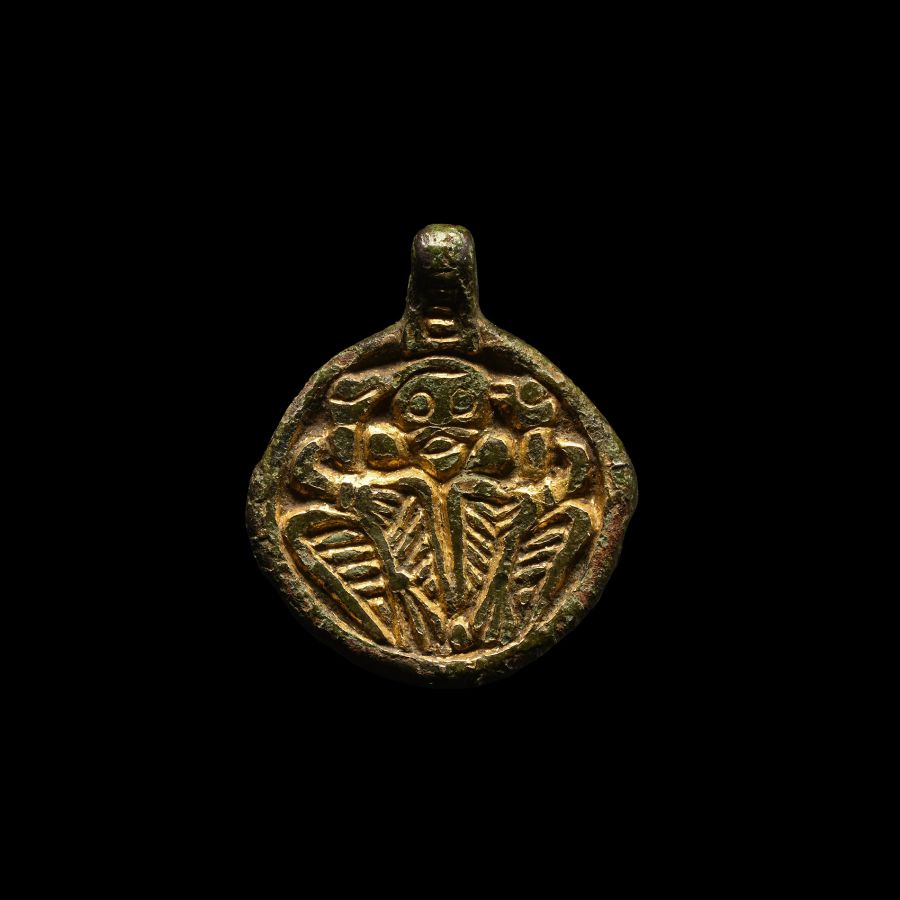
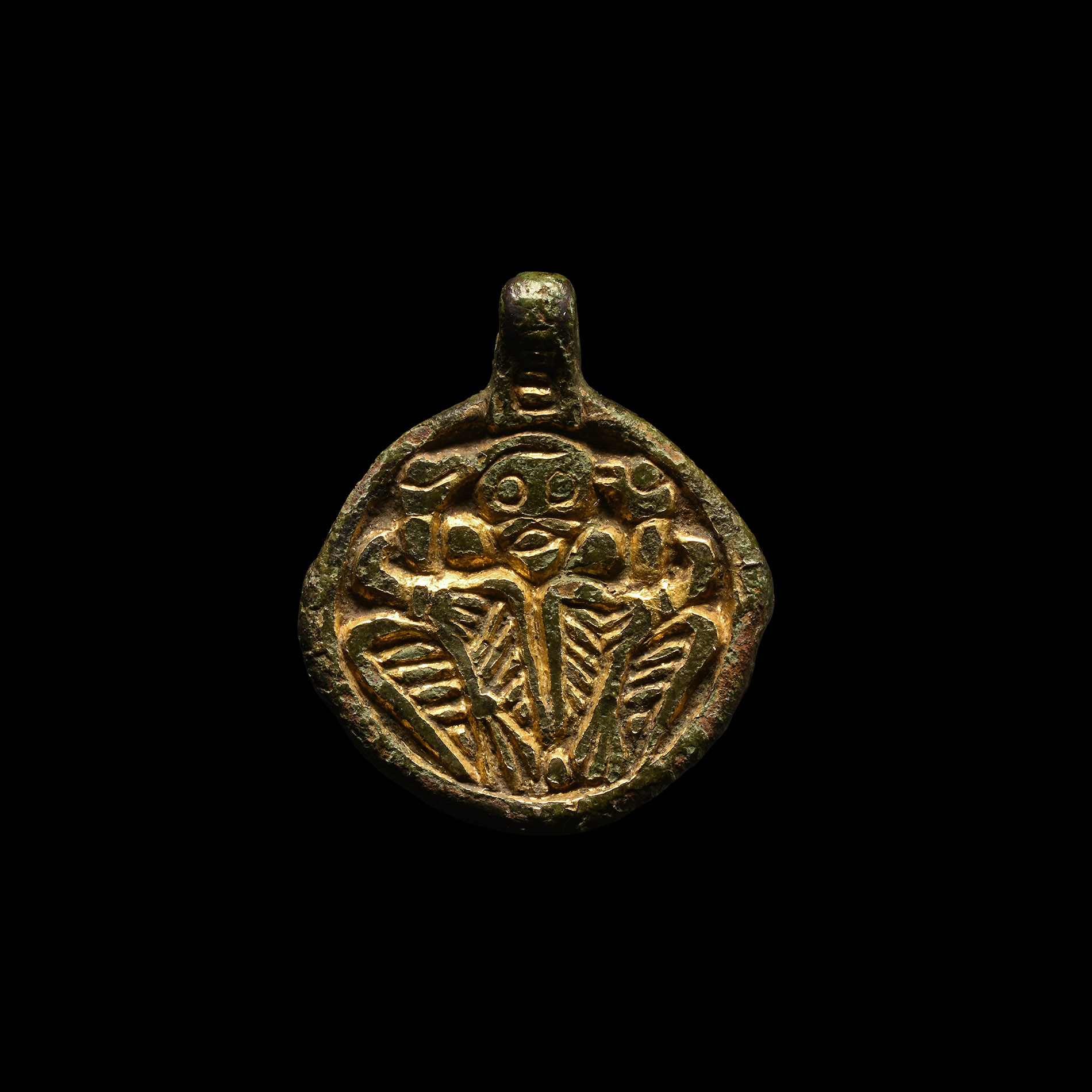
Viking Silver-Gilt Pendant with Odin Gripping Two Ravens
9TH-10TH CENTURY A.D.
1 in. (3.58 grams, 24 mm).
Integral loop, border enclosing a low-relief image of a male facing mask between two birds embraced at the necks. [No Reserve]
ProvenanceFrom the collection of a North American gentleman, formed in the 1990s.
LiteratureCf. Hammond, B. M., British Artefacts Volume 2 - Middle Saxon and Viking, p.57, item 1.5.3-f.; and Korshyn, V.E., Yazcheskye Priveski Drevnei Rusi X-XIV Vekov, Moscow, 2013, item M.2.02.
FootnotesThe iconography of the pendant is evidently based on the mythological representation of Odin, whose ravens, Huginn and Muninn, were his spirit companions and confidents. Huginn and Muninn travelled around the world bringing news and information to their master. Odin sent them out at dawn to gather information and they returned in the evening, sitting on the god's shoulders and whispering the news into his ears. It is from these ravens that the raven-god kenning representing Odin was derived.
CONDITIONTimeLine Auctions follows a vetting process to ensure the authenticity and legality of all items, reinforcing our commitment to integrity and responsible trading. Each antiquity, antique, and coin lot undergoes thorough examination by a vetting committee of at least ten external specialists, professional trade association members, scientists, and archaeologists: Our Vetting Process
AUCTIONS:
TimeLine is a leading auction house specialising in antiquities, ancient art, collectables, natural history, coins, medals, and books. Our auctions offer museums, collectors, historians, and enthusiasts the opportunity to acquire unique and historically significant pieces.
LOT 1468
Viking Silver-Gilt Pendant with Odin Gripping Two Ravens
Sold for (Inc. bp): £494
-
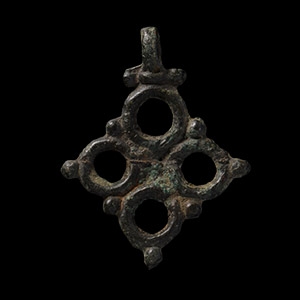
Viking Age Bronze Lozenge-Shaped Pendant
9th-11th century A.D.Sold for (Inc. bp): £59
Composed of an openwork body adorned with bulbs, bar and loop above. 4.9 grams, 35 mm
From the collection of a North American gentleman, formed in the 1990s. -
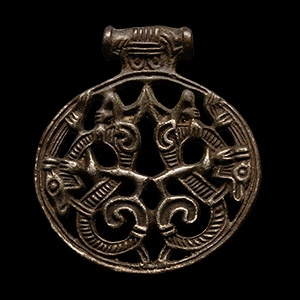
Viking Age Silver Gripping Beasts Pendant
10th century A.D.Estimate: £1,800 - 2,400 (‡+bp*)
Opening Bid: £1,000
Composed of an openwork discoid body with integral T-shaped tubular loop; raised gusseted rim enclosing a pair of S-shaped beasts with billetted bodies and comma-shaped tails, enmeshed gripping paws clutching the rim and their own bodies. 12.4 grams, 43 mm
Acquired on the European art market in the 1990s. Ex property of a German gentleman.
Despite the long period of overlap of Borre and Jellinge art styles, there are only few examples of their fusion. The principal and most popular motif of the Borre style displays an animal with gripping paws, usually enmeshed in a circular frame, while a typical Jellinge style beast is more slender with long, S-shaped body and ribbon decoration. The most famous example of a pendant featuring a fusion of these styles was found in a hoard from Vårby (Sweden), formed as a circle with a pair of Jellinge-style beasts with ribbon-shaped bodies in profile and heads with open jaws and extended tongues; however, each is provided with gripping paws and an enmeshed body, which are typical features of the Borre style. A few examples of these pendants were also found near the important trading settlement of Gnezdovo, near Smolensk, Russia. -
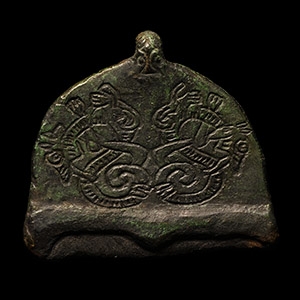
Viking Age Fire Steel with Bronze Jellinge Dragon Handle
10th century A.D.Sold for (Inc. bp): £650
Comprising a bronze body with engraved pair of Jellinge-style beasts on both sides, inserted iron part to the underside; attachment loop to the top. 31.4 grams, 52 mm
Acquired 1980-2000. Ex property of an American collector.
