
Loading, please wait...
LOT 1115
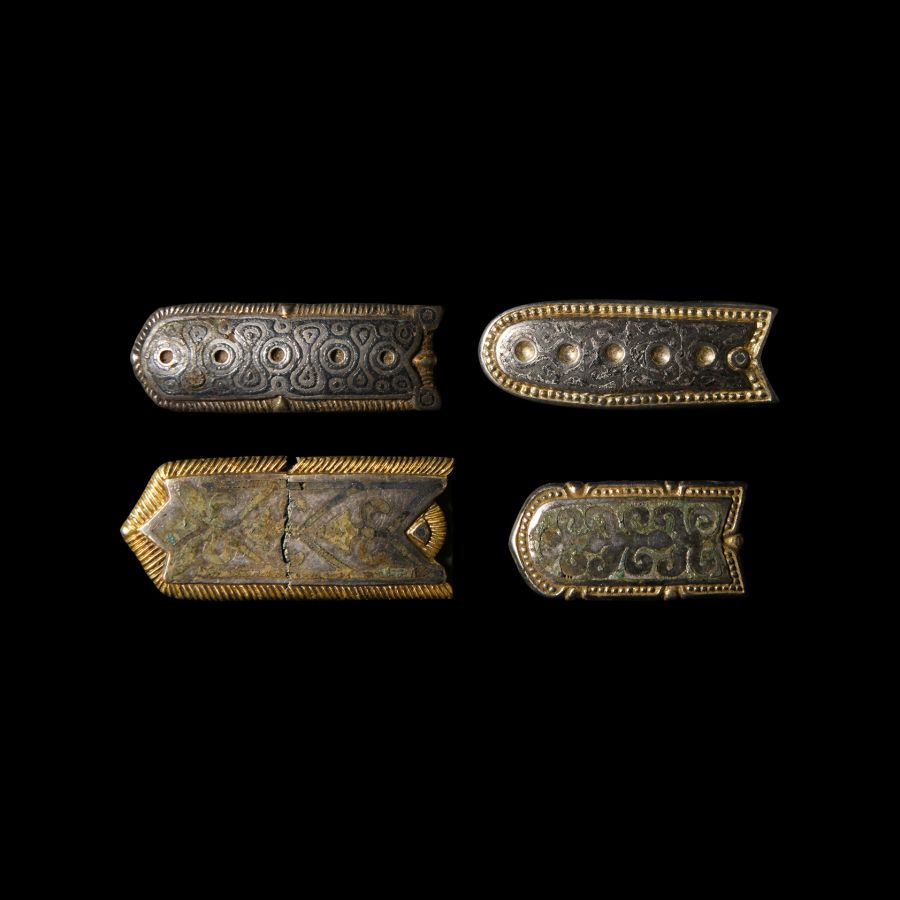
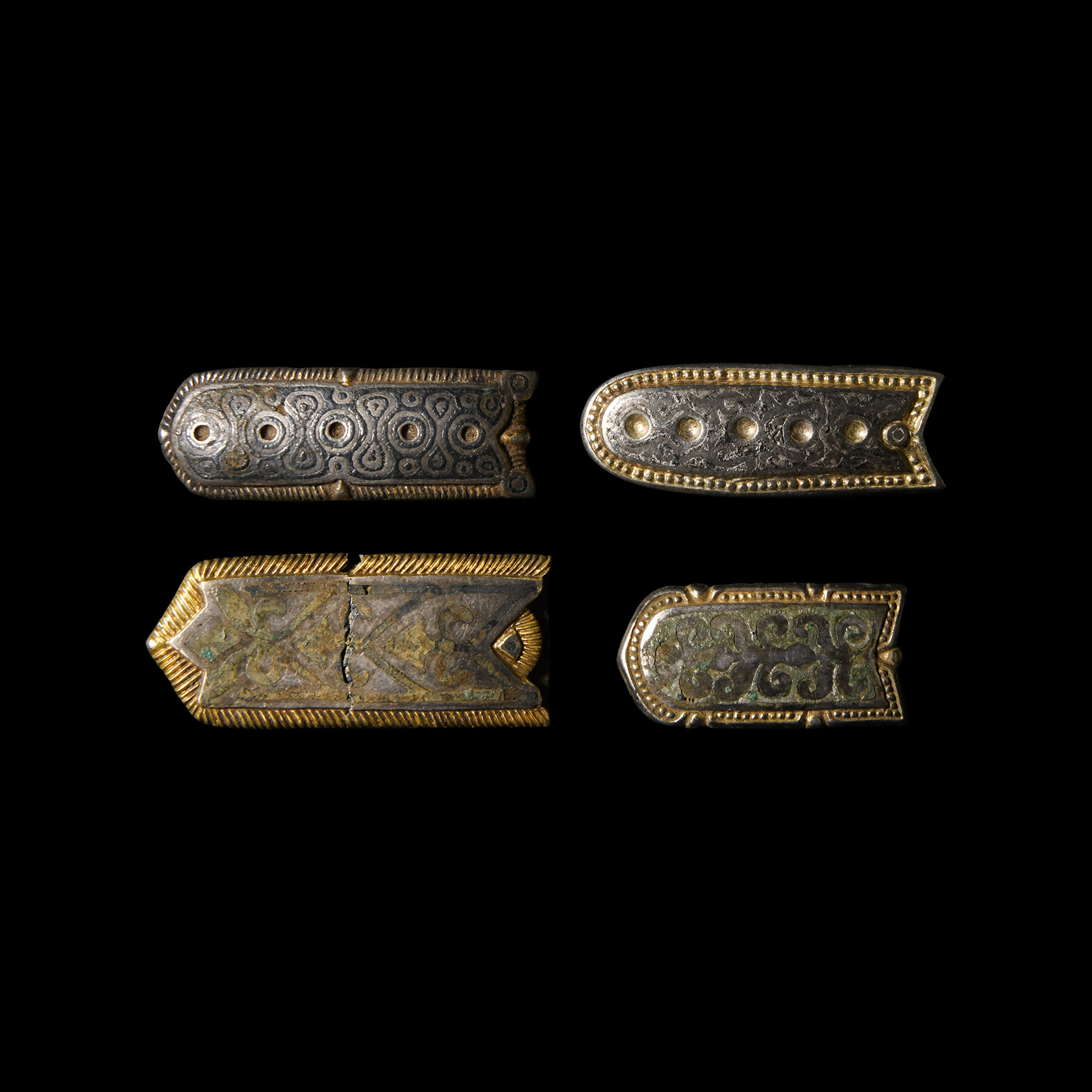
Viking Rus Silver-Gilt Sword Belt End Group
10TH CENTURY A.D.
1 1/2 - 2 in. (34 grams total, 37-50 mm).
Comprising four sword belt strap ends of roughly rectangular form, with one rounded or gabled end and one fishtail end, each bearing a different nielloed decorative scheme, comprising: one with split front plate bearing geometric foliage framed by radiating lines to the perimeter; one with pelletted border and medial scrolled bar; one displaying a medial row of circular recesses and surrounding circular motifs; one decorated with five medial circular recesses on a ground of foliate forms, pellet border; all with a set of mounting lugs to the reverse. [4]
ProvenanceAcquired in the 1980s-1990s.
Ex an important central London gallery, London W1.
Cf. Murasheva, V.V., Old Russian belt ornaments, Moscow, 2000, pl.61, for similar types.
FootnotesDuring the medieval period, belts had a range of functions. They girdled the clothes and enabled suspension of small items such as knives, whetstones, purses and leather bags. The decoration of the belt depended on the social status of its owner: peasants wore woven and simple leather straps, whereas large feudal lords, prominent warriors, and princes wore golden belts, which were passed down through the generations.
CONDITIONTimeLine Auctions follows a vetting process to ensure the authenticity and legality of all items, reinforcing our commitment to integrity and responsible trading. Each antiquity, antique, and coin lot undergoes thorough examination by a vetting committee of at least ten external specialists, professional trade association members, scientists, and archaeologists: Our Vetting Process
AUCTIONS:
TimeLine is a leading auction house specialising in antiquities, ancient art, collectables, natural history, coins, medals, and books. Our auctions offer museums, collectors, historians, and enthusiasts the opportunity to acquire unique and historically significant pieces.
LOT 1115
Viking Rus Silver-Gilt Sword Belt End Group
Estimate £300 - 400€350 - 460 (for guidance only)$410 - 540 (for guidance only)
-
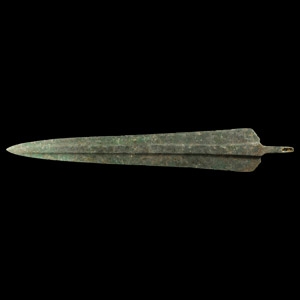
Luristan Bronze Short Sword Blade
Early 1st millennium B.C.Sold for (Inc. bp): £130
Triangular with thick rectangular-section midrib, rounded shoulders, narrow tip, short tang with inserted fixing pin for the organic grip. 472 grams, 42.2 cm
Ex German collection, Cologne, 1980-1990s.
This tanged bronze blade from Luristan belongs to a category of Luristan swords still in use in Achaemenid Period, as proved from a blade with a perished handle (probably bone or wood) of the same type, in the National Museum of Iran (2694/15633). Examples without inscriptions like our model have been classified by Grotkamp-Schepers in the Solingen Museum as pieces from Luristan. -
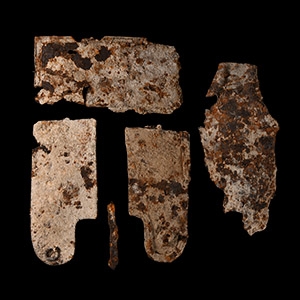
Medieval Iron Cheek Guards and Chamfron Group
Circa 14th-16th century A.D.Sold for (Inc. bp): £26
Comprising curved and flat plates, some incorporating shaped regions, raised borders and seized ring loops. 450 grams total, 7.2-19.5 cm
Acquired 1990s-early 2000s. East Anglian private collection. -
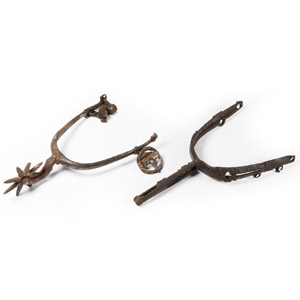
Medieval Iron Spur Group
13th-15th century A.D.Sold for (Inc. bp): £78
Comprising: one rowel spur with tapering D-section heelband, short shank and arched rowel box with articulated eight-armed rowel, attachment buckle with tongue suspended from integral loop on one arm, two lobed plaques with loops on reverse suspended from integral loops on the other; a spur with D-section heelband and lentoid-section shank, rectangular and quatrefoil openwork, sections of hatching and raised designs to the outer faces. 215 grams total, 16-18 cm
European collection, 1990s. Property of a Cambridgeshire, UK, gentleman.
