
Loading, please wait...
LOT 1693
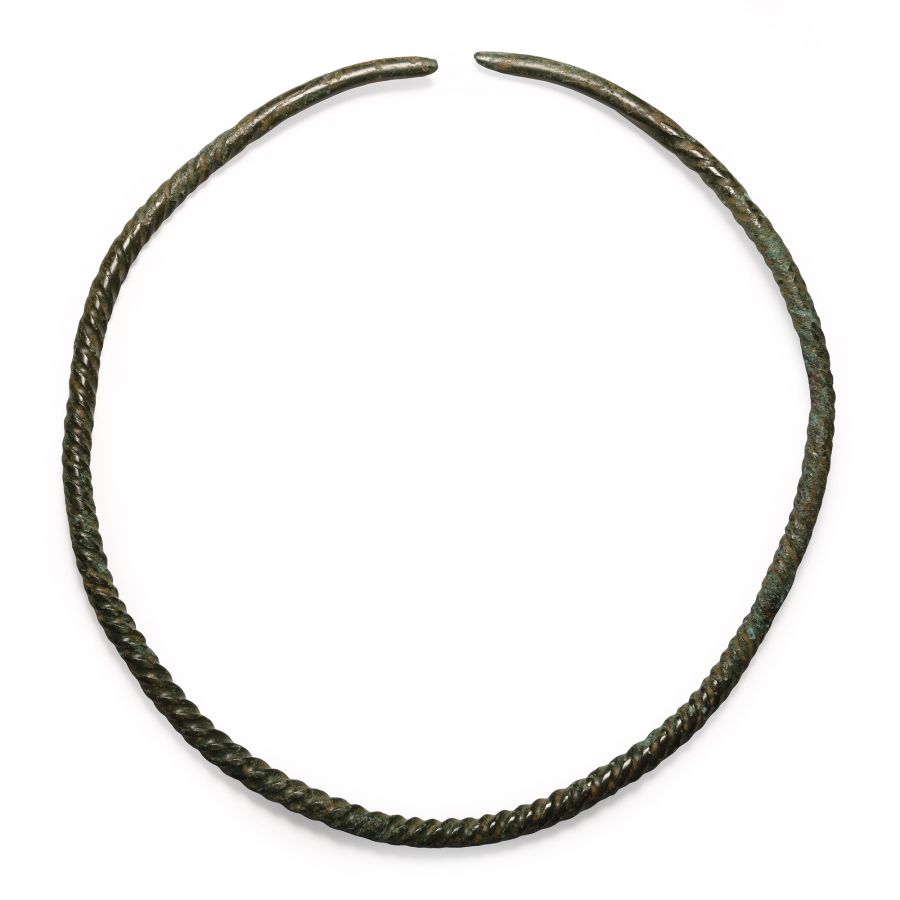
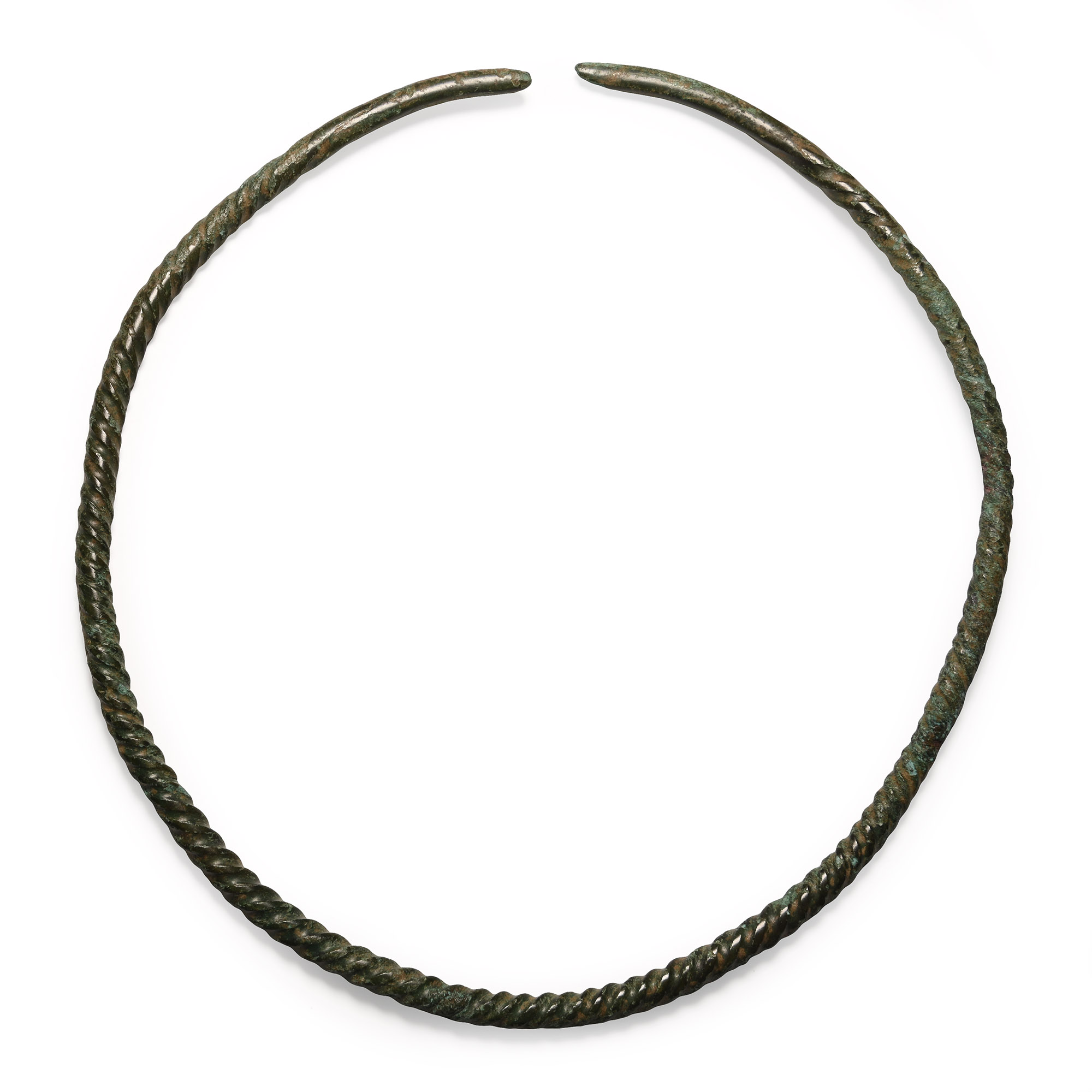
Viking Period Twisted Bronze Neck Torc
10TH-13TH CENTURY A.D.
6 3/4 in. (84 grams, 17 cm).
Penannular neck torc with tapering terminals. [No Reserve]
ProvenanceAcquired on the European art market in the 1980s, and thence by descent.
From an important private family collection of arms and armour.
See Lehtosalo-Hilander, P-L., Luistari: A History of Weapons and Ornaments, Helsinki, 2000.
CONDITIONTimeLine Auctions follows a vetting process to ensure the authenticity and legality of all items, reinforcing our commitment to integrity and responsible trading. Each antiquity, antique, and coin lot undergoes thorough examination by a vetting committee of at least ten external specialists, professional trade association members, scientists, and archaeologists: Our Vetting Process
AUCTIONS:
TimeLine is a leading auction house specialising in antiquities, ancient art, collectables, natural history, coins, medals, and books. Our auctions offer museums, collectors, historians, and enthusiasts the opportunity to acquire unique and historically significant pieces.
-
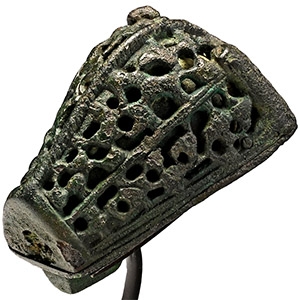
Viking Bronze Boar's Head Brooch with Openwork Beast Motif
9th-10th century A.D.Sold for (Inc. bp): £3,120
Hollow-formed with openwork decorative outer surface attached to a plain back-plate with one spring-lug and catchplate intact; the upper face divided by a heavy segmented median rib and zoomorphic ornament in the outer panels, arranged symmetrically along the rib with a similar transverse band; the corners of the wider end reinforced with vertical posts ending in heavy lobed ‘ears’; the side panels decorated with zones of interlace zoomorphic ornament and the upper-end panel with a continuation of the median rib, traces of ornamental interlace; the lower-end panel plain. 109 grams, 56 mm (162 grams total, 10.5 cm including stand)
Acquired on the UK art market, 1995-2000s. Private collection, London. This lot has been checked against the Interpol Database of stolen works of art and is accompanied by search certificate number no.12987-246190. -
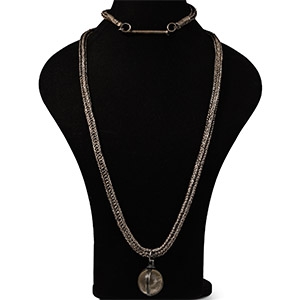
Large Viking Silver Interlaced Chain with Amuletic Rock Crystal Pendant
10th century A.D.Sold for (Inc. bp): £7,475
Comprising: openwork trichinopoly chain with sleeve terminals each with a loop and bar closure; spherical rock crystal pendant with silver wire cage and mounting cap. 367 grams, 120 cm
Private collection, Europe, mid-1990s. Private collection, UK. This lot has been checked against the Interpol Database of stolen works of art and is accompanied by search certificate number no.12985-246022. -
.jpg)
Large Scandinavian Viking Bronze Shield Pendant
8th-10th century A.D.Sold for (Inc. bp): £247
A broad sheet-bronze disc horse harness pendant with band of repoussé bosses to the edge, applied cross-bands to the obverse and central boss; applied attachment loop with tremolier detailing. 60 grams, 12.1 cm
From the private collection of a London gentleman, from his grandfather's collection formed before the early 1970s.
