
Loading, please wait...
_900x900.jpg "Viking Period Silver Lunar Pendant")
_200x200.jpg "Viking Period Silver Lunar Pendant")
.jpg "Viking Period Silver Lunar Pendant")
LOT 1631
Viking Period Silver Lunar Pendant
CIRCA 10TH CENTURY A.D.
1 in. (3.94 grams, 26 mm).
A silver crescent pendant with applied rim, recurved suspension loop with granule, three applied granules and curved band to the field; Slavic workmanship.
ProvenanceAcquired in the late 1990s-2000.
Property of an East London gentleman.
Cf. similar item in the British Museum, London, under accession no.1991,1003.2.
CONDITIONTimeLine Auctions follows a vetting process to ensure the authenticity and legality of all items, reinforcing our commitment to integrity and responsible trading. Each antiquity, antique, and coin lot undergoes thorough examination by a vetting committee of at least ten external specialists, professional trade association members, scientists, and archaeologists: Our Vetting Process
AUCTIONS:
TimeLine is a leading auction house specialising in antiquities, ancient art, collectables, natural history, coins, medals, and books. Our auctions offer museums, collectors, historians, and enthusiasts the opportunity to acquire unique and historically significant pieces.
-
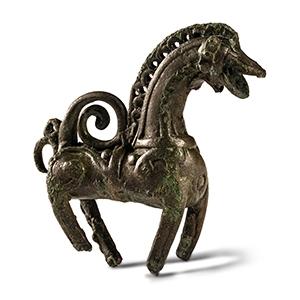
Viking Age Bronze 'Great Beast' Horse Figure
Circa 9th-11th century A.D.Estimate: £2,000 - 3,000 (+bp*)
Opening Bid: £1,000
Hollow-formed finial in the shape of a stylised horse with scrolled tail, arcading to the mane, applied strap and pellet harness detailing. 30 grams, 59 mm
From the private collection of a London gentleman, from his grandfather's collection formed before the early 1970s. This lot has been checked against the Interpol Database of stolen works of art and is accompanied by search certificate no.12078-213598. -
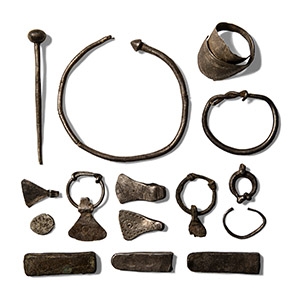
Viking Age Silver 'Hoard' Group
Circa 10th-12th century A.D.Estimate: £800 - 1,000 (+bp*)
Opening Bid: £400
Comprising: two dome-headed dress pins; three pieces of hack-silver ingot; five miniature axeheads; a mitre-shaped finger ring; and other items. 42.8 grams total, 9-53 mm
Acquired on the London art market in the late 1980s-1990s. From the family collection of an East London, UK, gentleman. -
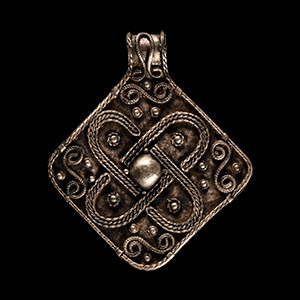
Viking Age Scandinavian Silver Filigree Lozenge-Shaped Pendant
Circa 9th-11th century A.D.Sold for (Inc. bp): £715
With integral loop, twisted filigree rim, applied filigree knot and scroll motifs, granules and central boss. 1.92 grams, 31 mm
Private collection formed in Europe in the 1980s. Westminster collection, central London, UK.
