
Loading, please wait...
LOT 1359
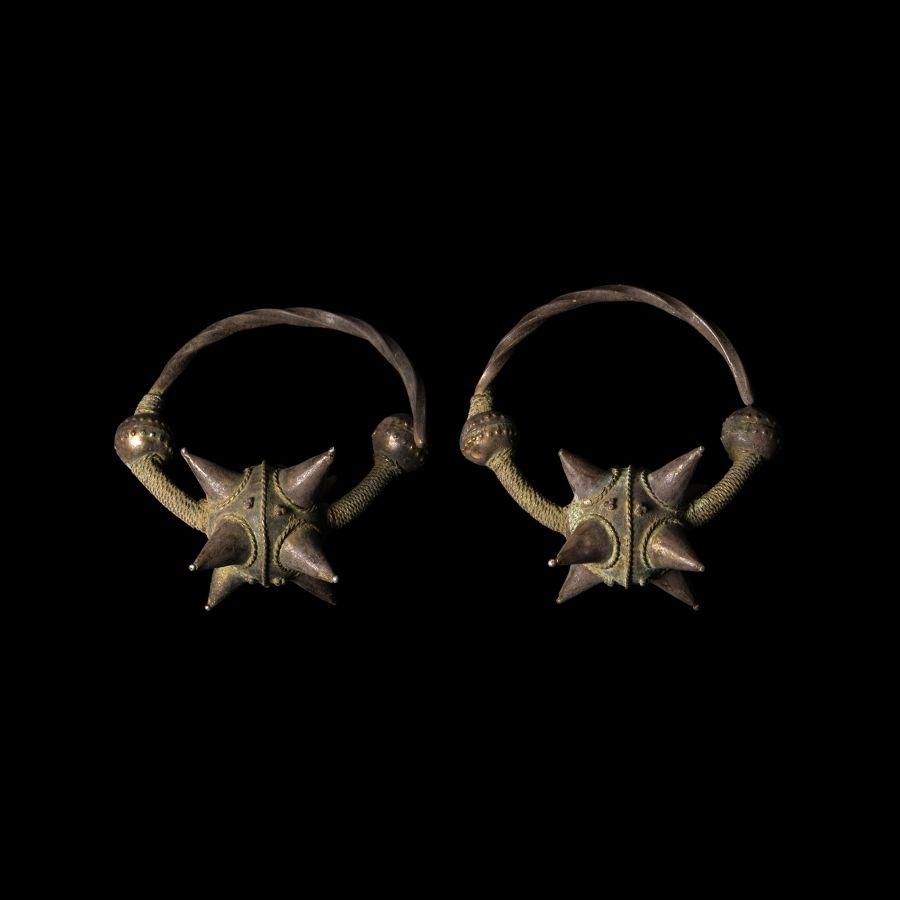
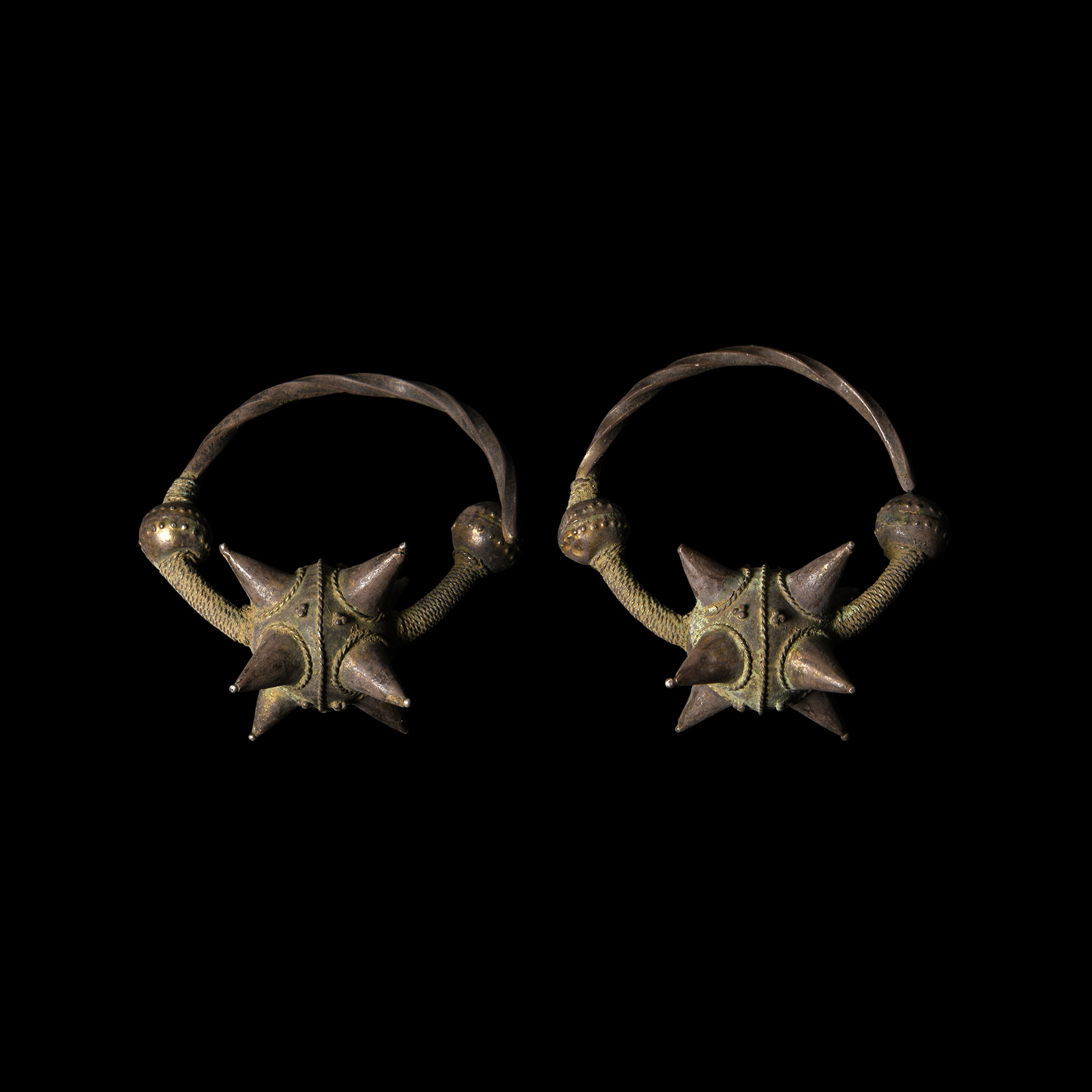
Viking Period Rus Silver Temple Earring Pair
10TH-12TH CENTURY A.D.
2 1/8 - 2 1/4 in. (30 grams total, 55-57 mm).
Each composed of a decoratively twisted upper hoop, bulbous collars and a large central bulb with projecting cones and granules. [2, No Reserve]
ProvenanceFrom the collection of a North American gentleman, formed in the 1990s.
LiteratureSee Various, Археалогія Беларусі. Т. 1., A-K, Minsk, 2009, p.372, for similar earring typology.
FootnotesThis style of earring was typical among Slavic women in the 8th-12th centuries, an imitation of Eastern Roman models. Examples have been found in Poland, Czech Republic, and Slovakia, and with similar decoration in Belarus. Such rings were also worn as part of head-dresses, in which context they are known as ‘temple rings’ because they were worn by women near the temples. They were usually made of base metals, but some silver and gold examples also survive. Different tribes had their own designs, which were often threaded onto a cord, forming part of a
head-dress, or woven directly into braids of hair.
TimeLine Auctions follows a vetting process to ensure the authenticity and legality of all items, reinforcing our commitment to integrity and responsible trading. Each antiquity, antique, and coin lot undergoes thorough examination by a vetting committee of at least ten external specialists, professional trade association members, scientists, and archaeologists: Our Vetting Process
AUCTIONS:
TimeLine is a leading auction house specialising in antiquities, ancient art, collectables, natural history, coins, medals, and books. Our auctions offer museums, collectors, historians, and enthusiasts the opportunity to acquire unique and historically significant pieces.
-
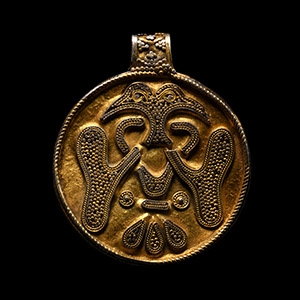
Viking Age Silver-Gilt Filigree Pendant with Conjoined Ravens
9th-11th century A.D.Sold for (Inc. bp): £5,460
The upper face decorated with a two-headed filigree raven, raised ropework border, suspension loop with pyramids of granules continuing onto the reverse. 6.26 grams, 42 mm
Private collection formed in Europe in the 1980s. Westminster collection, central London, UK. This lot has been checked against the Interpol Database of stolen works of art and is accompanied by search certificate no.203746.
Pairs of ravens were considered auspicious in medieval Scandinavian society. In pre-Christian times, two such birds were the informants of the god Odin, who relayed news of the deeds of men. They were also carrion birds, frequenting battlefields to feast on the bodies of fallen warriors. -
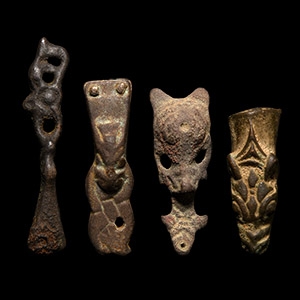
Viking Bronze Zoomorphic Strap End Collection
9th-11th century A.D.Sold for (Inc. bp): £169
Most with piercings or attachment rivets and displaying beasts in relief or openwork. 37.7 grams total, 34-50 mm
From the collection of a North American gentleman, formed in the 1990s. -
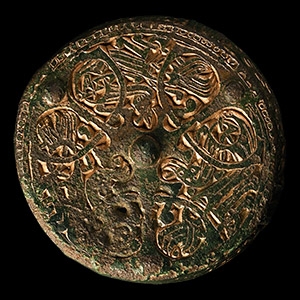
Viking Age Gilt Bronze Oseberg Box Brooch with Entwined Animals
8th century A.D.Sold for (Inc. bp): £3,510
Formed as a hollow drum-shaped casting with ornament to the obverse and sidewall; the high-relief designs comprising three radiating panels of Oseberg Style 'gripping-beast' motifs with a dome at the centre and three to the beaded border; the slightly sloping sidewall with four panels of S-shaped animals with interlaced tendrils, separated by beaded borders; to the reverse, the perimeter flange supported by two integral blocks supporting the catchplate and pin-hole respectively, the latter damaged and replaced by a second offset hole. 44 grams, 50 mm
European collection, acquired 1980s. Ex property of a UK collector. This lot has been checked against the Interpol Database of stolen works of art and is accompanied by search certificate no. 200319.
The Oseberg style shows a strong interplay between zoomorphic and geometric patterns that continues artistic traditions predating the Viking Age, but continued in the Viking Age at least until 875 A.D. While 8th century art and ornaments show considerable variation across Scandinavia, the gripping-beast motif was adopted in every region within a few decades after 790 A.D.
