
Loading, please wait...
LOT 1393
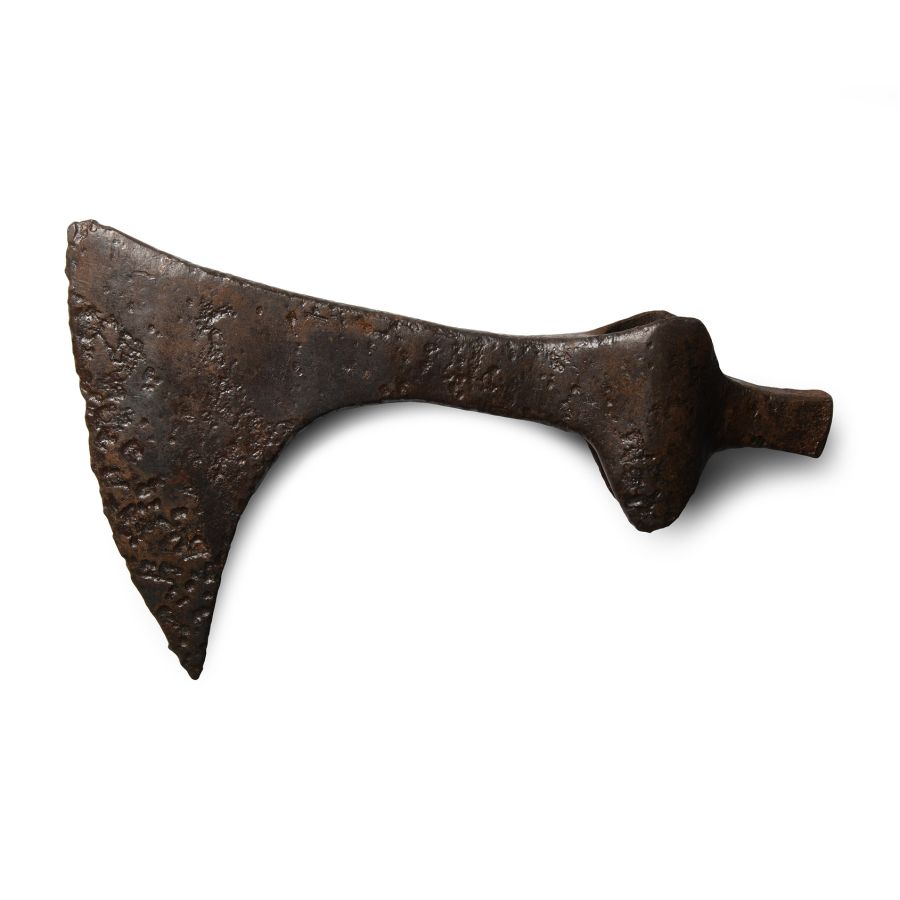
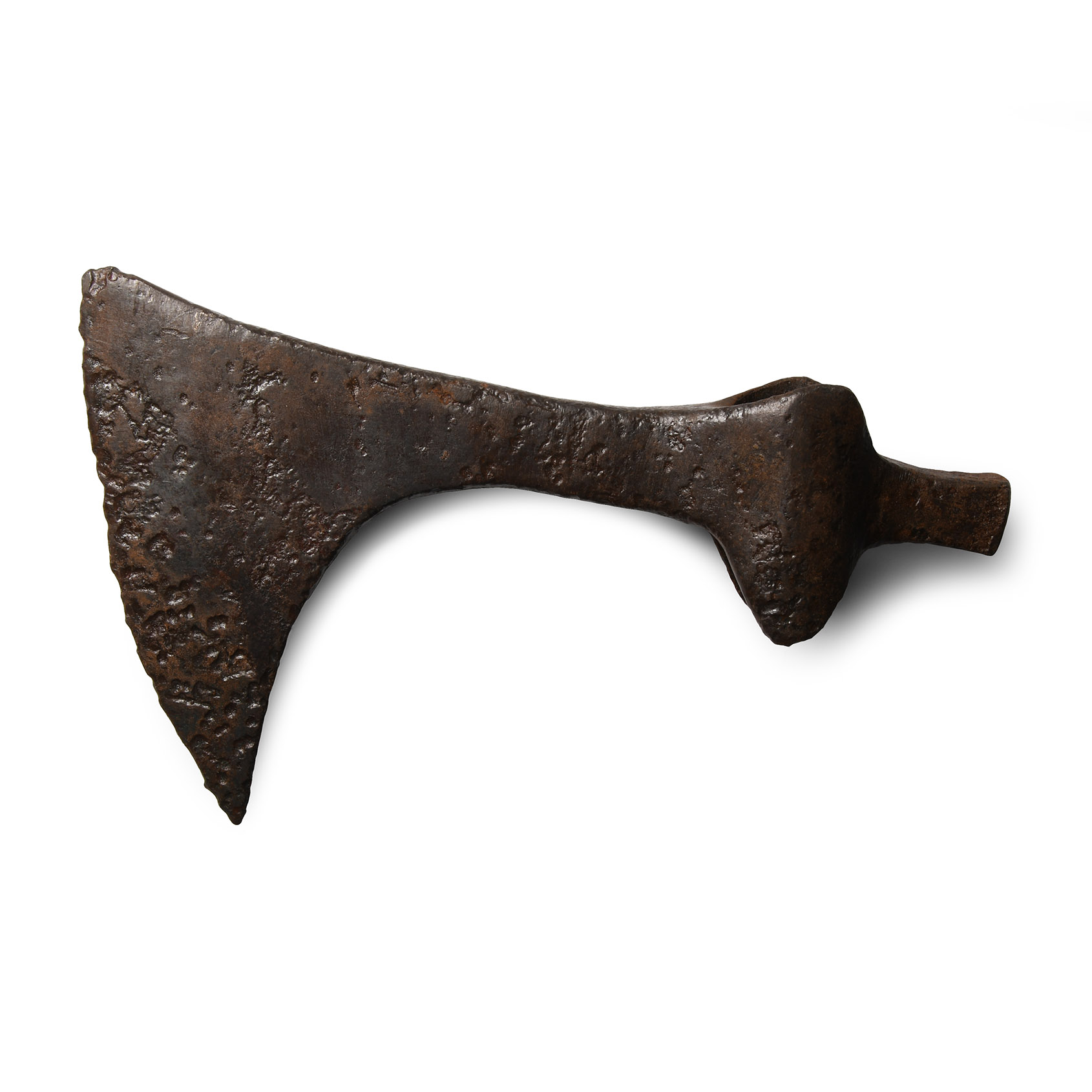
Viking Period Iron Broad Baltic Axe-Hammer
CIRCA 12TH-13TH CENTURY A.D.
7 1/4 in. (349 grams, 18.5 cm).
Comprising a flat socket with lateral spurs, slender neck developing to a broad blade with curved edge, chin to the lower edge and point to the upper, rear square-section shank with disc hammer-face. [No Reserve]
ProvenancePrivate collection, Arundel, West Sussex, UK, 1975-late 1990s.
LiteratureCf. Sedov, B.B., Finno-Ugri i Balti v Epokhi Srednevekovija, Moscow, 1987, pl.CXXIV, item 21.
FootnotesDuring the mid 13th century, the axes were favourite weapons among the Baltic people. For example, the Curonian army included lightly armed soldiers who fought with spears, shields, fighting knives and axes. A heavily armed soldier could also carry a sword, a helmet, a shield and a wide-bladed axe.
CONDITIONTimeLine Auctions follows a vetting process to ensure the authenticity and legality of all items, reinforcing our commitment to integrity and responsible trading. Each antiquity, antique, and coin lot undergoes thorough examination by a vetting committee of at least ten external specialists, professional trade association members, scientists, and archaeologists: Our Vetting Process
AUCTIONS:
TimeLine is a leading auction house specialising in antiquities, ancient art, collectables, natural history, coins, medals, and books. Our auctions offer museums, collectors, historians, and enthusiasts the opportunity to acquire unique and historically significant pieces.
-
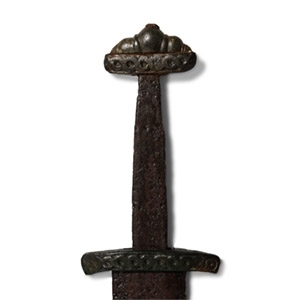
Viking Age Iron Pattern-Welded Sword with Bronze Jellinge Hilt
11th-13th century A.D.Estimate: £3,000 - 4,000 (+bp*)
Opening Bid: £1,500
Double-edged cutting sword of Curonian Type with tapering fullers and showing battle scars; boat-shaped bronze cross-guard with Jellinge Style decoration, the seven-lobed pommel with similar decoration. 918 grams, 92.5 cm
From the private collection of a London gentleman, from his grandfather's collection formed before the early 1970s. Accompanied by an academic report by Dr Raffaele D’Amato. This lot has been checked against the Interpol Database of stolen works of art and is accompanied by search certificate number no.12175-221434.
The Curonian swords of this type, sometimes with animal head decoration on the lower guard, were widespread and used in the Eastern Baltic lands from 10th to 13th century. Curonian swords possessed both plastic hilt details (ends of the lower guards in the form of animal heads) of animal style, a clear influence from the Germanic style of Scandinavians, as well as a regular geometric ornament, a decoration motif derived from the Romanesque art. -
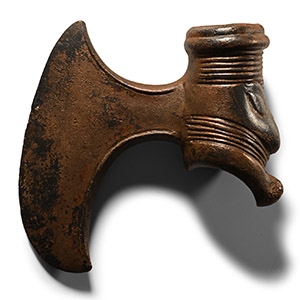
Elamite Copper Axehead with 'Human' Face
2nd millennium B.C.Sold for (Inc. bp): £1,170
With crescentic blade and rounded knot at the butt, ornamental curved edging to the upper shaft hole, a cord edge on the upper and lower shaft hole, incised band around the edge of the blade; the butt inversed, forming a bearded human face. 246 grams, 94 mm
with a London, UK gallery, 1971-early 2000s.
The type corresponds to Gernez type H.2.H.a, axes with collar and short sleeve lined with mouldings, fan-shaped blade and rear knot. It was a variant only known in Elam and Luristan. In Luristan one identical specimen was found at Chigha Sabz (grave M7). In Elam, the majority of these axes were found in the Middle-Bronze Age (Age of Isin-Larsa or Early Babylonian Age) tombs of Sarcophagi, at Susa. -
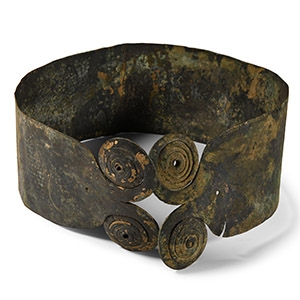
Luristan Bronze Armour Belt with Double Scroll Terminals
9th-7th century B.C.Sold for (Inc. bp): £169
A broad hammered military belt or cuirass band with plain surface, the terminals shaped as a double spiral ornament, holes in the centre of both ends for fastening. 330 grams, 22 cm
UK private collection before 2000. Acquired on the UK art market. Property of a London gentleman.
The rich and noble aristocrats of Luristan, Elamites, Hurrians, Lullubians, Kutians, and Kassites, went to battle splendidly equipped and used magnificent bronze armours. For metal sheets used for quiver plaques and bronze protective belts or shields, they used the hammering technique (Čakoškāri).
