
Loading, please wait...
LOT 1099
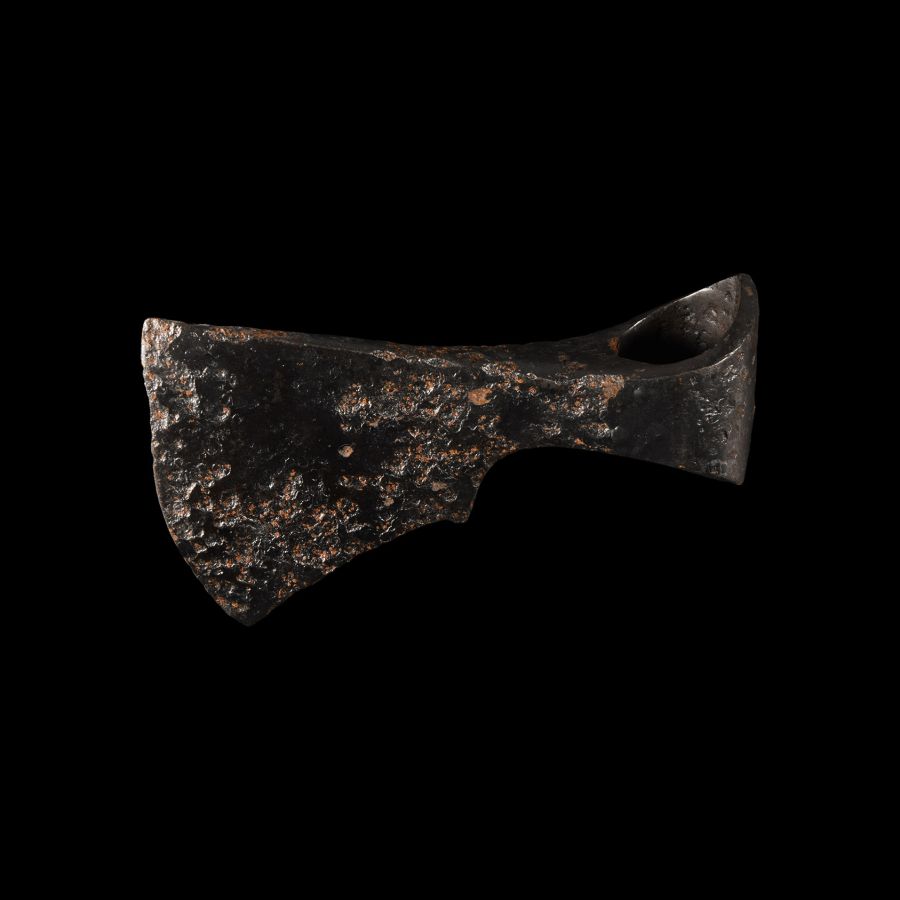
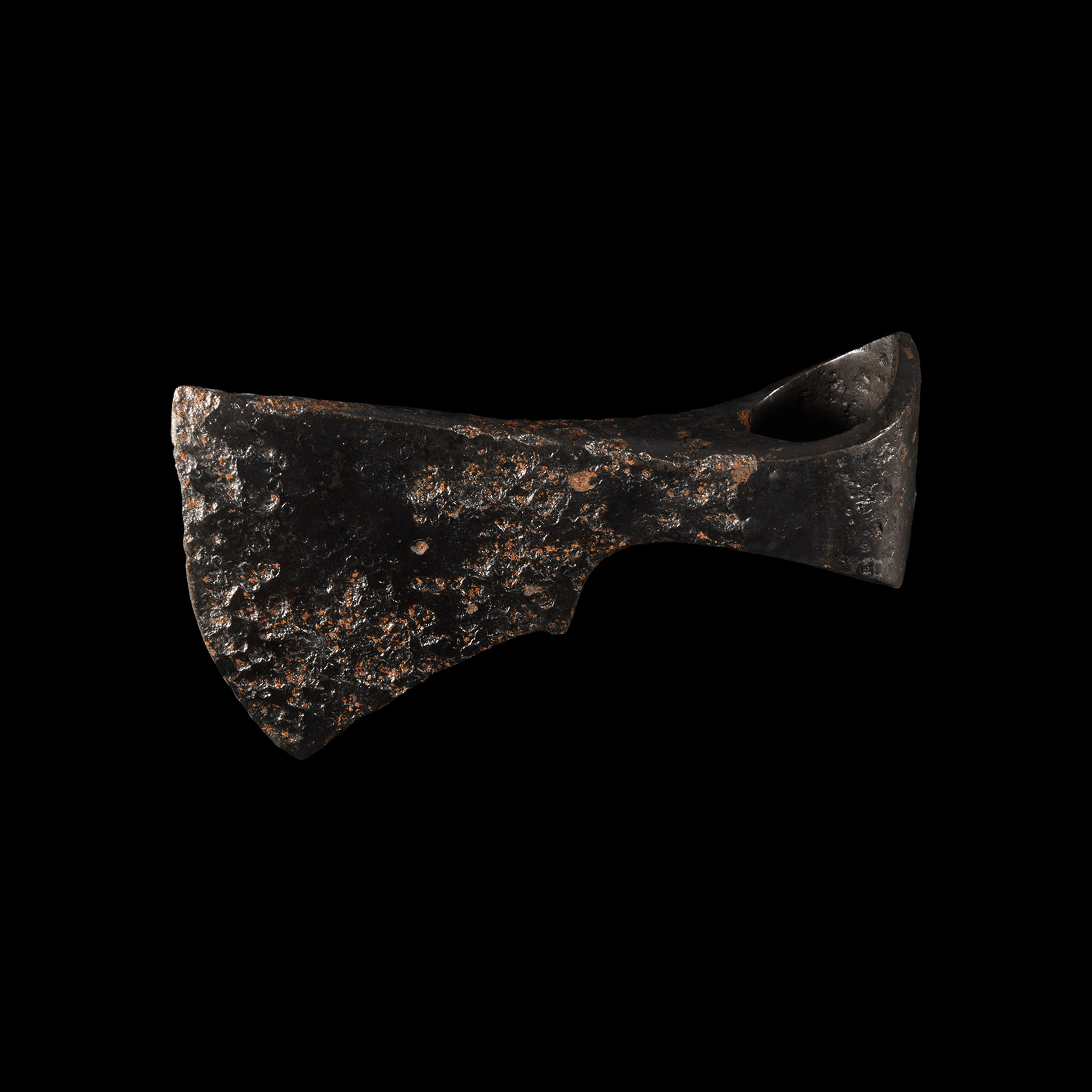
Viking Iron Bearded Axehead
9TH-12TH CENTURY A.D.
6 3/8 in. (688 grams, 16.2 cm).
Composed of a flanged and rounded butt, shaped lower edge and convex cutting edge.
ProvenanceEx American collection, acquired 1980-200.
The Kusmirek Collection, UK.
TimeLine Auctions follows a vetting process to ensure the authenticity and legality of all items, reinforcing our commitment to integrity and responsible trading. Each antiquity, antique, and coin lot undergoes thorough examination by a vetting committee of at least ten external specialists, professional trade association members, scientists, and archaeologists: Our Vetting Process
AUCTIONS:
TimeLine is a leading auction house specialising in antiquities, ancient art, collectables, natural history, coins, medals, and books. Our auctions offer museums, collectors, historians, and enthusiasts the opportunity to acquire unique and historically significant pieces.
-
.jpg)
Nathan Starr 1816 Pattern Musket
1832 A.D.Sold for (Inc. bp): £715
Type III, made under contract by Nathan Starr of Middletown, CT; with .69 calibre, 107 cm (42”) browned barrel with side lock marked with Starr’s earlier style of 'US / (ornate sunburst) / N. STARR' ahead of the cock and 'MIDDTN / CONN / 1832 / (rosette)' to the rear with 'US / JM' over a raised 'P' in sunken circular cartouche to top of breech, with various inspection and other small marks, fitted with sling swivels (upper possibly a replacement), steel ramrod with flared tip, full wood stock with steel butt plate, trigger guard, side-plate, barrel rings and fore-end, lock with brass pan; action in good working order. 4.10 kg, 148 cm
Acquired from M J Noble Ltd, UK, 2015. The Kusmirek Collection, UK. Accompanied by the Noble purchase invoice and listing.
Sold as an exempt item under Section 58 (2) of the Firearms Act, 1968, to be held as a curiosity or ornament. No license required but buyer must be over 18 years of age. Overseas bidders should note that, due to UK regulations governing export of all firearms, overseas buyers will need to make arrangements for shipping this lot out of the UK directly, by air freight, with a specialist company or agent. -
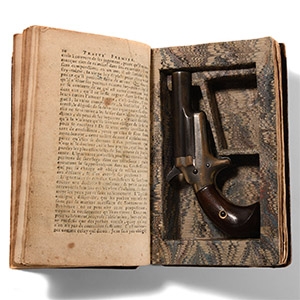
Colt .41 Rimfire Derringer Pistol and Book Case
19th century A.D.Sold for (Inc. bp): £572
Comprising a Colt .41 calibre single action rimfire single-shot derringer pocket pistol, the barrel top marked 'COLT' and the left frame '41 CAL'; with nickel-plated brass frame and steel rifled barrel (swivel to load) and bird's beak butt with plain wood grips; the pistol contained in an original case formed from a hollowed out leather-bound book Pratique du Sacrament de Penitence ou Methode pour L'Administrer Utilement, published Paris, 1714, the compartment lined with marbled paper with section for spare bullets; action in working order. 450 grams total, book 17 x 10 cm
Acquired from Holts Auction, 2020, lot 899. Formerly with a Kent collector. With TimeLine Auctions, lot 1086. Property of an Australian collector. Accompanied by Holts lot ticket.
Sold as an exempt item under Section 58 (2) of the Firearms Act, 1968, to be held as a curiosity or ornament. No license required but buyer must be over 18 years of age. Overseas bidders should note that, due to UK regulations governing export of all firearms, overseas buyers will need to make arrangements for shipping this lot out of the UK directly, by air freight, with a specialist company or agent. -
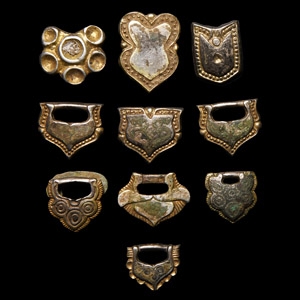
Volga Silver-Gilt Sword Belt Mount Group
11th-12th century A.D.Sold for (Inc. bp): £195
Comprising: two matching ogival plates with pellet borders; a trefoil plate with border of radiating lines framing three concentric circle and oval motifs; a plate with five lobes decorated with dashed lines and six concentric oval motifs at the centre; ogival plate with scalloped border, trefoil motif at centre; ogival plate with pellet border divided into three 'petals' by larger single pellets, scrolling vegetal motif; a floral style plate composed of discoid dimples; irregular hexagonal plate, the shape repeated at the centre, pellet border; trilobate plate with three single pellets to the perimeter and pellet border; ogival plate with expanded waist, raised 'wings' and rounded lozenge against a background of radiating lines; nine with three attachment lugs to reverse, one with two lugs. 31.8 grams total, 17-26 mm
Fine condition.
Acquired in the 1980s-1990s. Ex an important central London gallery, London W1.
The belt fittings find various comparisons with non-ferrous belt appliqués found in the territories of the Volga Bulgars, like specimens from the Semenovsky village. These items were parts of long warrior belts, the leather surfaces decorated all over with such bronze and silver appliqués. Symbols of ranks and elite warrior aristocracy, these belts also served a utilitarian purpose of suspending weapons such as a bow, quiver or a sabre.
