
Loading, please wait...
LOT 1344
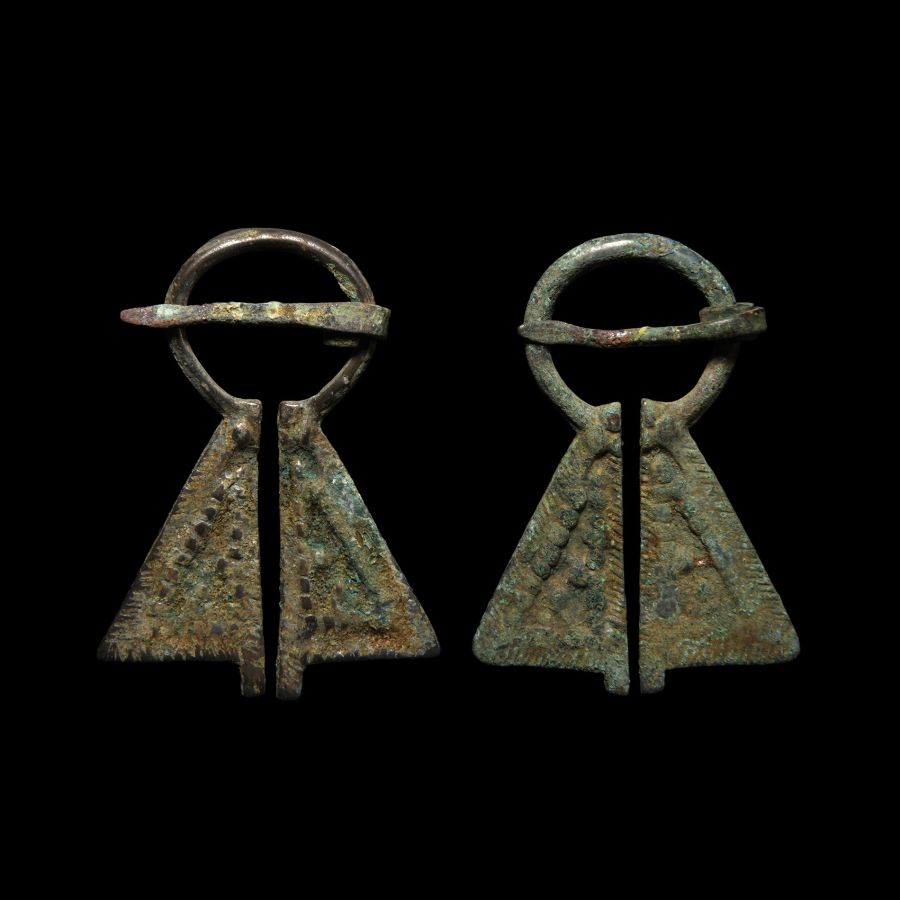
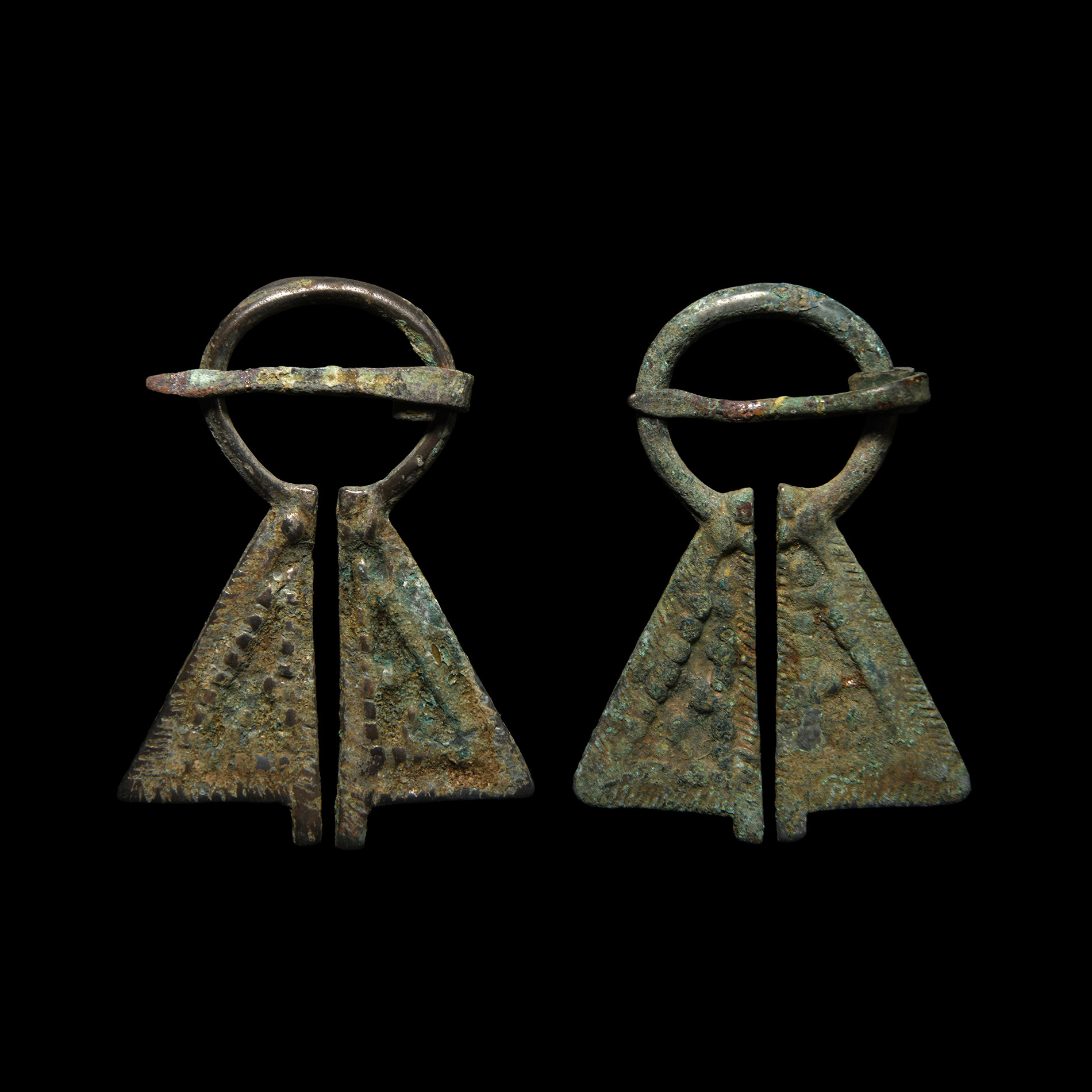
Viking Inspired Decorated Bronze Omega Brooch Group
CIRCA 12TH CENTURY A.D.
2 3/8 in. (30.8 grams total, 60-61 mm).
Comprising a round-section hoop and two trapezoidal plate finials each with a geometric design of granulation; round-section pin coiled to the hoop. [2, No Reserve]
ProvenanceAcquired 1990s-early 2000s.
East Anglian private collection.
Cf. Sedov, V.V., Finno-Ugri i Balti v Epokhy Srednevekoviya, Moscow, 1987, pl.XLIV, item 11.
CONDITIONTimeLine Auctions follows a vetting process to ensure the authenticity and legality of all items, reinforcing our commitment to integrity and responsible trading. Each antiquity, antique, and coin lot undergoes thorough examination by a vetting committee of at least ten external specialists, professional trade association members, scientists, and archaeologists: Our Vetting Process
AUCTIONS:
TimeLine is a leading auction house specialising in antiquities, ancient art, collectables, natural history, coins, medals, and books. Our auctions offer museums, collectors, historians, and enthusiasts the opportunity to acquire unique and historically significant pieces.
-
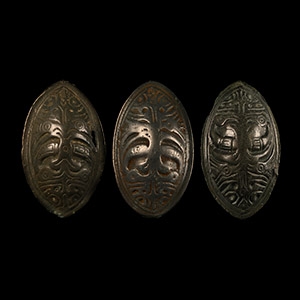
Viking Age Bronze Tortoise-Type Brooch Group
9th-11th century A.D.Estimate: £1,000 - 1,400 (‡+bp*)
Opening Bid: £500
Comprising three shallow-domed plate brooches each with low-relief zoomorphic ornament and a narrow ledged rim; to the reverse, a small catch and T-shaped pin-lug; one with textile remains in situ. 140 grams total, 77-80 mm
From the collection of a North American gentleman, formed in the 1990s. -
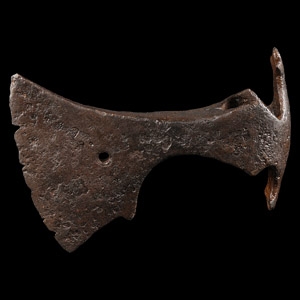
Viking Age Iron Bearded Axehead
9th-11th century A.D.Sold for (Inc. bp): £546
Composed of a convex cutting edge, tapering cheeks with bearded lower edge and an oval-shaped socket with lozengiform flanges and roughly rectangular extensions to the butt, hole inside the blade. 567 grams, 15.5 cm
Acquired 1971-1972. From the collection of the vendor's father. Property of a London, UK, collector.
Iron axeheads of this typology, diffused especially in the regions of the Baltic Sea where they were imported from Scandinavia, show a sub-trapezoidal asymmetrical blade, often perforated through the centre. They are characterised by two projections spurs from the top and the bottom of the back of the shaft-hole. -
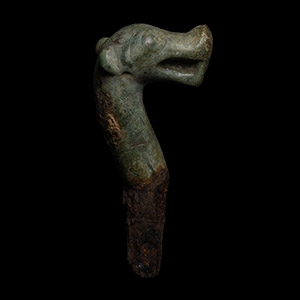
Viking Age Bronze Beast-Head Staff Terminal
9th-11th century A.D.Sold for (Inc. bp): £234
Comprising a hollow socket with iron rod inserted, terminal formed as a beast-head with open jaws, lobed snout, canine teeth prominent, ribbed brow and bulbous eyes, D-shaped ears to the rear. 41.7 grams, 58 mm
Acquired in the 1990s. Ex property of a German collector.
