
Loading, please wait...
_900x900.jpg "Viking Hammer-Shaped Gold Ingot")
_200x200.jpg "Viking Hammer-Shaped Gold Ingot")
.jpg "Viking Hammer-Shaped Gold Ingot")
LOT 1576
Viking Hammer-Shaped Gold Ingot
9TH-12TH CENTURY A.D. OR LATER
3/4 in. (8.25 grams, 22 mm).
D-shaped in section with T-shaped finial and central annulet. [No Reserve]
ProvenanceFrom a collection formed prior to 2000.
From the property of a Cambridgeshire, UK, gentleman.
TimeLine Auctions follows a vetting process to ensure the authenticity and legality of all items, reinforcing our commitment to integrity and responsible trading. Each antiquity, antique, and coin lot undergoes thorough examination by a vetting committee of at least ten external specialists, professional trade association members, scientists, and archaeologists: Our Vetting Process
AUCTIONS:
TimeLine is a leading auction house specialising in antiquities, ancient art, collectables, natural history, coins, medals, and books. Our auctions offer museums, collectors, historians, and enthusiasts the opportunity to acquire unique and historically significant pieces.
-
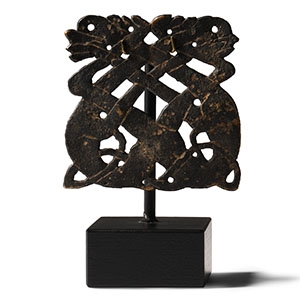
Viking Bronze Openwork Applique
8th-10th century A.D.Sold for (Inc. bp): £878
Flat bronze plaque with openwork detailing of two opposed zoomorphs, their slender bodies enmeshed within a lattice of tails, limbs and lappets; attachment holes at the eyes and rump; the eyes with pointillé surround; supplied with a custom-made stand. 20 grams total, 75 mm including stand
Ex German collection. with Artemis Gallery, Colorado, USA, 8 March 2016, 58A. Private American collection, New York, USA. Accompanied by a copy of a previous typed catalogue page.
The style of the plaque is very heavily influenced by the Irish Book of Kells where confronted, interlaced figures appear as ornament. -
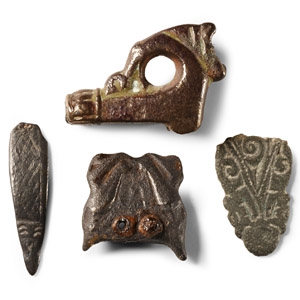
Viking and Saxon Artefact Group
8th-11th century A.D.Sold for (Inc. bp): £59
Including a narrow beast-head strap-end, a military strap-end fragment, a stirrup mount and looped fitting. 49.9 grams total, 26-40 mm
Acquired since the 1970s. From the private collection of a Surrey, UK, gentleman. -
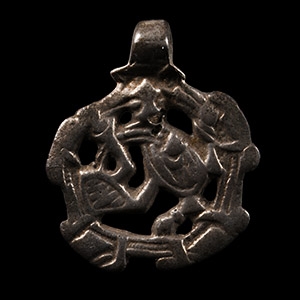
Viking Silver Gripping Beast Pendant
Late 10th-early 11th century A.D.Sold for (Inc. bp): £374
With integral loop; the openwork plaque with banded border and four panels, internal stylised zoomorph with hatched panel to the hip, gripping three-fingered hands to the body and border, two detailed feet, clearly visible facing mask below the loop with pellet eyes. 5.7 grams, 35 mm
From the collection of a North American gentleman, formed in the 1990s.
