
Loading, please wait...
_900x900.jpg "Viking Gilt Gotland-Type Fish Pendant")
_200x200.jpg "Viking Gilt Gotland-Type Fish Pendant")
.jpg "Viking Gilt Gotland-Type Fish Pendant")
LOT 0352
Viking Gilt Gotland-Type Fish Pendant
9TH-10TH CENTURY A.D.
2 3/4 in. (23.2 grams, 72 mm high).
Composed of a tapering, round-section body with flat base and inverted triangular mouth holding a moveable bar, suspended on a ring with twisted wire coils and stamped with small circles repeated on the bar below; the fish body decorated with four panels of low-relief Mammen Style interlacing with remains of gilding; two circular piercings to each side of the body. [No Reserve]
ProvenancePrivate collection formed in Europe in the 1980s.
Ex Westminster collection, central London, UK.
Cf. MacGregor, A. et al., A Summary Catalogue of the Continental Archaeological Collections, Oxford, 1997, item 13.1, for similar.
FootnotesOriginally produced as a necklace element, refashioned at an unspecified point in antiquity into a pendant, possibly as early as the 9th-10th century A.D.
Pendants of this type were worn strung together in groups, the tapering profile allowing them to sit comfortably as a collar below the neck. They were often worn suspended between two zoomorphic brooches. This example has been taken from a necklace and mounted on a suspension ring for use as an amuletic pendant.
TimeLine Auctions follows a vetting process to ensure the authenticity and legality of all items, reinforcing our commitment to integrity and responsible trading. Each antiquity, antique, and coin lot undergoes thorough examination by a vetting committee of at least ten external specialists, professional trade association members, scientists, and archaeologists: Our Vetting Process
AUCTIONS:
TimeLine is a leading auction house specialising in antiquities, ancient art, collectables, natural history, coins, medals, and books. Our auctions offer museums, collectors, historians, and enthusiasts the opportunity to acquire unique and historically significant pieces.
-
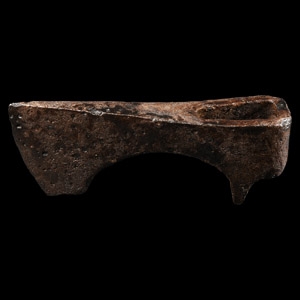
Viking Age Iron Bearded Axehead
11th-13th century A.D.Sold for (Inc. bp): £130
Finno-Ugrian with curved blade, swept rear edge, square chin, socket with downwards flanged sides. 602 grams, 16.5 cm
Acquired 1971-1972. From the collection of the vendor's father. Property of a London, UK, collector.
This type of bearded axe seems to correspond to the category of Eastern Axes inside the Viking axe classification. Usually these bearded axeheads (skeggöks) had a longer edge, designed to split tree trunks into planks and beams. Some of the bearded axes were known as halfÞynna öx; the neck on such 'half thin axe' was thinly forged, to make it lighter. Bearded axes of this type appear also in the weaponry of people from the Baltic. -
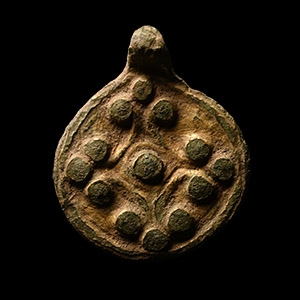
Viking Age Gilt Bronze Pendant with Lobed Cross
9th-11th century A.D.Sold for (Inc. bp): £72
Composed of raised pellets, integral suspension loop. 7.29 grams, 33 mm
From the collection of a North American gentleman, formed in the 1990s. -
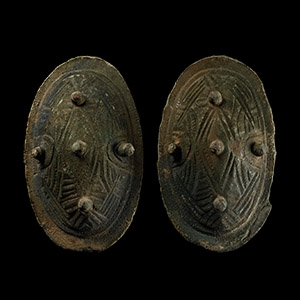
Viking Age Bronze Tortoise Brooch Pair
Circa 10th century A.D.Sold for (Inc. bp): £247
Each composed of a domed ovoid body with chased lozenges and geometric motifs, five projecting studs in cruciform arrangement; remains of pin lug and catchplate to reverse. 141 grams total, 71 mm each
From the collection of a North American gentleman, formed in the 1990s.
These brooches are usually found on the breast of Viking women in grave excavations. Two oval brooches on the upper chest represent the pinafore dress worn by the Viking women, decorated with zoomorphic or geometric ornaments.
