
Loading, please wait...
LOT 1720
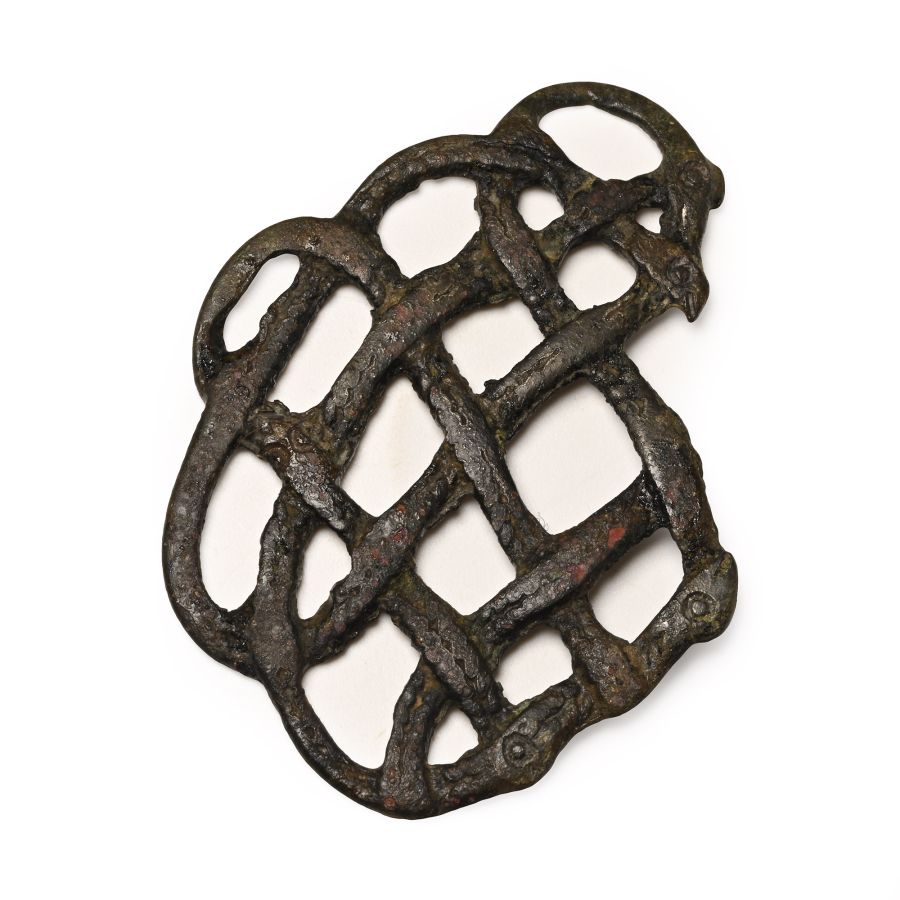
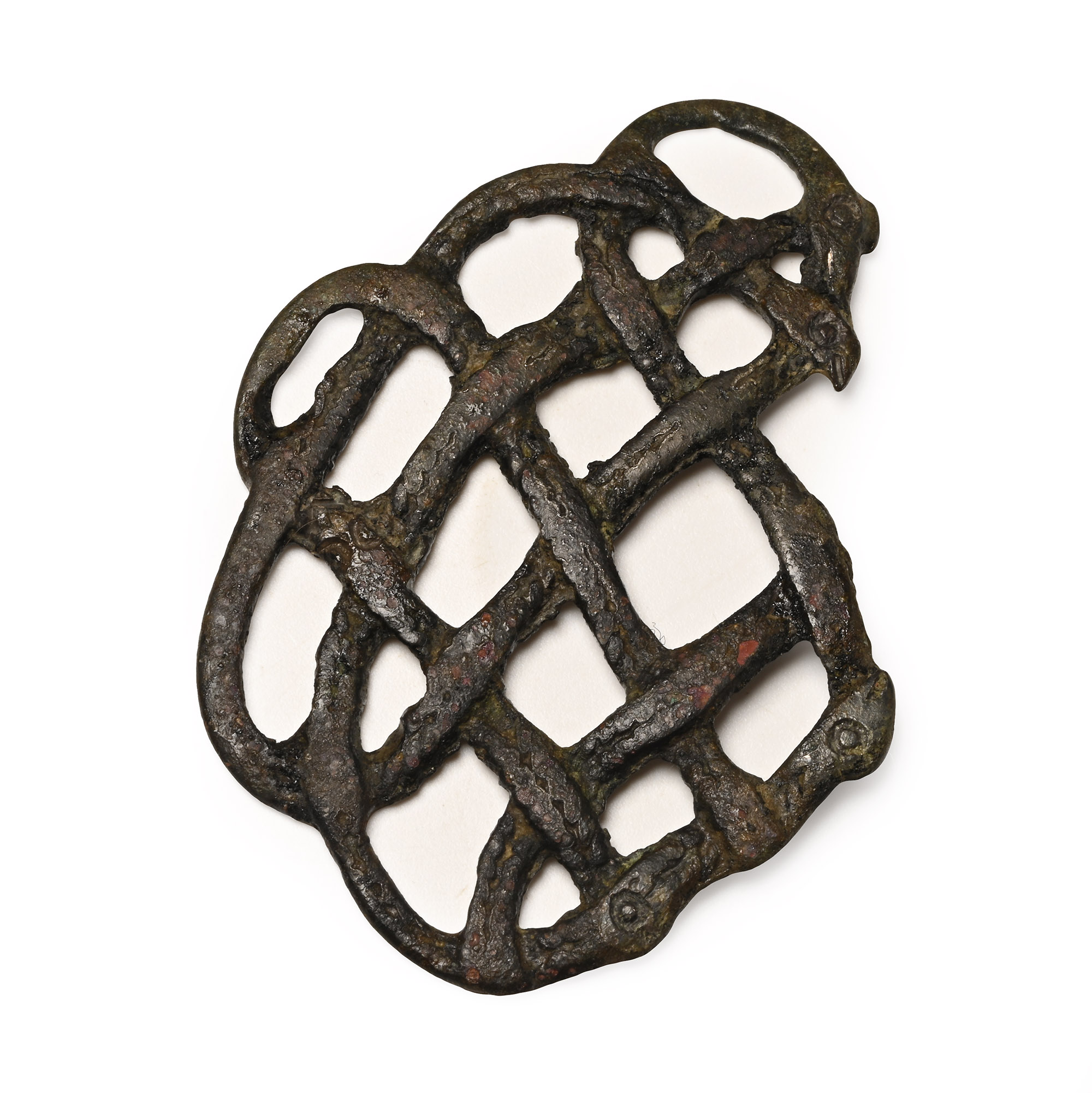
Viking Bronze Urnes Style Sword Scabbard Mount
11TH CENTURY A.D.
1 7/8 in. (7.4 grams, 47 mm).
Ellipsoid in plan with elegantly formed Urnes Style interlaced design, hatched surface texture. [No Reserve]
ProvenanceFrom the private collection of a London gentleman, from his grandfather's collection formed before the early 1970s.
LiteratureCf. Williams, D., Late Saxon Stirrup-Strap Mounts, York, 1997, item 192, for similar treatment of a panel in Urnes Style knotwork.
CONDITIONTimeLine Auctions follows a vetting process to ensure the authenticity and legality of all items, reinforcing our commitment to integrity and responsible trading. Each antiquity, antique, and coin lot undergoes thorough examination by a vetting committee of at least ten external specialists, professional trade association members, scientists, and archaeologists: Our Vetting Process
AUCTIONS:
TimeLine is a leading auction house specialising in antiquities, ancient art, collectables, natural history, coins, medals, and books. Our auctions offer museums, collectors, historians, and enthusiasts the opportunity to acquire unique and historically significant pieces.
-

Viking Age Bronze Fire Steel with Figure and Animals
8th-10th century A.D.Estimate: £400 - 600 (+bp*)
Opening Bid: £160
With openwork bifacial handle depicting central standing figure with arms outstretched towards the necks of two flanking rampant beasts; iron blade beneath; Finno-Ugric type. 58 grams, 60 mm
From the private collection of a London gentleman, from his grandfather's collection formed before the early 1970s. This lot is accompanied by an illustrated lot declaration signed by the Head of the Antiquities Department, Dr Raffaele D'Amato. -
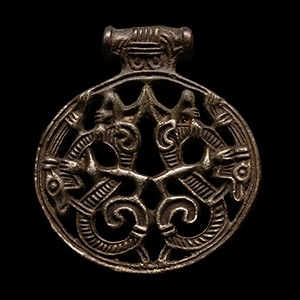
Viking Age Silver Gripping Beasts Pendant
10th century A.D.Estimate: £2,000 - 3,000 (‡+bp*)
Opening Bid: £1,000
Composed of an openwork discoid body with integral T-shaped tubular loop; raised gusseted rim enclosing a pair of S-shaped beasts with billetted bodies and comma-shaped tails, enmeshed gripping paws clutching the rim and their own bodies. 12.4 grams, 43 mm
Acquired on the European art market in the 1990s. Ex property of a German gentleman.
Despite the long period of overlap of Borre and Jellinge art styles, there are only a few examples of their fusion. The principal and most popular motif of the Borre style displays an animal with gripping paws, usually enmeshed in a circular frame, while a typical Jellinge style beast is more slender with a long, S-shaped body and ribbon decoration. The most famous example of a pendant featuring a fusion of these styles was found in a hoard from Vårby (Sweden), formed as a circle with a pair of Jellinge-style beasts with ribbon-shaped bodies in profile and heads with open jaws and extended tongues; however, each is provided with gripping paws and an enmeshed body, which are typical features of the Borre style. A few examples of these pendants were also found near the important trading settlement of Gnezdovo, near Smolensk, Russia. -

Viking Age Bronze Sword Scabbard Chape Collection
10th-11th century A.D.Sold for (Inc. bp): £715
Comprising: a long and narrow tongue-shaped type (Paulsen's Gruppe V 2A, Untergruppe C) with scooped upper edge and palmette motif to the centre, spurs to the a vertical band of reserved stylised ring-chain decoration on a pounced field, long lateral straps and a knop finial; a heater-shaped type (Paulsen's Gruppe I 2, Untergruppe C) with central openwork panel displaying a bird in flight with the fan-shaped tail marked with radiating lines, guilloche bands to the outer sides, upper edges angled and with lobe at the apex; an elongated type (Gruppe V 1) with low-relief pointillé bands to each face and a palmette at the apex of the central spur; a long tongue-shaped type (Paulsen's Gruppe I 1) with an openwork centre and Ringerike Style bird formed with looped bands, pellets to the pinions, a triangular in plan head joined to the inner faces of the ropework border forming the upper edge of the chape, with a wolf's head at the apex and stepped knop finial; a single plaque (Gruppe V 1) from a two-part chape, long and rounded with palmate detailing to the upper edge, tendrils and scrolls to the body, pierced in two places to accept rivets. 178 grams total, 51-70 mm
From the collection of a North American gentleman, formed in the 1990s.
Most of these chapes originate in Sweden or the western Baltic according to Paulsen's classification.
