
Loading, please wait...
LOT 1408
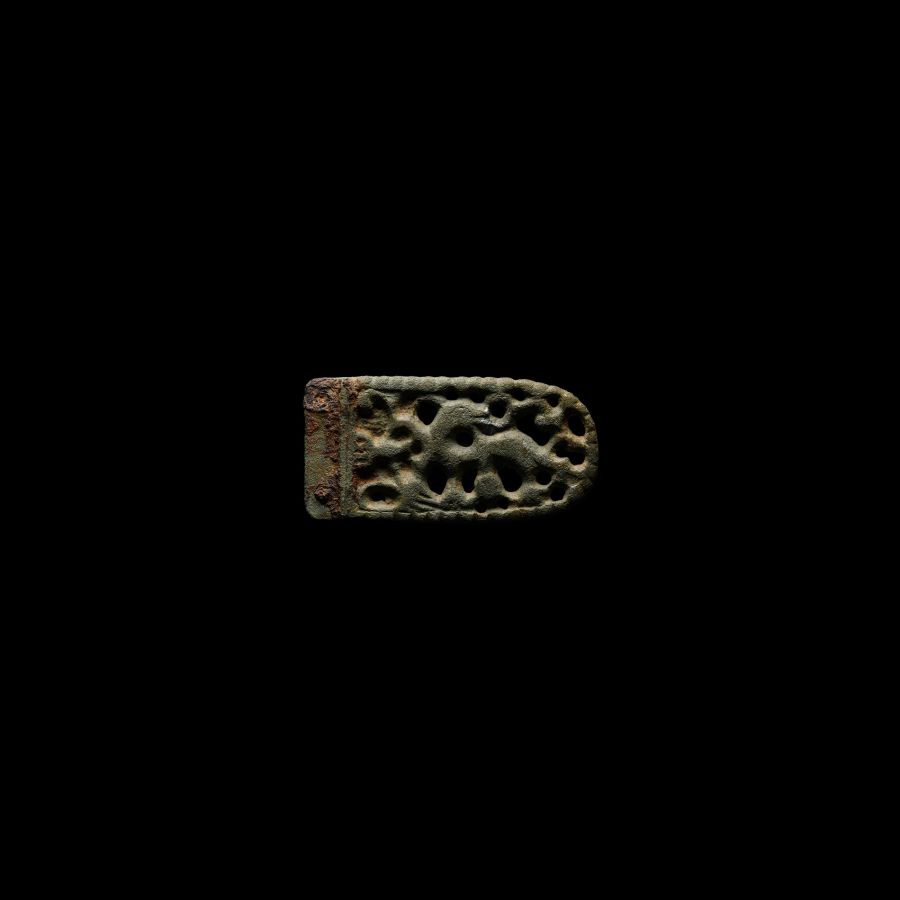
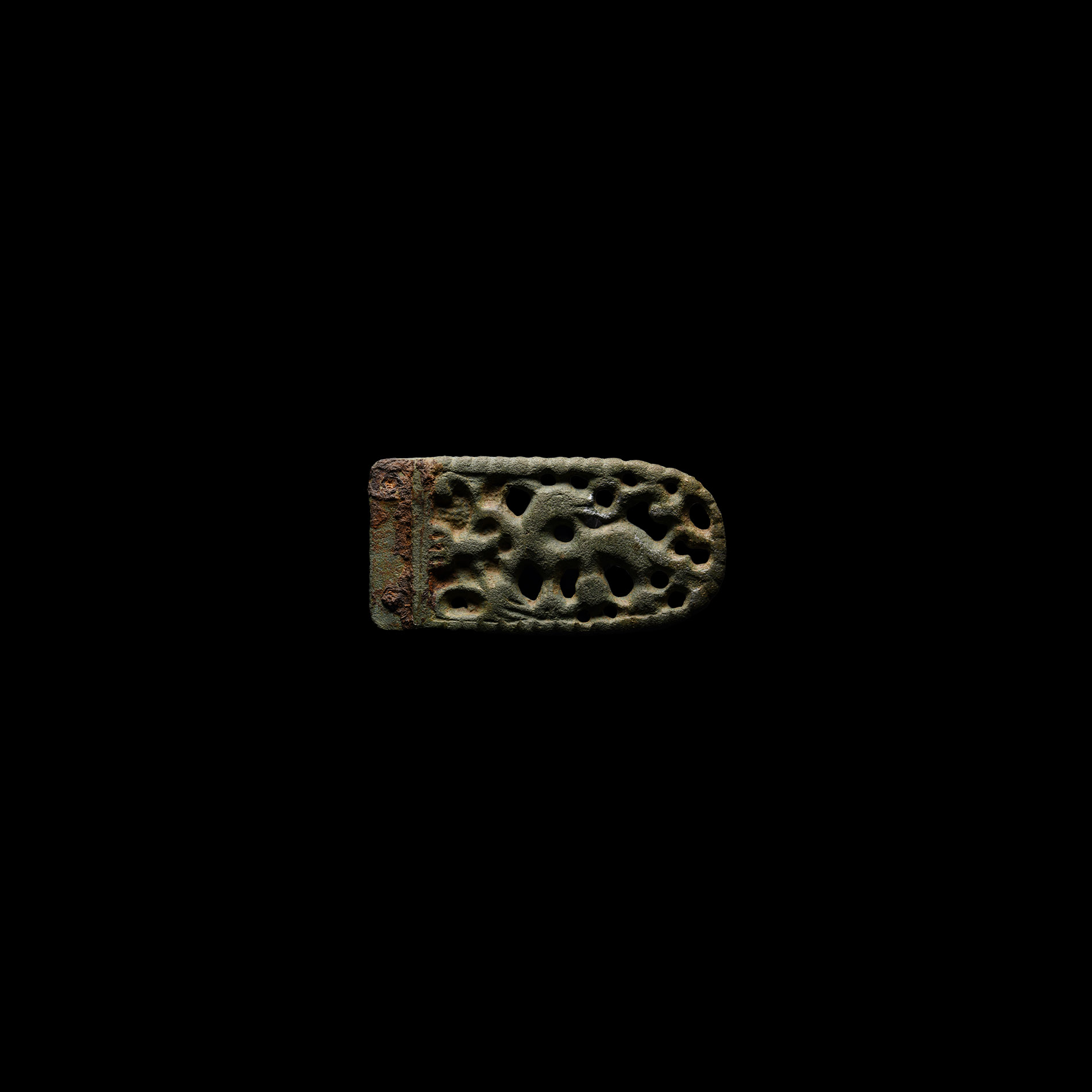
Viking Bronze Strap End with Beast Facing Back
9TH-10TH CENTURY A.D.
2 in. (16 grams, 52 mm).
Tongue-shaped with pelletted border enclosing an openwork mesh of tendrils and advancing beast with head reversed; flat attachment panel with ferrous remains of two rivets.
ProvenanceFound whilst searching with a metal detector on 10th February 2019 in Brigstock, East Northamptonshire, UK, by Scott Marshman.
Accompanied by a copy of the British Museum's Portable Antiquities Scheme (PAS) report no.BH-56D411.
British Museum's Portable Antiquities Scheme (PAS) report no.BH-56D411.
LiteratureSee Thomas, G., Late Anglo-Saxon and Viking Age Strap-Ends 750-1100: Part 2, Finds Research Group datasheet 33, Sleaford, 2007.
CONDITIONTimeLine Auctions follows a vetting process to ensure the authenticity and legality of all items, reinforcing our commitment to integrity and responsible trading. Each antiquity, antique, and coin lot undergoes thorough examination by a vetting committee of at least ten external specialists, professional trade association members, scientists, and archaeologists: Our Vetting Process
AUCTIONS:
TimeLine is a leading auction house specialising in antiquities, ancient art, collectables, natural history, coins, medals, and books. Our auctions offer museums, collectors, historians, and enthusiasts the opportunity to acquire unique and historically significant pieces.
-
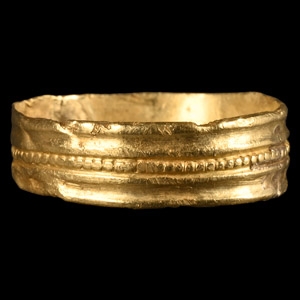
Viking Decorated Gold Ring
8th-10th century A.D.Sold for (Inc. bp): £494
With medial band of pellets between shallow channels. 1.64 grams, 17.62 mm overall, 16.17 mm internal diameter (approximate size British J 1/2, USA 5, Europe 9.32, Japan 9)
From the collection of a North American gentleman, formed in the 1990s. -
.jpg)
Viking Gilt Gotland-Type Fish Pendant
9th-10th century A.D.Sold for (Inc. bp): £494
Composed of a tapering, round-section body with flat base and inverted triangular mouth holding a moveable bar, suspended on a ring with twisted wire coils and stamped with small circles repeated on the bar below; the fish body decorated with four panels of low-relief Mammen Style interlacing with remains of gilding; two circular piercings to each side of the body. 23.2 grams, 72 mm high
Fine condition.
Private collection formed in Europe in the 1980s. Ex Westminster collection, central London, UK.
Originally produced as a necklace element, refashioned at an unspecified point in antiquity into a pendant, possibly as early as the 9th-10th century A.D. Pendants of this type were worn strung together in groups, the tapering profile allowing them to sit comfortably as a collar below the neck. They were often worn suspended between two zoomorphic brooches. This example has been taken from a necklace and mounted on a suspension ring for use as an amuletic pendant. -
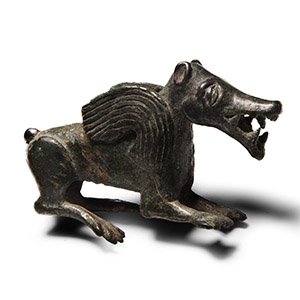
Viking Age 'Great Beast' Weather Vane Terminal
11th century A.D.Sold for (Inc. bp): £2,340
Formed as a crouching beast modelled in the round with hollow slot to the underside; elongated head with raised lentoid eyes and ellipsoid ears, ribbed wings to the shoulders, knop tail and splayed claws to the feet; mouth open with detailed fangs. 84.9 grams, 66 mm
From the collection of a North American gentleman, formed in the 1990s. This lot has been checked against the Interpol Database of stolen works of art and is accompanied by search certificate no. 200289.
The navigation techniques in use in Iron Age Northern Europe were very sophisticated, as would be expected from people bordering the Baltic, North Sea and North Atlantic where boat- and ship-building traditions have been perfected over more than a thousand years. A carved wooden panel from Bergen, Norway, shows a number of Viking longships at sea, some with weathervanes mounted on the stempost. They are mounted vertically with the beast on the outer end. Gilded bronze weathervanes appear on the roofs of medieval churches in Sweden, Norway and Finland where they are often regarded as ornamental: symbols of access to resources and craftsmanship for the important families who endowed such buildings. These weathervanes in many cases originally adorned ships and were used as part of the navigational equipment. They may have inspired the medieval Norman custom of attaching a gilded weathervane or cock to church roofs, which eventually spread to secular buildings such as castles in France and Italy where their use was restricted to certain ranks of nobility (Lindgrén, 1983).
