
Loading, please wait...
LOT 1683
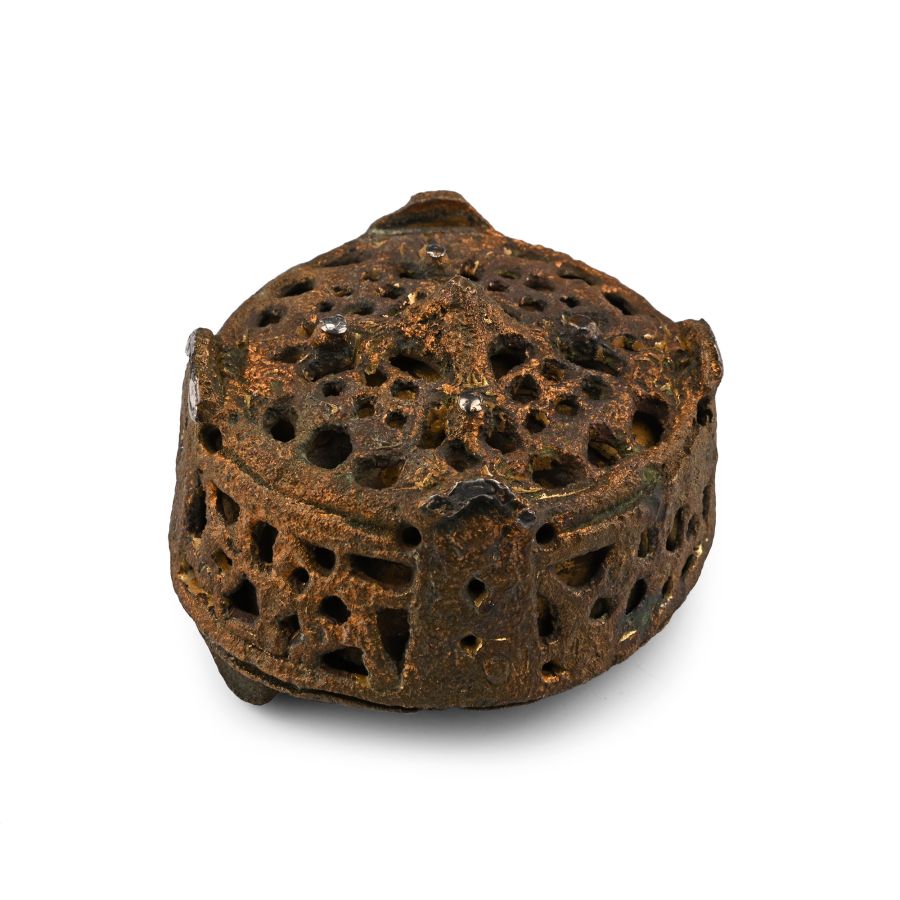
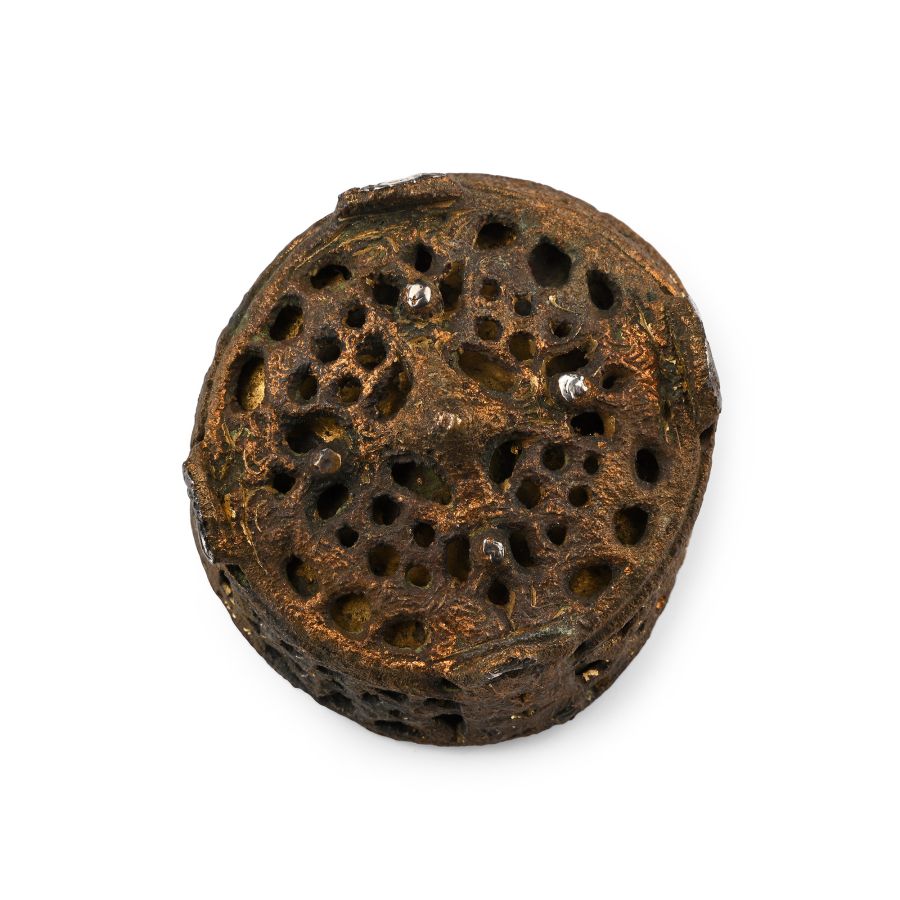
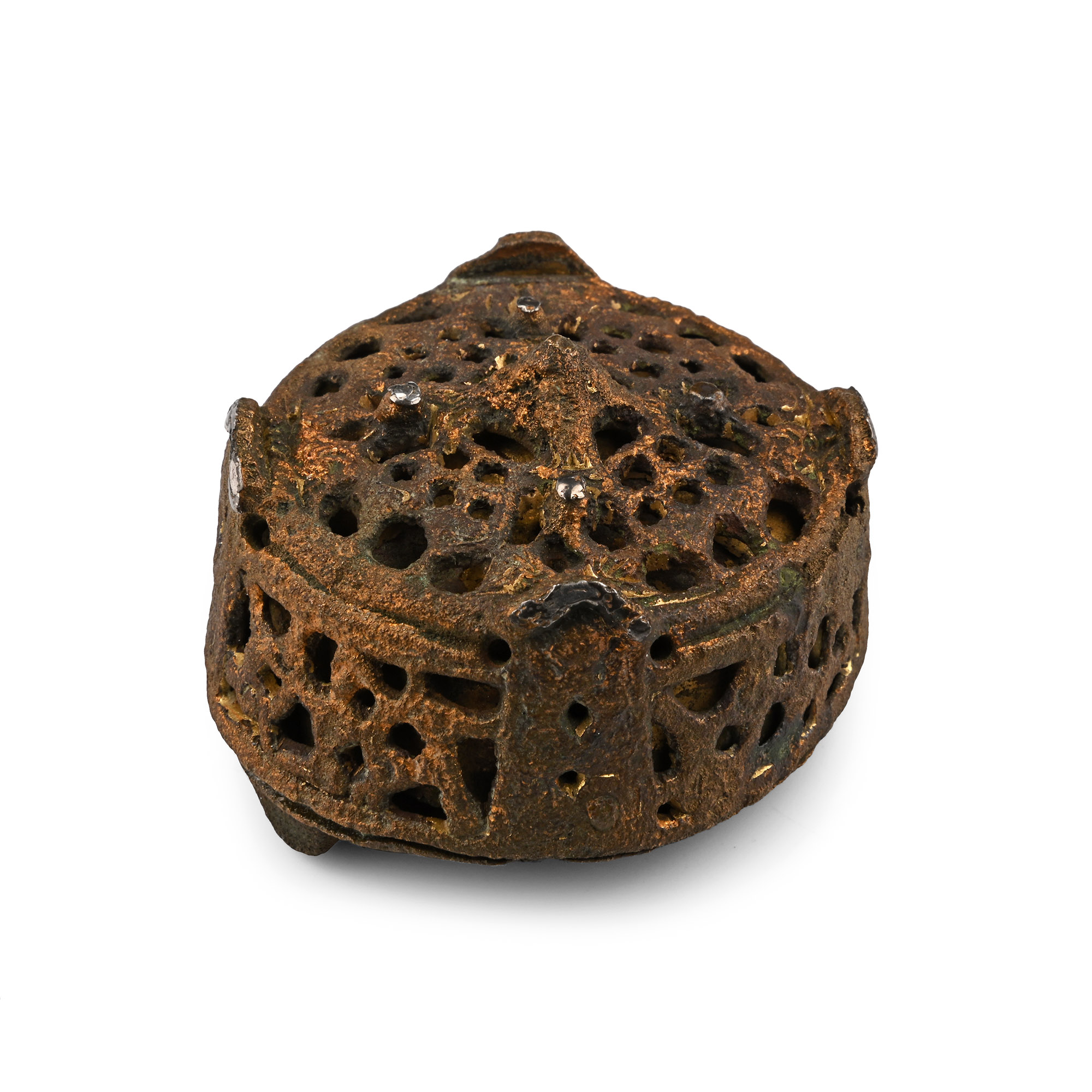
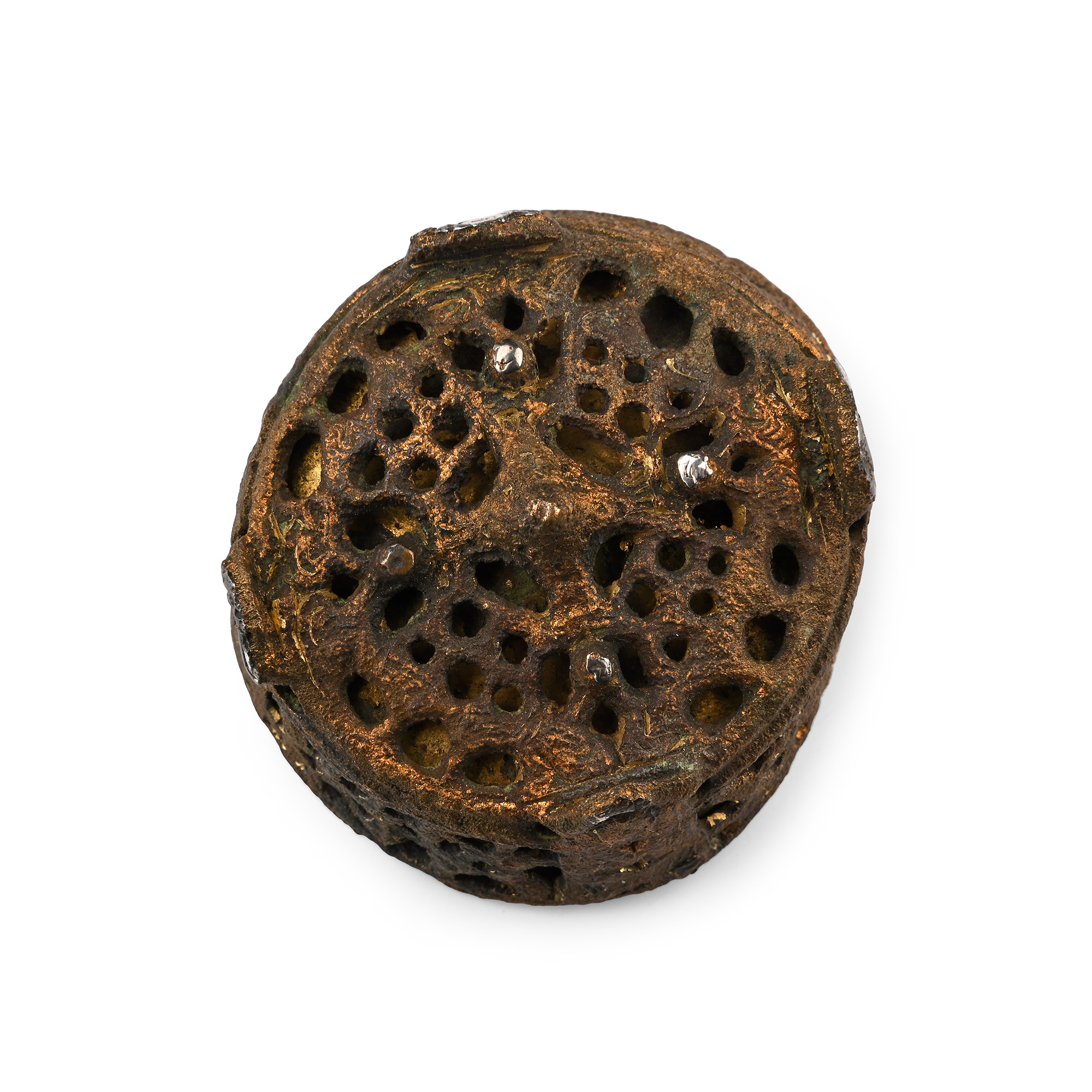
Viking Bronze Openwork Box Brooch with Silver Detailing
11TH CENTURY A.D.
2 1/8 in. (95 grams, 55 mm).
Formed as an openwork outer shell, inner container and bottom plate; the upper face with central conical boss and four small satellite bosses each with a silver surface disc; to the outer face four pierced tongue-shaped panels with D-shaped finials proud of the upper face, each with a silvered element to the upper end; the bottom plate with integral catchplate and central void, four attachment pins to the underside; the upper face and sidewall executed in Urnes style zoomorphic openwork; the inner element a plain sheet-bronze container.
ProvenanceAcquired in the 1950s.
Ex private collection, South West England.
Exhibited at the Harwich Museum, Harwich, Essex, UK, 27th August-10th December 2025; accompanied by a copy of a photograph of the artefacts on display.
LiteratureCf. MacGregor, A. et al., A Summary Catalogue of the Continental Archaeological Collections, Oxford, 1997, items 1.8,9, for type.
FootnotesOn the Baltic island of Gotland, high-ranking females wore 'box' (or 'drum') brooches to secure their outer garments at the shoulders. The inner container may have been used to hold small valuables.
CONDITIONTimeLine Auctions follows a vetting process to ensure the authenticity and legality of all items, reinforcing our commitment to integrity and responsible trading. Each antiquity, antique, and coin lot undergoes thorough examination by a vetting committee of at least ten external specialists, professional trade association members, scientists, and archaeologists: Our Vetting Process
AUCTIONS:
TimeLine is a leading auction house specialising in antiquities, ancient art, collectables, natural history, coins, medals, and books. Our auctions offer museums, collectors, historians, and enthusiasts the opportunity to acquire unique and historically significant pieces.
LOT 1683
Viking Bronze Openwork Box Brooch with Silver Detailing
Estimate £600 - 800€700 - 930 (for guidance only)$810 - 1,080 (for guidance only)
-
Pre-Viking Silver Filigree Aroma Bucket Pendant
Circa 4th-7th century A.D.Sold for (Inc. bp): £312
Miniature drum-shaped vessel with strap handle, extensive filigree decoration on the body. 2.77 grams, 21 mm
Private collection formed in Europe in the 1980s. Westminster collection, central London, UK.
Pendants in the form of miniature buckets have been found in a number of pagan Anglo-Saxon and Viking contexts and are generally made of bronze or iron, with gold examples being rare; three gold examples were found with the hoard from Hoen, Norway. Bronze bucket amulets have been found at Driffield in Yorkshire, and Vimose bog in Denmark, among other places. In form they represent wooden buckets bound with bronze or iron bands which have been found in Anglo-Saxon and Viking graves and are believed to have held mead or ale and were used to replenish the cups from which warriors drank. As amulets they probably represent the ecstatic power of alcoholic drink and the role of women as the dispensers of these precious beverages. -
.jpg)
Very Large Anglo-Scandinavian Viking Bronze Horse Harness Link
11th century A.D.Sold for (Inc. bp): £3,380
Lozengiform in plan with pierced bulb to opposed angles, one with ring in situ; obverse with reserved rim, beast in profile with bent forelegs and gaping jaws, tail curled above the back, attacking a serpentine creature with segmented body and three-toed claws. 81 grams, 10.8 cm
Found Lincolshire, UK. This lot has been checked against the Interpol Database of stolen works of art and is accompanied by search certificate number no.12988-242245.
Openwork rhombic mounts were found in various Scandinavian places. One was found, for example, in a sunken hut at Sebbersund in Northern Jutland, and dated to the passage of 10th-11th century A.D. An openwork mount depicting a four-legged animal from Lund was excavated from a pit in a cultural deposit with dendro-chronological dates between 1060-1070. -
Anglo-Scandinavian Viking Bronze Stirrup Apex Mount with Beasts
10th-11th century A.D.Sold for (Inc. bp): £1,040
Broad and shallow with narrow pierced ledge to reverse, Williams's Class B; openwork scene of two quadrupeds addorsed with legs resting on the outer edge of the frame and heads turned towards the median column; three loops to the curved upper edge. 35.2 grams, 52 mm
Found Spalding, Lincolnshire, UK.
This exact from does not appear in Williams's study, although examples with addorsed animals do appear in the 'Unclassified' section (p.102-4). The general shape and proportions are consistent with his Class B examples.
