
Loading, please wait...
LOT 0383
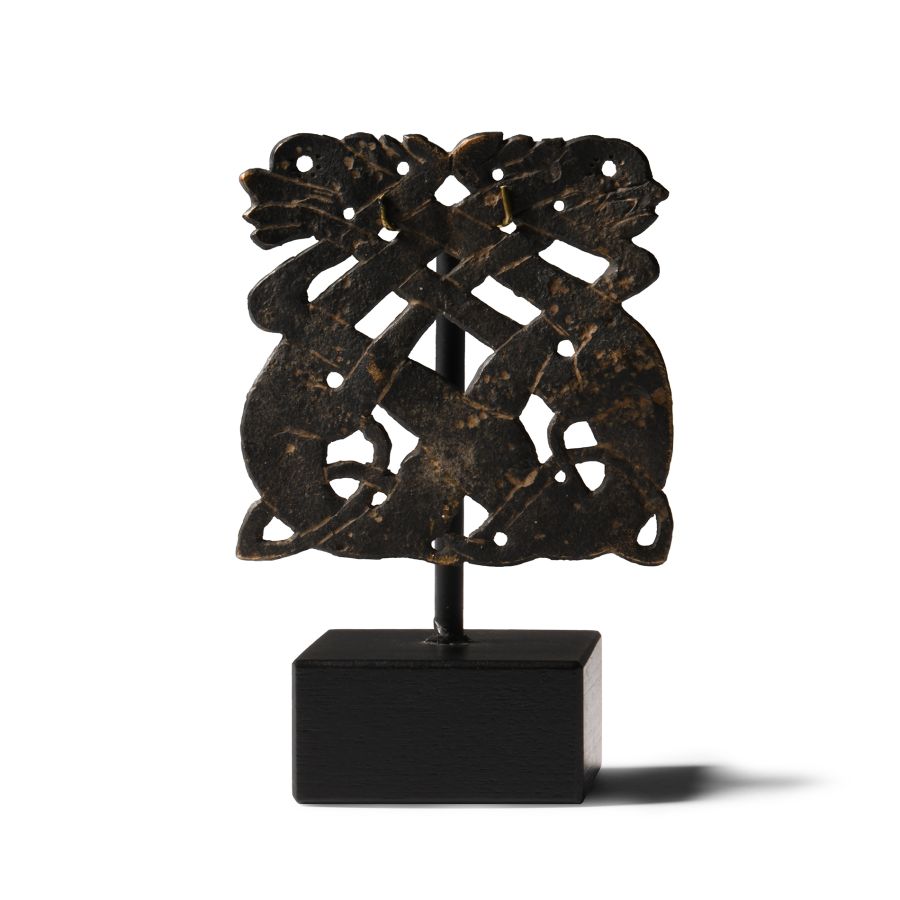
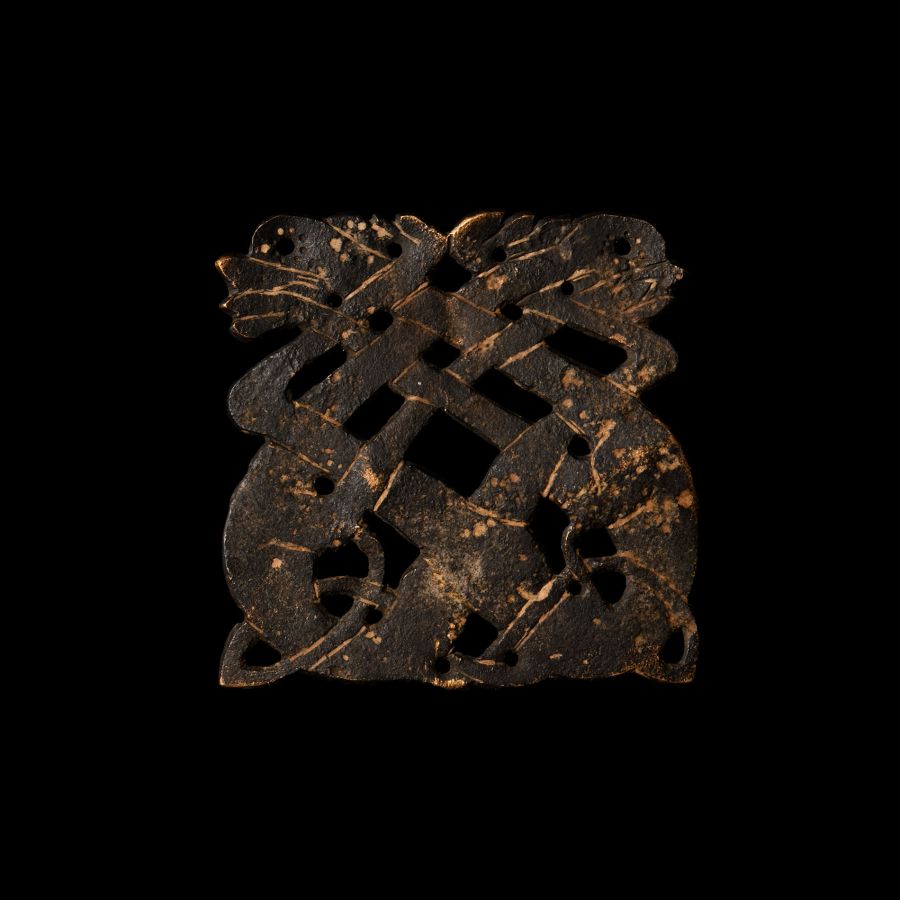
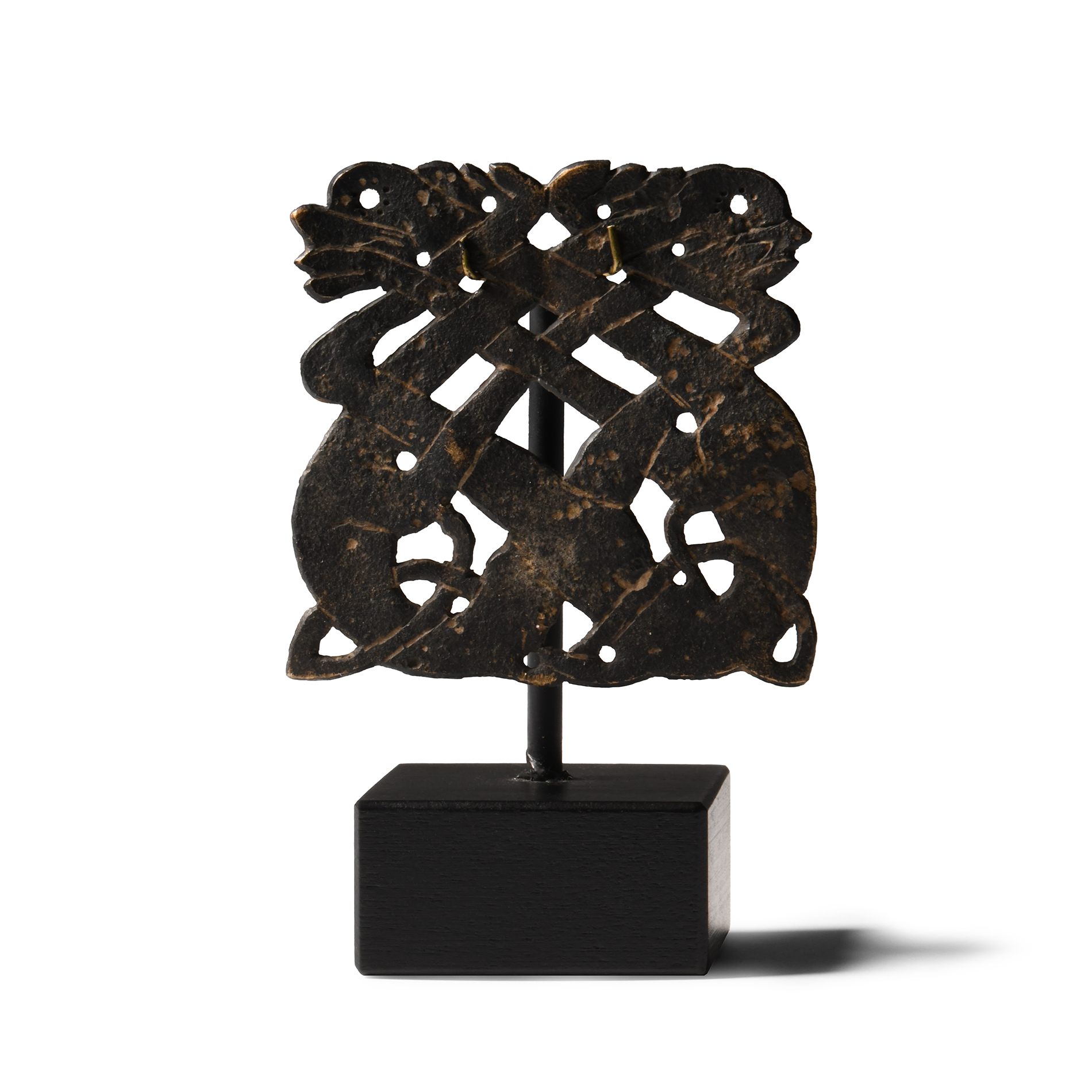
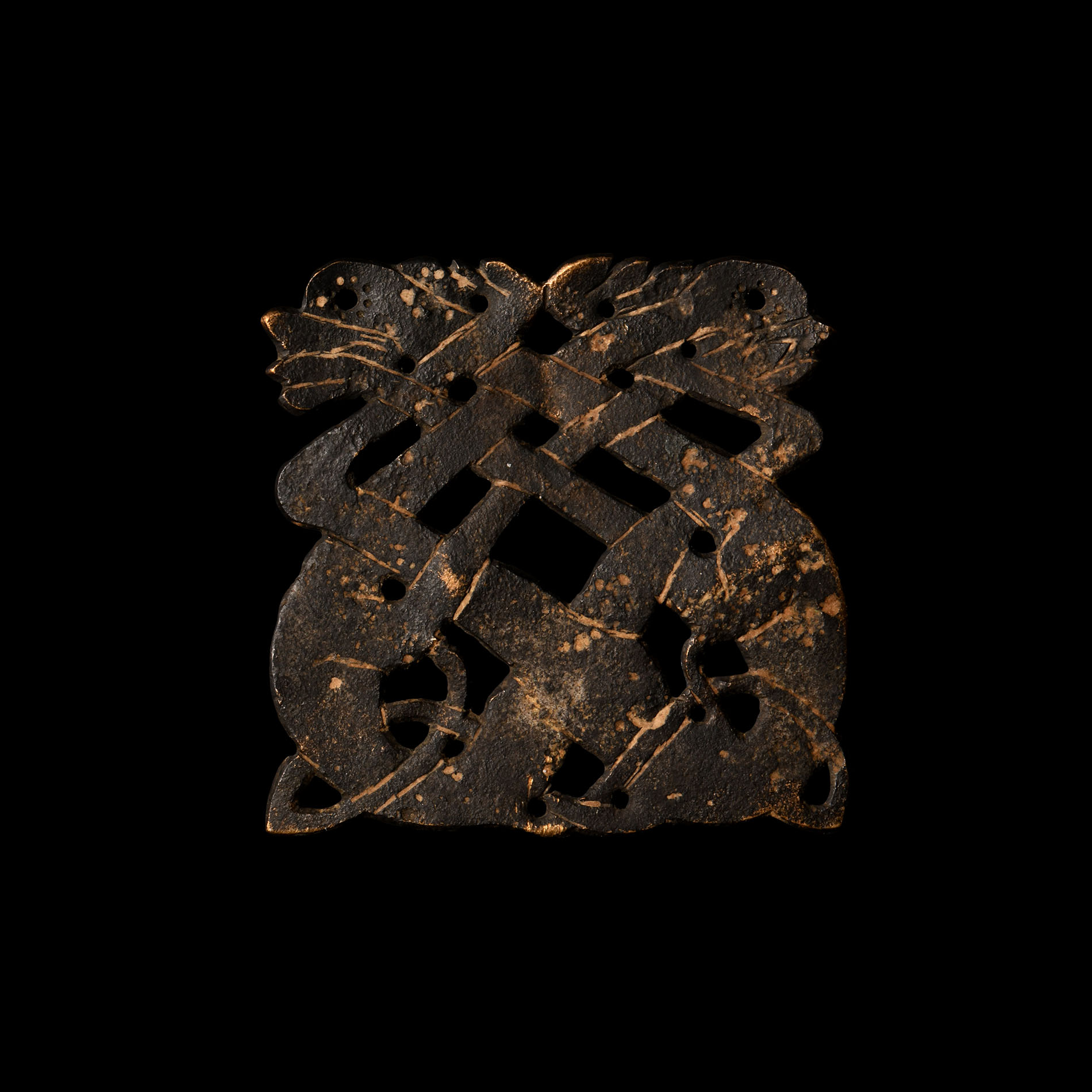
Viking Bronze Openwork Applique
8TH-10TH CENTURY A.D.
3 in. (20 grams total, 75 mm including stand).
Flat bronze plaque with openwork detailing of two opposed zoomorphs, their slender bodies enmeshed within a lattice of tails, limbs and lappets; attachment holes at the eyes and rump; the eyes with pointillé surround; supplied with a custom-made stand.
ProvenanceEx German collection.
with Artemis Gallery, Colorado, USA, 8 March 2016, 58A.
Private American collection, New York, USA.
Accompanied by a copy of a previous typed catalogue page.
The style of the plaque is very heavily influenced by the Irish Book of Kells where confronted, interlaced figures appear as ornament.
CONDITIONTimeLine Auctions follows a vetting process to ensure the authenticity and legality of all items, reinforcing our commitment to integrity and responsible trading. Each antiquity, antique, and coin lot undergoes thorough examination by a vetting committee of at least ten external specialists, professional trade association members, scientists, and archaeologists: Our Vetting Process
AUCTIONS:
TimeLine is a leading auction house specialising in antiquities, ancient art, collectables, natural history, coins, medals, and books. Our auctions offer museums, collectors, historians, and enthusiasts the opportunity to acquire unique and historically significant pieces.
-
.jpg)
Viking Silver-Gilt Bronze Boar's Head Brooch
Circa 9th-11th century A.D.Sold for (Inc. bp): £3,575
Richly decorated and with an applied backplate; the body of the brooch formed as a hollow-cast case with upstanding ears and a slightly 'clubbed' end to the muzzle with a narrow median raised band separating the face into two panels; both those and the upper panel (between the 'ears') decorated with interlaced ornament in low relief depicting serpents locked in combat, their bodies dramatically entwined; on the rear panel four 'lower arm and hand' motifs, radiating from a central lozenge with pellet; rectangular guilloche to the lower borders, muzzle-band, rear panel and median upper band; Jellinge Style scrollwork to the outer and upper faces of the conical 'ears'; a hinged pin to the underside with curved shield, applied plate to the underside with two bands of punched lozenge decoration. 141 grams, 66 mm
Private collection, New York, USA. with Artemis Gallery, Colorado, USA, 15 February 2018, no.58. Private American collection, New York, USA. This lot has been checked against the Interpol Database of stolen works of art and is accompanied by search certificate no.12073-211003.
Box-shaped hollow animal-head brooches were created on the island of Gotland, Sweden, although they have been found in other parts of the Viking world. They were made to be worn in pairs high on the chest of women's 'hangerok' apron-dresses with chains and swags of beads suspended between them. They are found in women's burials alongside utility items such as a knife or tweezers, and formed part of the costume of females from prosperous families. This example shows exceptionally fine decoration and would have been a treasured item, denoting the wealth and status of the family of the woman who wore it. -
Viking White Metal Filigree Crucifix Pendant
8th-12th century ADEstimate: £1,200 - 1,700 (+bp*)
Opening Bid: £600
Depicting Christ bound by his wrists to the cross, wearing trousers; granulation to the body indicates a patterned shirt; beaded border around the perimeter of the cross; this lot bears close parallels with the ‘Birka Crucifix’ held by the Swedish History Museum but is not made from silver. 9.32 grams, 31 mm
Very fine condition, some wear. Rare.
Acquired on the London art market in the 2000s.
The Birka Crucifix pendant, unearthed from Birka grave 660 in Uppland, Sweden, is thought to be the oldest representation of Christ in the Nordic world and bears many similarities to this lot. The Swedish History Museum’s example was excavated from the grave of a wealthy female Christian convert; it is a filigree figure of Christ bound to the cross by his wrists, wearing trousers; this lot is a lower-relief white metal filigree crucifix with integral suspension loop, featuring a representation of head and face executed in the same shape and style as that of the Birka Crucifix figure. -
Pre Viking Scandinavian Silver Aroma Bucket Pendant with garnets
Circa 4th-7th century A.D.Sold for (Inc. bp): £546
With braided wire handle, applied wire bands to the rim, granulation to the sidewall and base, five cells each set with a cabochon garnet. 3.02 grams, 19 mm
Private collection formed in Europe in the 1980s. Westminster collection, central London, UK.
Pendants in the form of miniature buckets have been found in a number of pagan Anglo-Saxon and Viking contexts and are generally made of bronze or iron, with gold examples being rare; three gold examples were found with the hoard from Hoen, Norway. Bronze bucket amulets have been found at Driffield in Yorkshire, and Vimose bog in Denmark, among other places. In form they represent wooden buckets bound with bronze or iron bands which have been found in Anglo-Saxon and Viking graves and are believed to have held mead or ale and were used to replenish the cups from which warriors drank. As amulets they probably represent the ecstatic power of alcoholic drink and the role of women as the dispensers of these precious beverages.
