
Loading, please wait...
LOT 0355
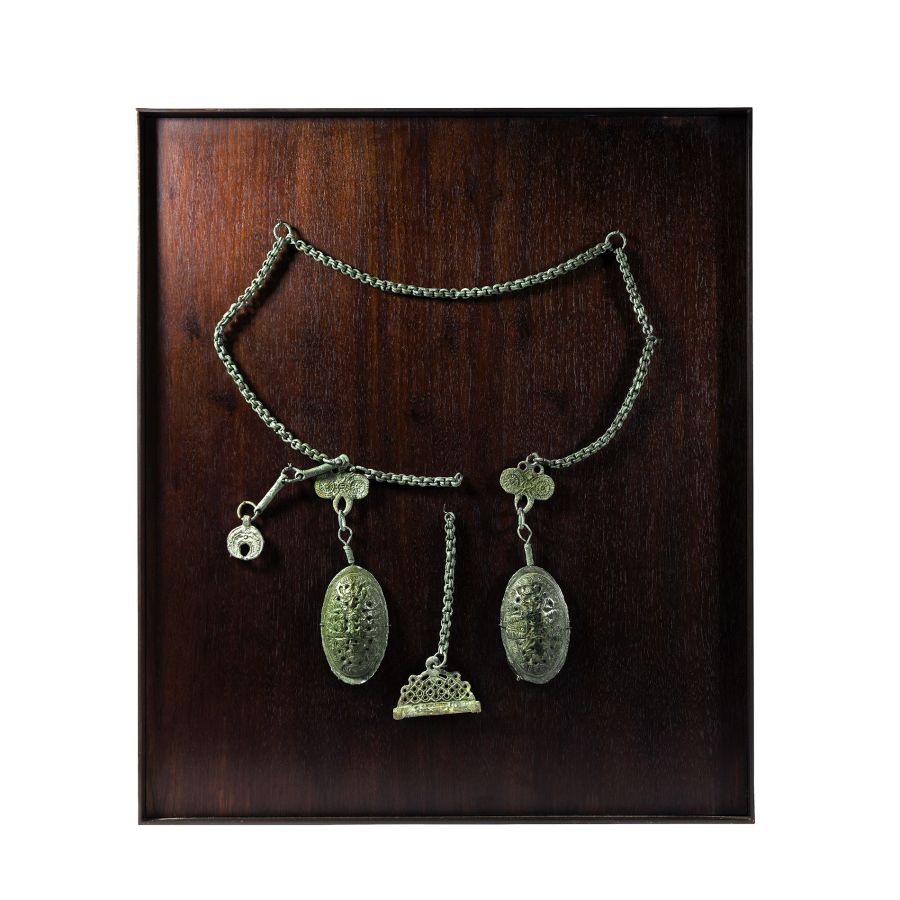
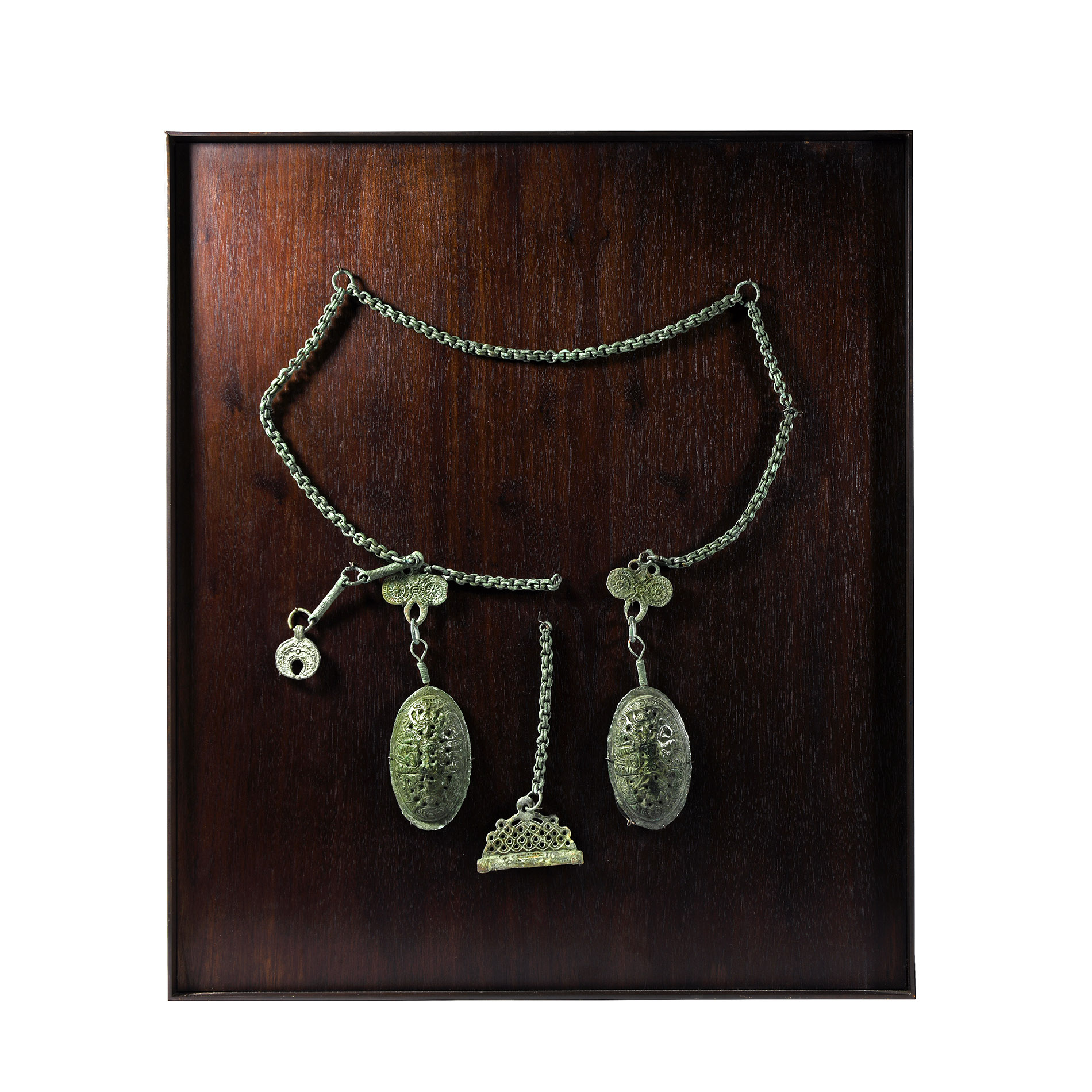
Viking Bronze Borre Style Tortoise Brooch Set with Pendants
10TH-11TH CENTURY A.D.
21 3/4 x 18 3/4 in. (6.75 kg total, 55 x 47.5 cm including display frame).
Composed of a pair of brooches with pin to the reverse; attached to each brooch is a double rosette spacer with chain extending to other tortoise brooch; from the other rosette spacer hang two more chains, one with a needle case with openwork scroll pattern above, and one with a decorated lunate pendant; mounted on a large high-quality custom-made display stand by Colin Bowles Limited.
ProvenanceProperty of a professional collector; acquired before 1990.
Ex London collection since 2016.
Accompanied by an academic report by Dr Raffaele D’Amato.
This lot has been checked against the Interpol Database of stolen works of art and is accompanied by search certificate number no.11736-201216.
For similar oval brooches see Arbman, H., Birka I: Die Gräber, Uppsala, 1940, pls.58ff. and in particular 62-63, 67; see also Graham-Campbell, J. & Kidd, D., The Vikings, London, 1980, figs.52-53, for similar brooches from Norway; Roesdahl, E., Wilson D.M., From Viking to Crusader: The Scandinavians and Europe 800 to 1200 (22nd Council of Europe Exhibition), Copenhagen, 1992, p.69, pp.75, 89, for similar specimens; Berthelot, S., Musin, A., Russie Viking, vers une autre Normandie? Novgorod et la Russie du Nord, des migrations scandinaves á la fin due Moyen Age (VIIIe-Xve s.), Paris, 2011, pp.90-91.
FootnotesThe most characteristic items of Viking women's jewellery are oval brooch pairs, sometimes called tortoise brooches due to their shape, found in many Viking Age female graves. As in this example, the tortoise brooches themselves were sometimes chained together. These chains suspended from the pair of brooches also supported utilitarian objects such as tweezers, ear spoon, scissors and a small knife, as well as amulets. Sometimes the brooches suspended strands of beads of glass, silver, amber or jet.
CONDITIONTimeLine Auctions follows a vetting process to ensure the authenticity and legality of all items, reinforcing our commitment to integrity and responsible trading. Each antiquity, antique, and coin lot undergoes thorough examination by a vetting committee of at least ten external specialists, professional trade association members, scientists, and archaeologists: Our Vetting Process
AUCTIONS:
TimeLine is a leading auction house specialising in antiquities, ancient art, collectables, natural history, coins, medals, and books. Our auctions offer museums, collectors, historians, and enthusiasts the opportunity to acquire unique and historically significant pieces.
LOT 0355
Viking Bronze Borre Style Tortoise Brooch Set with Pendants
Estimate £2,000 - 3,000€2,320 - 3,480 (for guidance only)$2,700 - 4,050 (for guidance only)
-
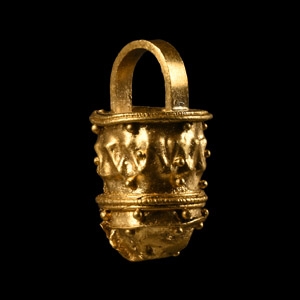
Pre-Viking Gold Filigree Aroma Bucket Pendant
4th-7th century A.D.Sold for (Inc. bp): £410
Adorned with repoussé chevrons and applied granules; replaced loop. 1.17 grams, 15 mm
From the collection of a North American gentleman, formed in the 1990s.
Pendants in the form of miniature buckets have been found in a number of pagan Anglo-Saxon and Viking contexts and are generally made of bronze or iron, with gold examples being rare; three gold examples were found with the hoard from Hoen, Norway. Bronze bucket amulets have been found at Driffield in Yorkshire, and Vimose bog in Denmark, among other places. In form they represent wooden buckets bound with bronze or iron bands which have been found in Anglo-Saxon and Viking graves and are believed to have held mead or ale and were used to replenish the cups from which warriors drank. As amulets they probably represent the ecstatic power of alcoholic drink and the role of women as the dispensers of these precious beverages. -
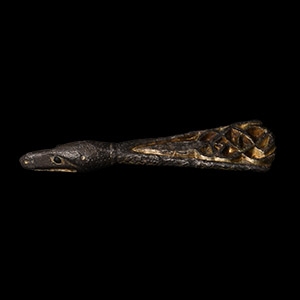
Viking Age Silver-Gilt Zoomorphic Strap End
9th-11th century A.D.Sold for (Inc. bp): £260
Comprising a slender animal head finial modelled with raised eyes, sub-triangular body with chased interlace; remains of gilding. 3.19 grams, 40 mm
From the collection of a North American gentleman, formed in the 1990s. -
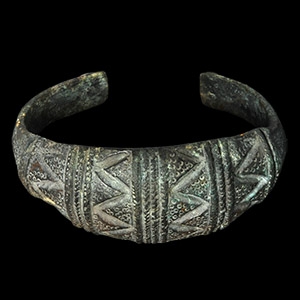
Viking Age Bronze Bracelet with Zig-Zag Design
9th-11th century A.D.Sold for (Inc. bp): £260
Engraved vertically between clusters of ribs, the penannular hoop with a convex outer face and expanded central section. 113 grams, 75 mm wide
From the collection of a North American gentleman, formed in the 1990s.
