
Loading, please wait...
LOT 1609
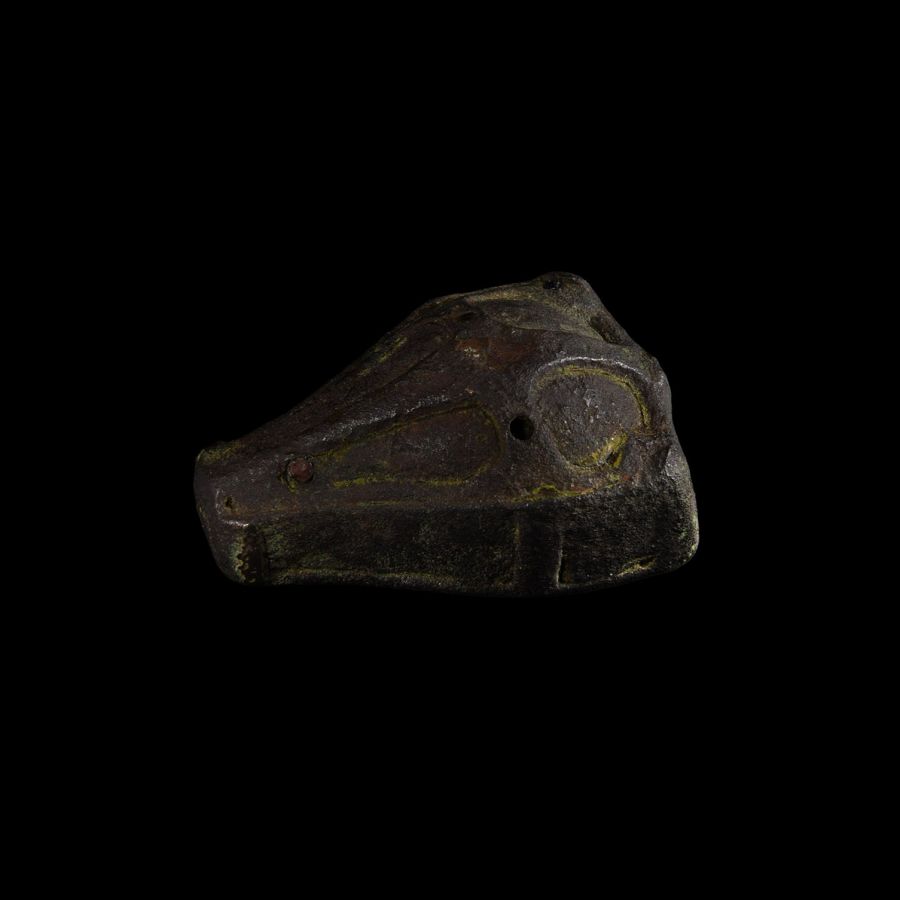
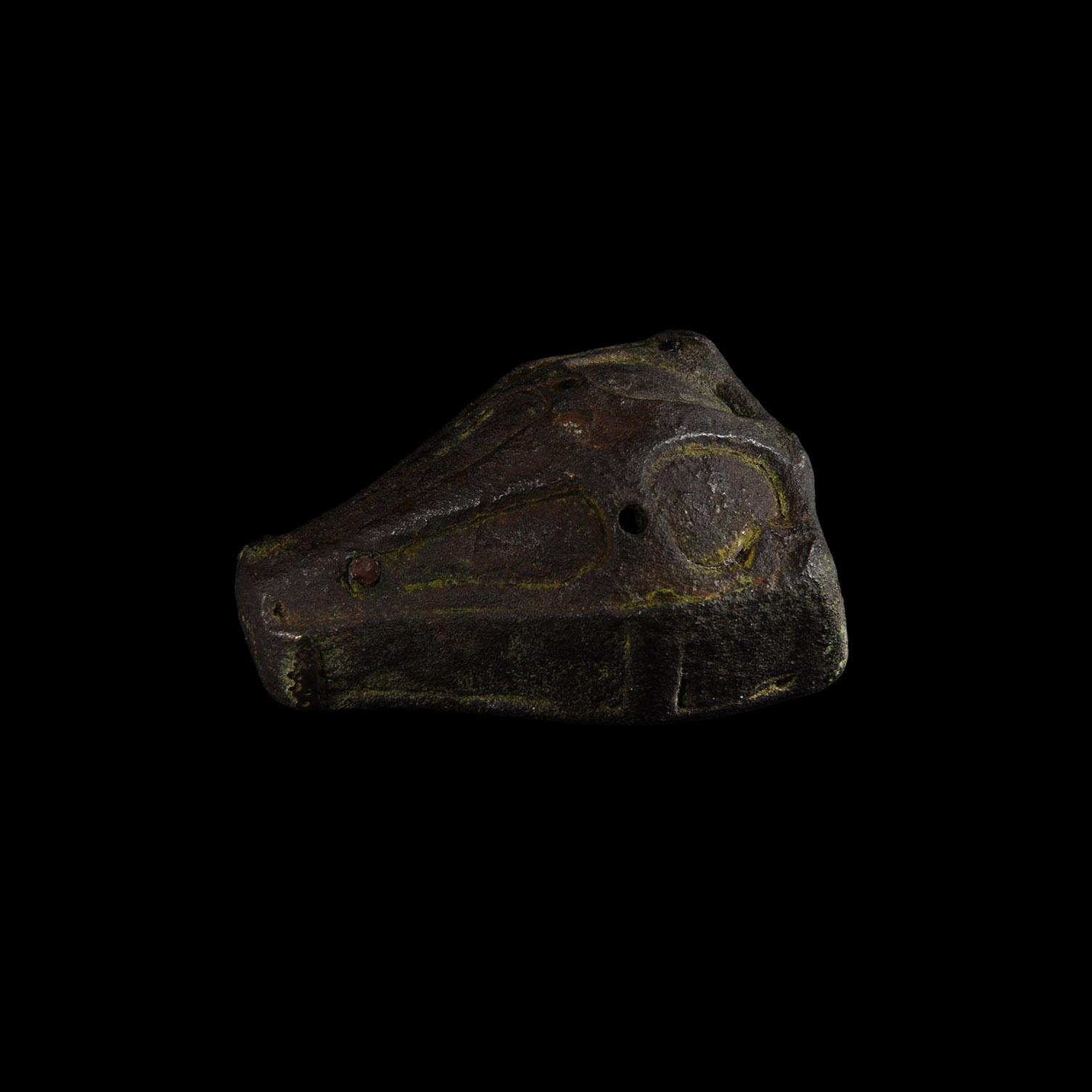
Viking Bronze Boar's Head Brooch with Cross
9TH-10TH CENTURY A.D.
2 1/8 in. (62 grams, 56 mm).
With decorative upper surface attached to a plain back-plate with spring-lugs and catchplate intact; the upper face divided by a heavy cast median rib with zoomorphic ornament in the outer panels, arranged symmetrically along the rib with a similar transverse band; the corners of the wider end reinforced with vertical posts ending in heavy lobed ‘ears’; the side panels decorated with zones of interlace ornament and the upper-end panel with a continuation of the median rib, traces of ornamental interlace; the lower-end panel plain; the transverse band pierced by two holes to accept pins (part of one one still in situ) representing 'eyes' on the stylised head; hollow-cast.
ProvenanceAcquired in the early 1990s.
From an old English collection.
Cf. MacGregor, A. et al., A Summary Catalogue of the Continental Archaeological Collections, Oxford, 1997, item 3.18, for type; and Franceschi, G., Jorn, A. & Magnus, B., Mennesker, Guder og Masker i Nordisk Jernalderkunst Vol. 1, Silkeborg, 2005, figs.130-1.
FootnotesThese animal head-brooches were seemingly manufactured solely on Gotland, and have been classified by scholars in various ways: for example, the manner in which the back-plate is formed and applied, or if a plain internal shell was overlaid with an openwork decorative casing. MacGregor classified them according to their decorative criteria, and his scheme is generally followed in Anglophone literature. They began to appear in the Vendel period (earlier 8th century) and continued into the 12th century in a broadly similar form. Our fitting is related to the conventional group of the gripping beast ornament, here very stylised.
CONDITIONTimeLine Auctions follows a vetting process to ensure the authenticity and legality of all items, reinforcing our commitment to integrity and responsible trading. Each antiquity, antique, and coin lot undergoes thorough examination by a vetting committee of at least ten external specialists, professional trade association members, scientists, and archaeologists: Our Vetting Process
AUCTIONS:
TimeLine is a leading auction house specialising in antiquities, ancient art, collectables, natural history, coins, medals, and books. Our auctions offer museums, collectors, historians, and enthusiasts the opportunity to acquire unique and historically significant pieces.
LOT 1609
Viking Bronze Boar's Head Brooch with Cross
Estimate £500 - 600€580 - 700 (for guidance only)$680 - 810 (for guidance only)
-
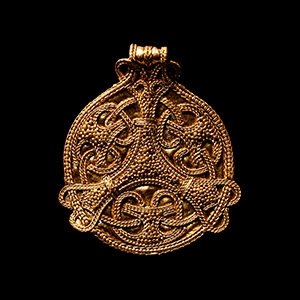
Viking Age Scandinavian Gold Filigree Pendant with Terslev Motif
Circa 9th-11th century A.D.Sold for (Inc. bp): £7,800
Disc with integral loop secured at the reverse; obverse with applied filigree Terslev ornament of three radiating looped knots and interstitial loops. 7.99 grams, 40 mm
Private collection formed in Europe in the 1980s. Westminster collection, central London, UK. This lot has been checked against the Interpol Database of stolen works of art and is accompanied by search certificate no.12113-212333. -
.jpg)
Hiberno-Viking Enamelled Bronze 'Balladoole Type' Trade Weight
9th-10th century A.D.Estimate: £800 - 1,000 (+bp*)
Opening Bid: £240
A discoid lead insular Scandinavian domed trade weight with inset boss; the copper-alloy bridle mount very similar in design to one found at the late 9th/early 10th century Balladoole Viking Boat Burial on the Isle of Man in the 1940s; enamel-inlaid copper-alloy mount from a horse-harness set with a ribbed rim; the obverse decorated with a series of rectangular cells filled with opaque yellowish-green and reddish enamel, forming a circular border around a zoomorphic interlaced and spiral design formed by a series of sub-triangular and curving cloisons surrounding a circular central cell; the lead weight undecorated on the reverse. 194 grams, 43.5 mm
Possibly found in Hampshire, UK. Acquired at a boot sale in Alton, Hampshire, UK in August 2023. Property of an Australian collector. Accompanied by a copy of the British Museum’s Portable Antiquities Scheme (PAS) report no.HAMP-7AD372. Recorded with Winchester City Museum and later the Finds Liaison Officer, Hampshire Cultural Trust, who in turn consulted with Medieval experts at the British Museum.
This is an Insular Scandinavian weight which would have had an original weight of 8 ounces which is towards the heavier extreme for weights of this type, which re-use a variety of insular metalwork items as ready-made decoration. They appear to have originated in Viking contexts in England and/or Ireland in the late 9th century-early 10th century. Manufacture in the Isle of Man has been suggested for the entire group with similar designs and manufacturing techniques. The copper-alloy element is likely to be part of a Hiberno-Norse, Manx or possibly Scottish horse-harness boss; it probably has a pierced lug to the reverse, now embedded in the lead plug. It is very similar to pieces of the harness set from the ship burial at Balladoole, Arbory Isle of Man. No find spot is available, but the majority of weights with decorative insets do come from archaeological contexts such sites such as Torksey, Aldwark and Woodstown, or graves such as Kiloran Bay. -
.jpg)
Viking Age Scandinavian Silver Pendant with Odin and his Ravens Huginn and Muninn
Circa 9th-10th century A.D.Sold for (Inc. bp): £1,170
With integral loop, border enclosing a low-relief image of a male facing mask between two birds embraced at the necks. 1.96 grams, 20 mm
Private collection formed in Europe in the 1980s. Westminster collection, central London, UK.
