
Loading, please wait...

LOT 1493
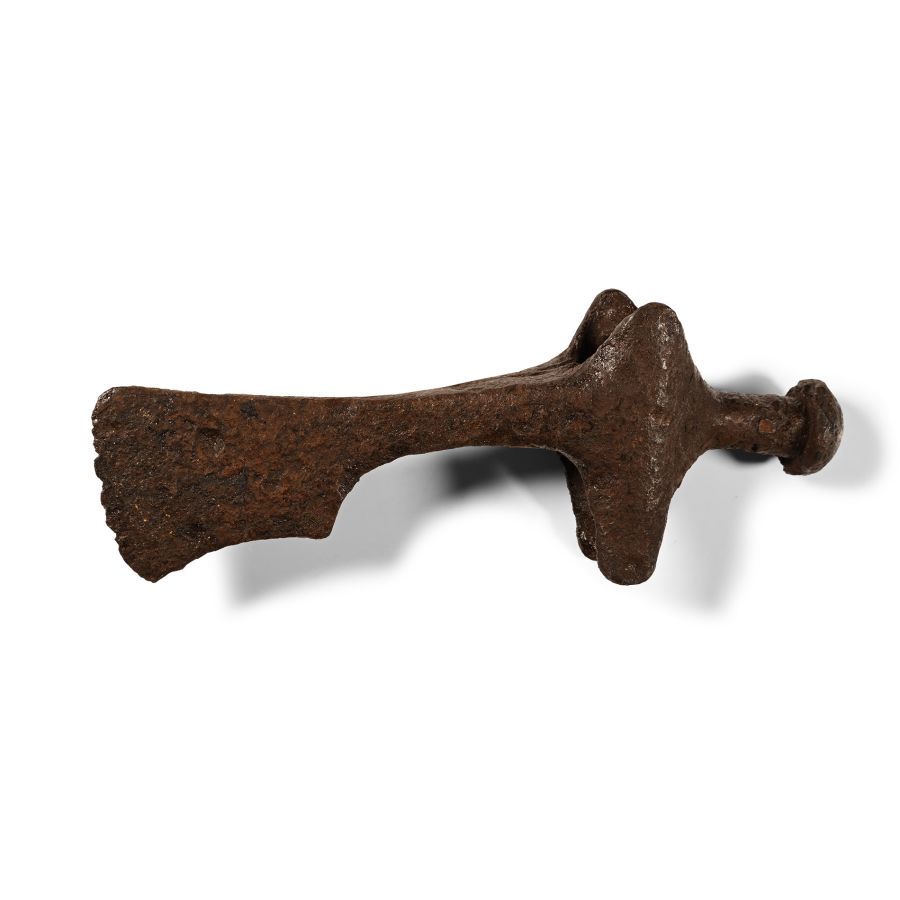
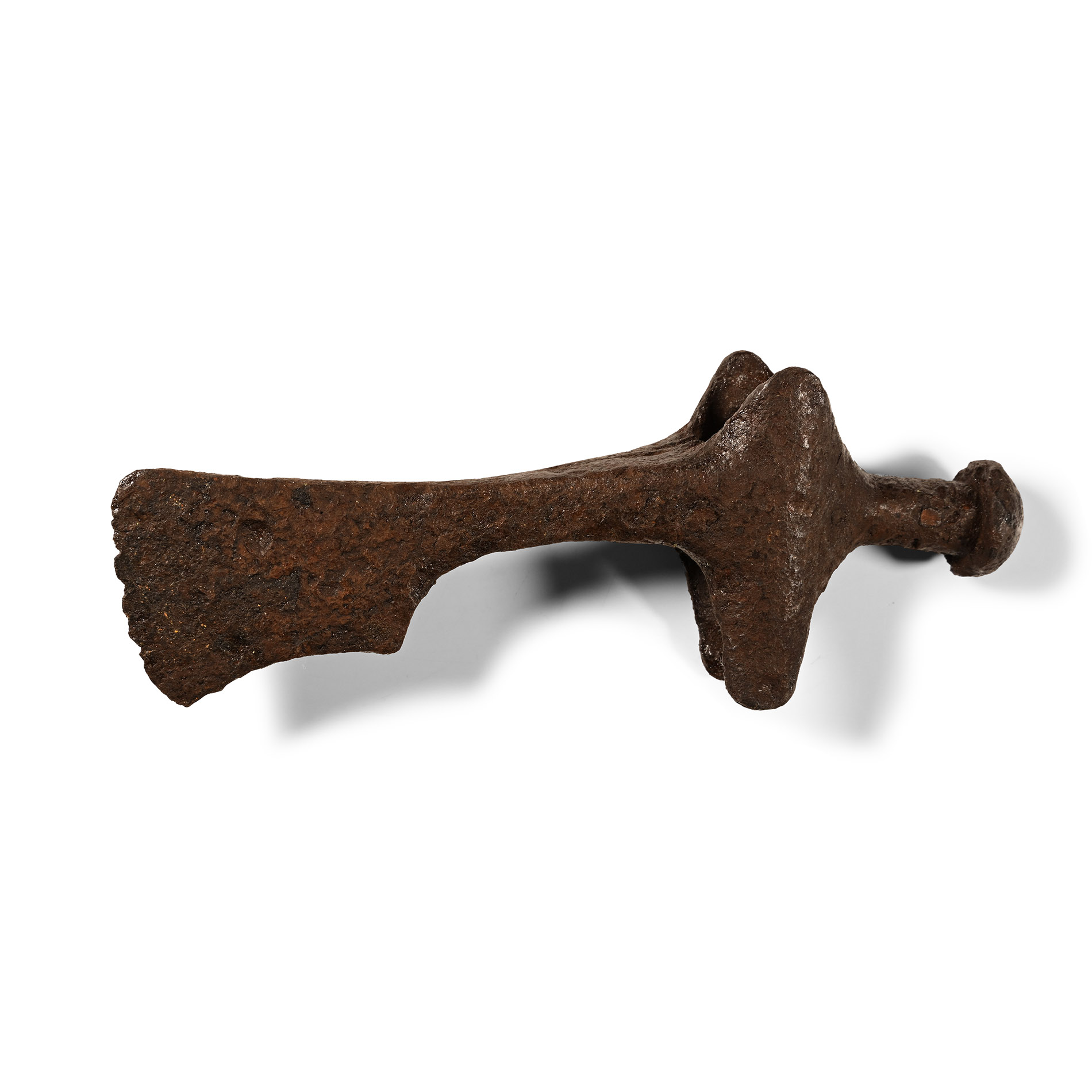
Viking Age Ugro-Finnian Battle Axehead
11TH-12TH CENTURY A.D.
6 1/8 in. (200 grams, 15.5 cm).
A hand-forged iron axehead with square chin to the blade, flanges raised to the socket, rear round hammer-head. [No Reserve]
ProvenanceFrom the private collection of a London gentleman, from his grandfather's collection formed before the early 1970s.
LiteratureCf. Sedov, B.B., Finno-Ugri i Balti v Epokhi Srednevekovija, Moscow, 1987, plate LII, item 15.
FootnotesThe more commonly used weapons of the Finno-Ugrian people were axes, commonly found in all Finnic areas, as well as spears. Iron axeheads of this typology show a sub-trapezoidal asymmetrical blade.
CONDITIONTimeLine Auctions follows a vetting process to ensure the authenticity and legality of all items, reinforcing our commitment to integrity and responsible trading. Each antiquity, antique, and coin lot undergoes thorough examination by a vetting committee of at least ten external specialists, professional trade association members, scientists, and archaeologists: Our Vetting Process
AUCTIONS:
TimeLine is a leading auction house specialising in antiquities, ancient art, collectables, natural history, coins, medals, and books. Our auctions offer museums, collectors, historians, and enthusiasts the opportunity to acquire unique and historically significant pieces.
-
Villanovan Bronze Helmet
8th century B.C.Estimate: £8,000 - 10,000 (‡+bp*)
Opening Bid: £4,444
With rounded bowl and flared rim; three sets of paired piercings for attachment of leather cheek-flaps; cracked. 1.7 kg, 30.5 cm wide
Bowl pierced and cracked.
Acquired early 1990s. Ex private American collection; thence by descent. Private European collection since 1998. Accompanied by an academic report by Dr Raffaele D'Amato. This lot has been checked against the Interpol Database of stolen works of art and is accompanied by search certificate no.11573-199009.
The ‘pot’ or ‘bell’ helmet, found in contexts as early as the 8th century coffer grave (ad arca) from the Esquiline (Rome) and other graves (Coussin, 1926, p.88, fig.23; Sekunda, Northwood,1995, p.6, grave 94) was made from a single piece of bronze, while later Italic variants were fashioned from jointed plates (Connolly, 1981, p.102, figs.2-2a; Egg, 1988, p.223, variant Vetulonia). The skull was somewhat spherical, with a flared rim: in some Etruscan and Italic specimens, this was rivetted for strength. -
Medieval Iron Stirrup and Horse Bit
14th-16th century A.D.Sold for (Inc. bp): £59
Comprising: a snaffle bit with single bar and an iron stirrup in a form of elongated D, with an oval-shaped loop at the top, wide openwork footrest slightly curved forward, with decoration at the sides. 467 grams total, 18.5-26 cm
From the collection of the famous author, writer and speaker, Gordon Bailey, Essex, UK; formed since 1968.
Snaffle bits have not altered very much in their design over the centuries. Medieval snaffle bits have survived in reasonable numbers, although they are still rare. A number of different designs are known for them. Some had a plain straight bar serving as the mouth piece, like our example. The 15th-16th century stirrup shows an interesting decoration at the sides of the footrest. -
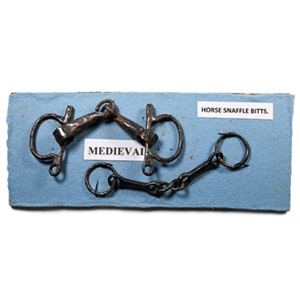
Medieval Iron Horse Snaffle Bit Collection
Circa 14th-16th century A.D.Sold for (Inc. bp): £72
Two snaffle bits with curb strap ring to each end, mounted on a fabric-covered display board with titling panel. 467 grams total, 17.5-20 cm
From the collection of the famous author, writer and speaker, Gordon Bailey, Essex, UK; formed since 1968.
