
Loading, please wait...
LOT 1610
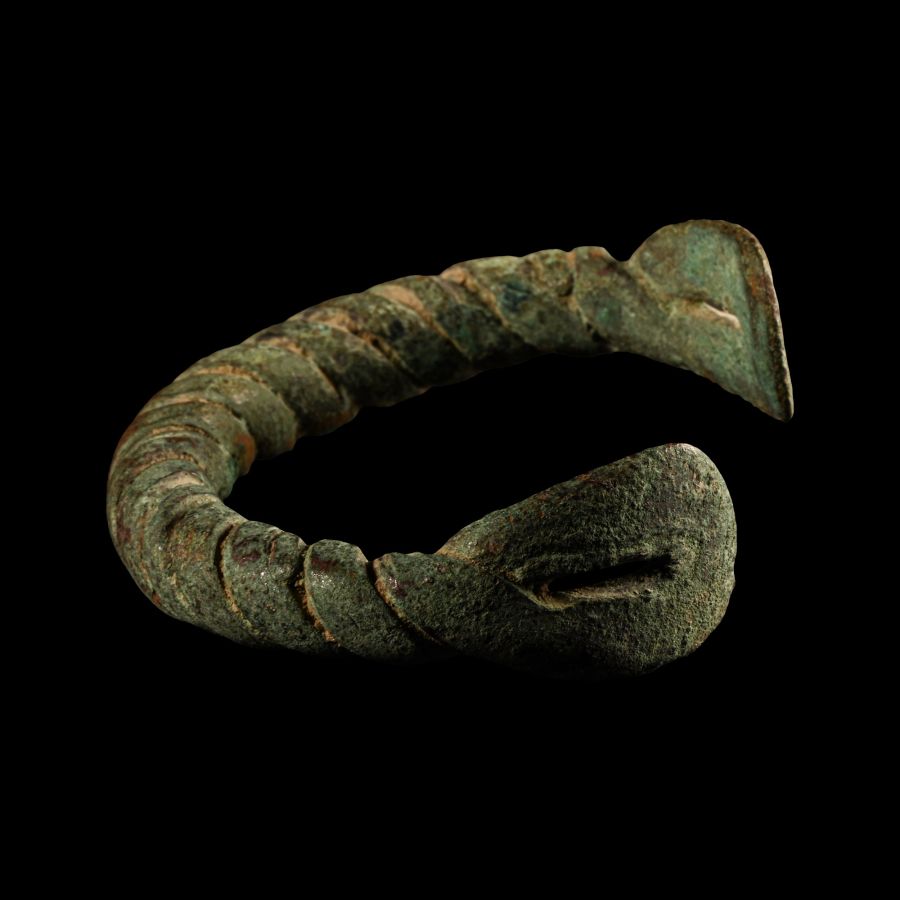
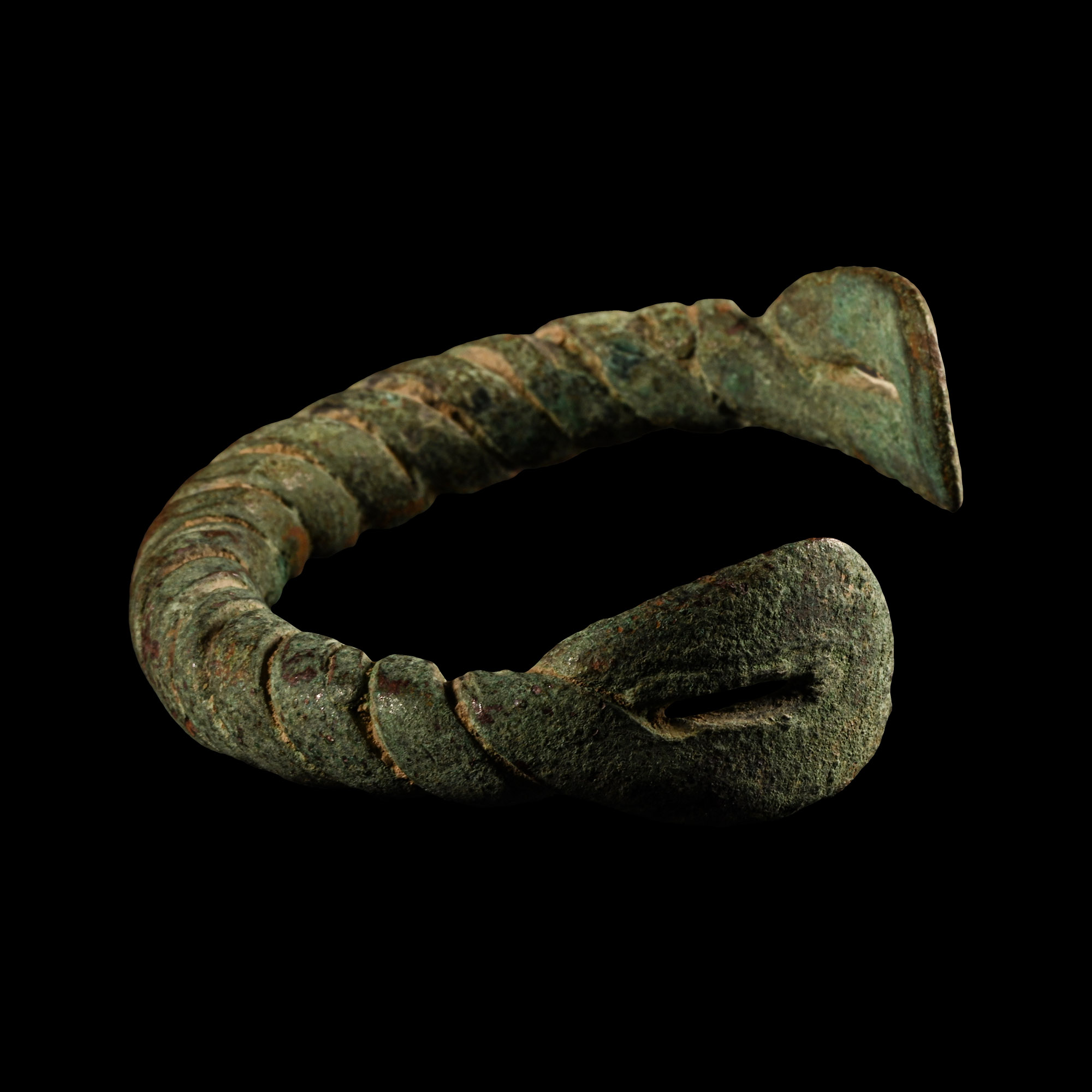
Viking Age Twisted Bronze Bracelet
CIRCA 10TH-12TH CENTURY A.D.
2 1/2 in. (70 grams, 66 mm).
Penannular with twisted twisted rod shank, returned loop finials. [No Reserve]
ProvenancePrivate European collection formed before 2000.
UK art market.
Property of an Essex gentleman.
Cf. Sedov, B.B., Finno-Ugri i Balti v Epokhi Srednevekovija, Moscow, 1987, pl.XCI (18), for type.
CONDITIONTimeLine Auctions follows a vetting process to ensure the authenticity and legality of all items, reinforcing our commitment to integrity and responsible trading. Each antiquity, antique, and coin lot undergoes thorough examination by a vetting committee of at least ten external specialists, professional trade association members, scientists, and archaeologists: Our Vetting Process
AUCTIONS:
TimeLine is a leading auction house specialising in antiquities, ancient art, collectables, natural history, coins, medals, and books. Our auctions offer museums, collectors, historians, and enthusiasts the opportunity to acquire unique and historically significant pieces.
-

Viking Age Silver-Gilt Oseberg Contorted Beast Pendant
Circa 10th-11th century A.D.Sold for (Inc. bp): £364
Openwork disc pendant with Oseberg Style disjointed body, facing mask, pierced suspension lug above. 6.29 grams, 39.51 mm
Acquired on the German art market before 2000. From a London W1, UK, collection.
There is a class of discoid pendants with banded borders and contorted figures found in the hinterland of the Baltic region, associated with the influence of Scandinavian settlers. The design of these items recalls specific elements of Scandinavian art - for example, the 'gripping hands' motif is a feature of the Oseberg Style named after the famous Norwegian ship-burial. Oseberg Style is associated with the beginnings of the Viking age, and was current in the 9th century when Scandinavian settlers began to establish centres of trade and political control in the area of the rivers Dnieper and Volga. The motif has been interpreted as a horse and linked with various legends and mythic figures. -
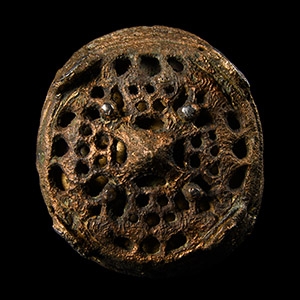
Viking Bronze Openwork Box Brooch with Silver Detailing
11th century A.D.Estimate: £500 - 700 (‡+bp*)
Opening Bid: £240
Formed as an openwork outer shell, inner container and bottom plate; the upper face with central conical boss and four small satellite bosses each with a silver surface disc; to the outer face four pierced tongue-shaped panels with D-shaped finials proud of the upper face, each with a silvered element to the upper end; the bottom plate with integral catchplate and central void, four attachment pins to the underside; the upper face and sidewall executed in Urnes style zoomorphic openwork; the inner element a plain sheet-bronze container. 95 grams, 55 mm
Acquired in the 1950s. Ex private collection, South West England.
On the Baltic island of Gotland, high-ranking females wore 'box' (or 'drum') brooches to secure their outer garments at the shoulders. The inner container may have been used to hold small valuables. -
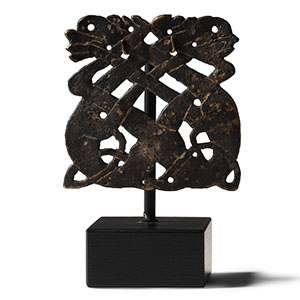
Viking Bronze Openwork Applique
8th-10th century A.D.Sold for (Inc. bp): £878
Flat bronze plaque with openwork detailing of two opposed zoomorphs, their slender bodies enmeshed within a lattice of tails, limbs and lappets; attachment holes at the eyes and rump; the eyes with pointillé surround; supplied with a custom-made stand. 20 grams total, 75 mm including stand
Ex German collection. with Artemis Gallery, Colorado, USA, 8 March 2016, 58A. Private American collection, New York, USA. Accompanied by a copy of a previous typed catalogue page.
The style of the plaque is very heavily influenced by the Irish Book of Kells where confronted, interlaced figures appear as ornament.
