
Loading, please wait...
LOT 0314
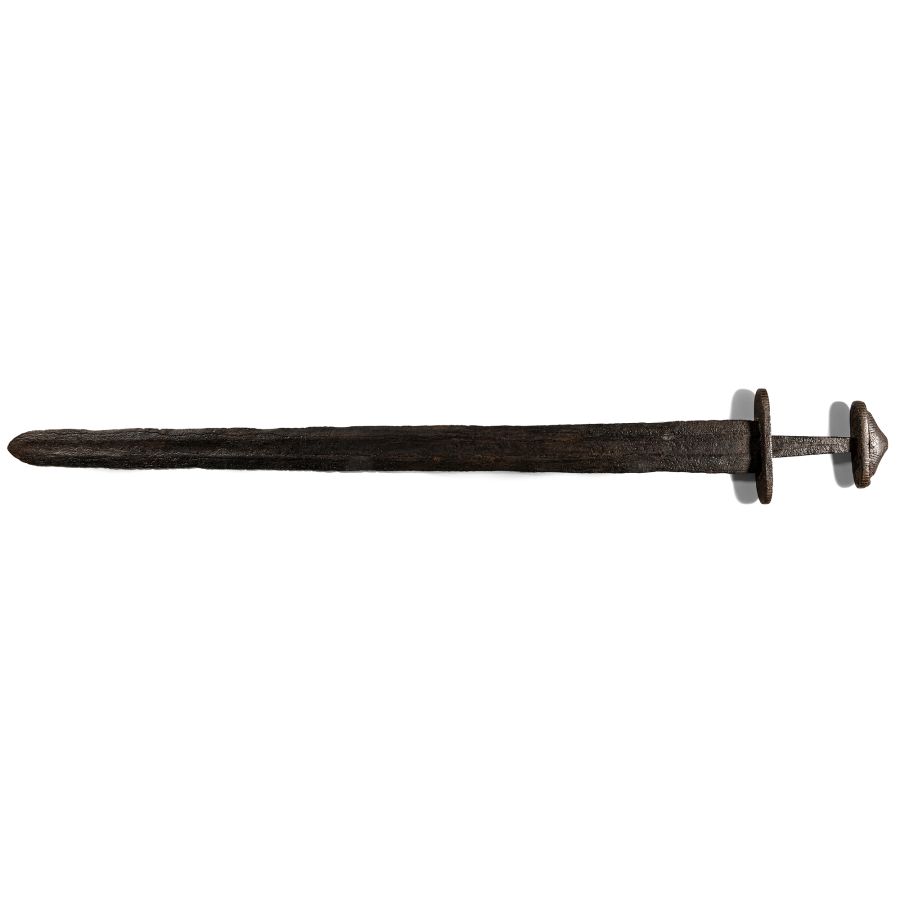
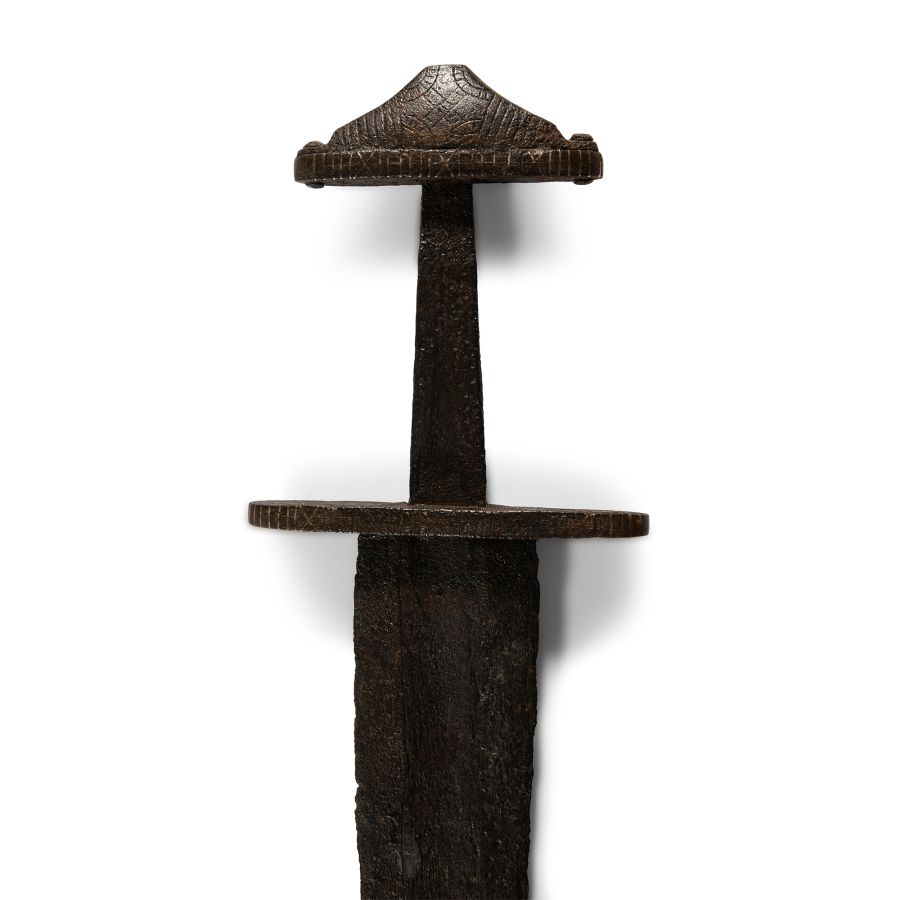
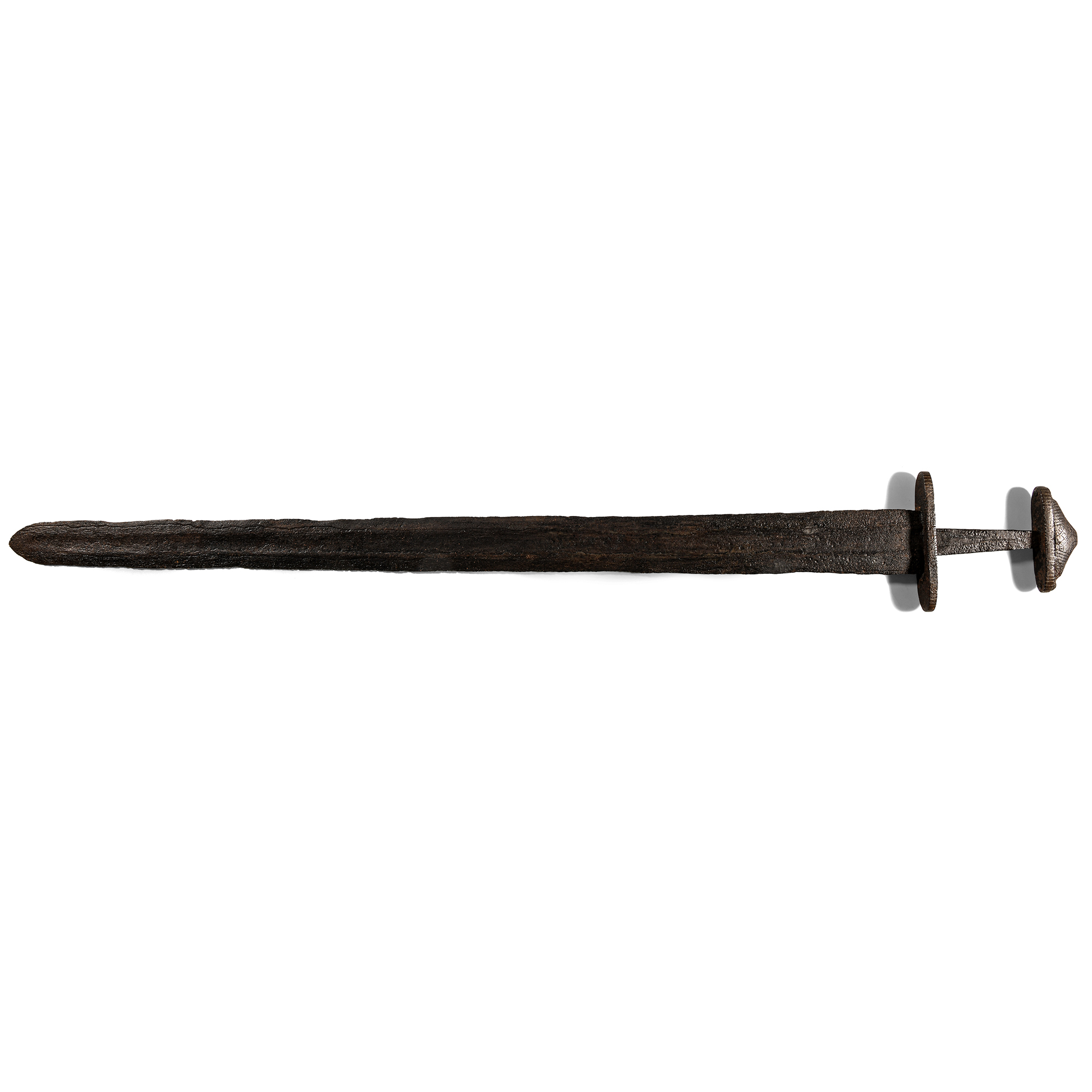
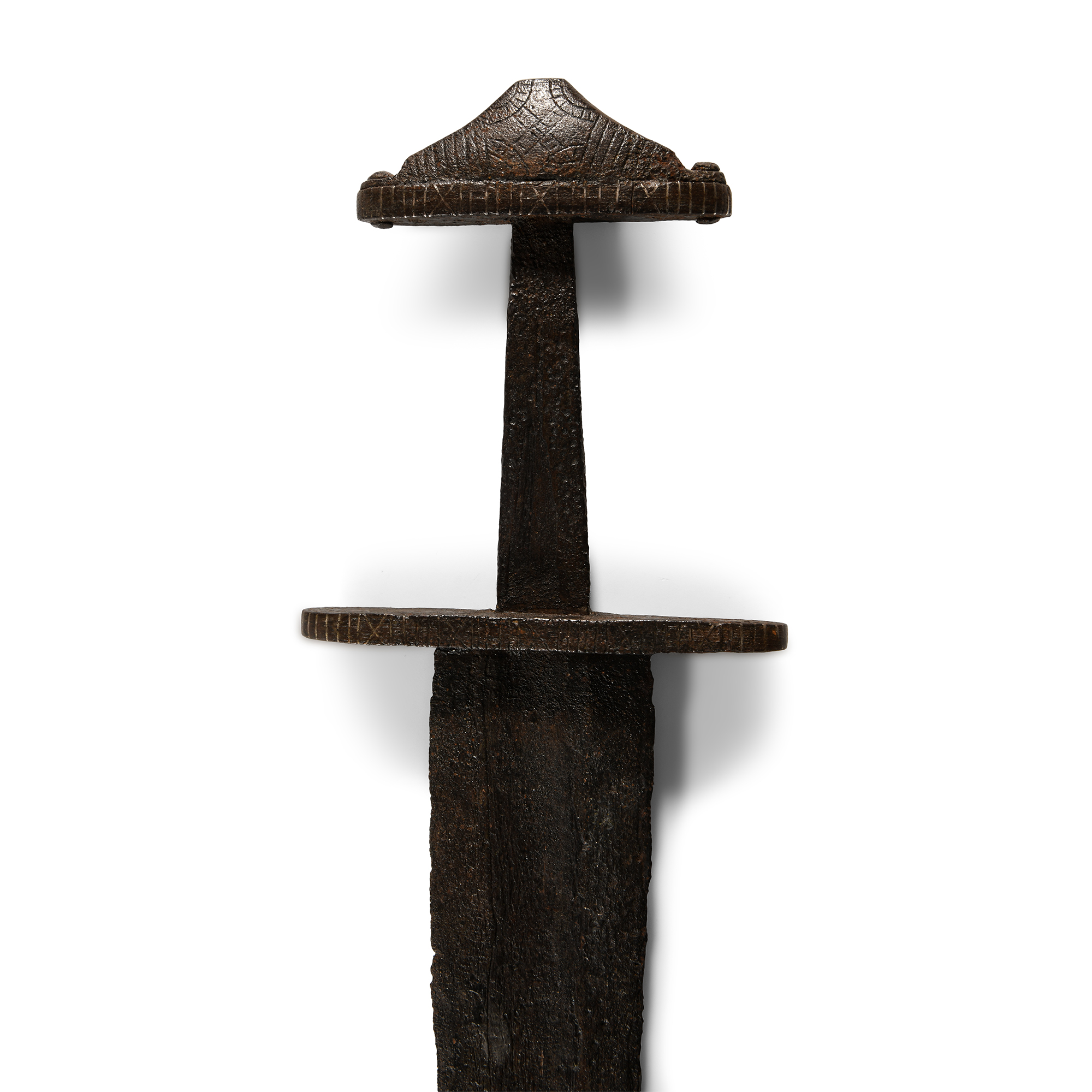
Viking Age Sword with Engraved Mammen Style Hilt
8TH-9TH CENTURY A.D.
35 1/2 in. (955 grams, 90.5 cm).
Pattern-welded, double-edged tapering blade with a tapering tang; the boat-shaped lower guard, pommel, and upper guard decorated in Mammen Style with silver inlay; professionally conserved. [No Reserve]
ProvenanceFrom the Bornhauser collections.
Ex A. Green private collection.
Ex Balticum.
with Army of Tennessee Relics, Knoxville, USA.
Accompanied by an Army of Tennessee certificate of authenticity dated 5th October 2017.
Accompanied by an academic report by Dr Raffaele D’Amato.
This lot has been checked against the Interpol Database of stolen works of art and is accompanied by search certificate number no.12021-214091.
Exhibited at Harwich Museum, Harwich, Essex, UK, 3rd February-9th March 2024; accompanied by a copy of a photograph of the artefact on display.
LiteratureCf. Lorange, A.L., Den Yngre Jernalders Svaerd, Bergen, 1889, pls.I,VI; Petersen, J., De Norske Vikingsverd, Oslo, 1919, fig.52; Oakeshott, E., The Archaeology of Weapons, Arms and Armour from Prehistory to the Age of Chivalry, Woodbridge, 1960 (1999); Peirce, I., Swords of the Viking Age, Woodbridge, 2002, sword from National Museum of Ireland, pp.28-29.
FootnotesThis beautiful Viking sword (probably a river find) shows engraved decoration in Mammen style (700-800 A.D.) and is an early type A according to the Petersen’s typology and classification. This category of swords evolved from the swords of the Vendel Period in Scandinavia, especially from the Swedish ones. Petersen originally individuated eight examples of this sword’s typology, one of the first categories of Viking swords, although these swords were also widely used in the Carolingian Empire.
CONDITIONTimeLine Auctions follows a vetting process to ensure the authenticity and legality of all items, reinforcing our commitment to integrity and responsible trading. Each antiquity, antique, and coin lot undergoes thorough examination by a vetting committee of at least ten external specialists, professional trade association members, scientists, and archaeologists: Our Vetting Process
AUCTIONS:
TimeLine is a leading auction house specialising in antiquities, ancient art, collectables, natural history, coins, medals, and books. Our auctions offer museums, collectors, historians, and enthusiasts the opportunity to acquire unique and historically significant pieces.
-
Luristan Bronze Arrowhead Group
14th-10th century B.C.Sold for (Inc. bp): £195
Comprising tanged arrowheads, including barbed and leaf-shaped examples. 158 grams total, 8-10.5 cm
Acquired 1990s. From the collection of a late Japanese weaponry collector.
The arrowheads seems to belong to the subtypes A and B of the Khorasani classification. They are mainly small triangular arrowheads with rounded and barbed shoulders. Some have angular or rounded midribs. The characteristic is also the cylindrical stem and the rectangular-sectioned tang. Many similar arrowheads were found in the Marlik excavations. -
Luristan Sar-e Gorz Bronze Macehead
14th-13th century B.C.Sold for (Inc. bp): £208
With plain globular body, extended to a small raised ring encircling the top of the mace-head, circular short shaft expanding to a circular flat base. 279 grams, 70 mm high
Acquired 1980-2015. Ex Abelita family collection.
Caucasian stone and bronze maces were distinguished by modestly finished, clean processed and predominantly close-to-ball shapes (with a variety of surface finishing, ranging from the smooth, ribbed, lobular forms to the rounded with protrusions and spikes), and the Western Iranian maces, especially the Luristan ones, notable for the variety of different forms. Similar mace-heads, probably realised in Luristan, decorated the head of the sceptres of Assyrian kings like Tukulti-Ninurta I (1243-1207 B.C.). -
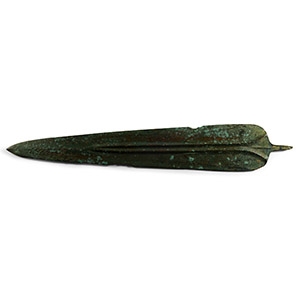
North West Persian Short Sword with Blood Channels
2nd-1st millennium B.C.Sold for (Inc. bp): £260
Broad leaf-shaped blade with rounded shoulders and short tang, grooved spine with curved ends extending to the shoulders. 288 grams, 38cm
Ex Abelita family collection, 1970s-2000s.
