
Loading, please wait...
LOT 0398
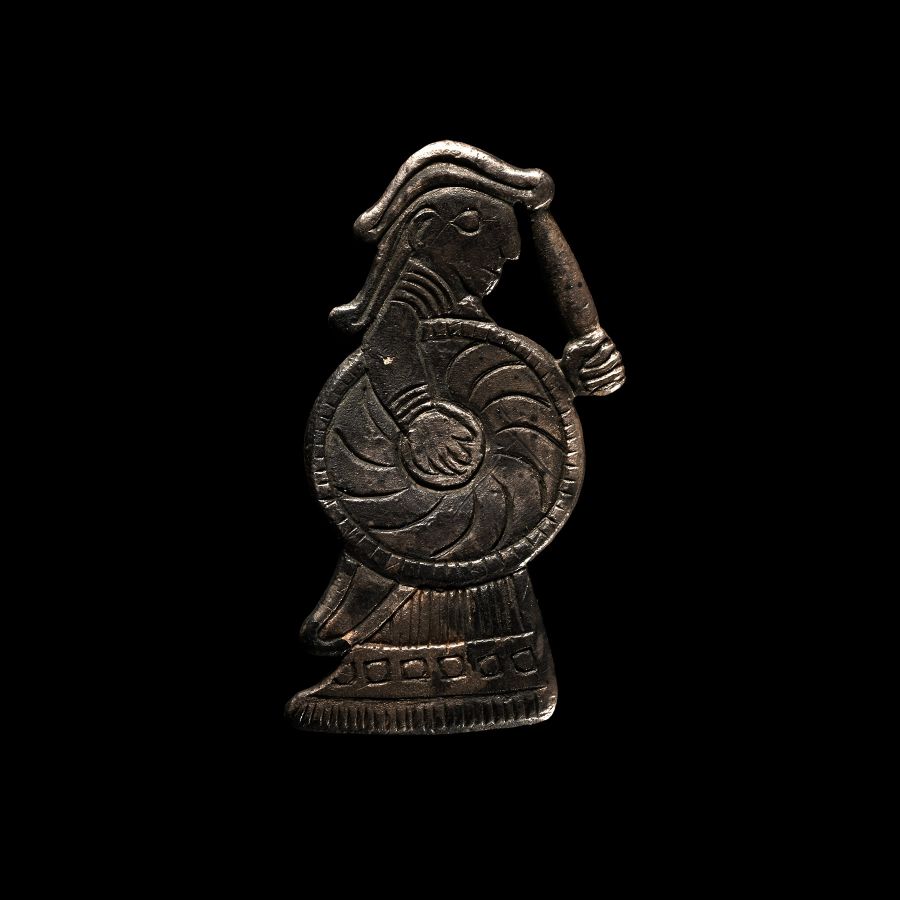
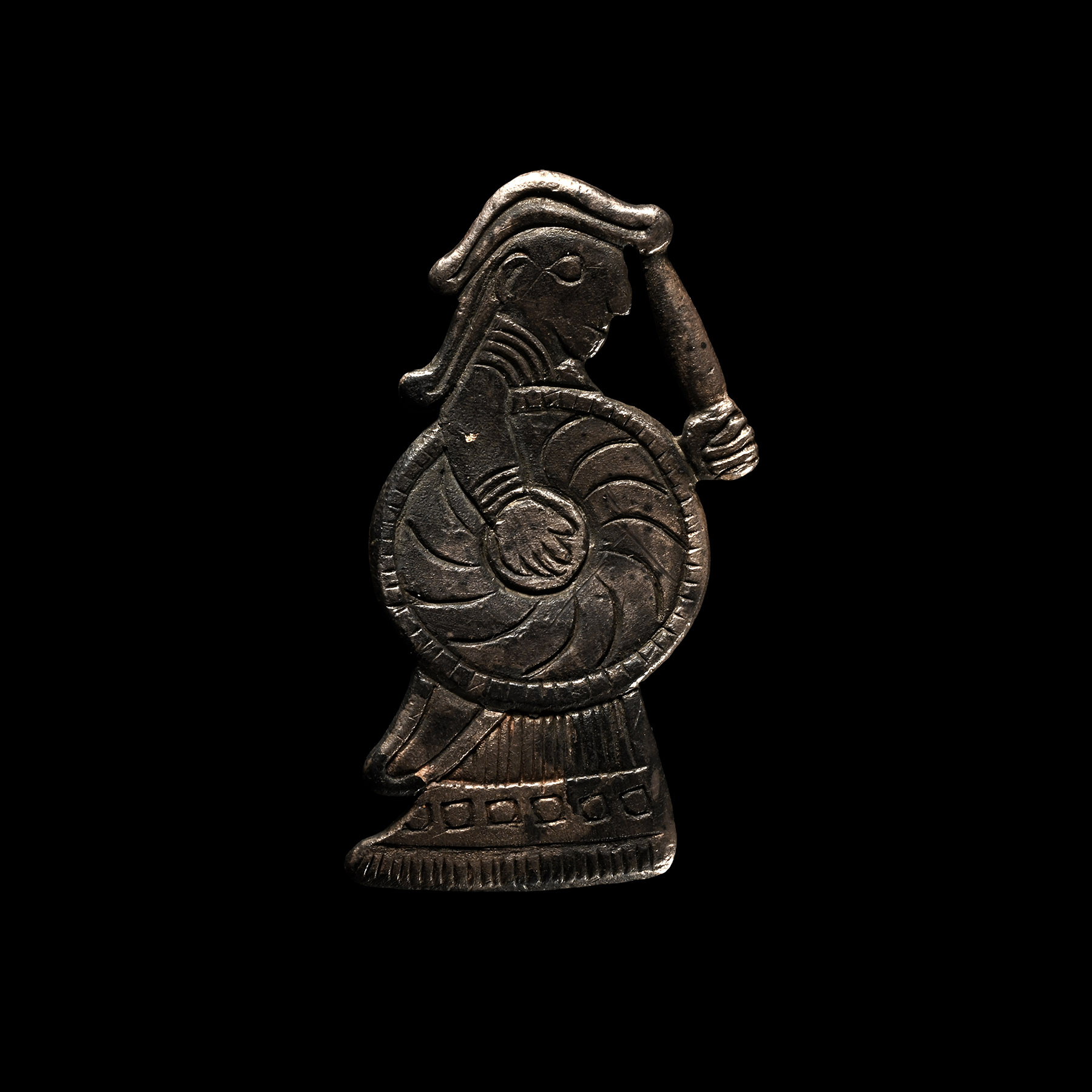
Viking Age Silver Shield-Maiden Pendant
CIRCA 9TH-10TH CENTURY A.D.
1 1/2 in. (8.08 grams, 40.68 mm).
A female in floor-length robe holding a shield in her right hand and drawn knife in her left, stylised headdress and long plaited band of hair to the rear; pierced lug to the reverse.
ProvenanceAcquired on the UK art market in the 1980s.
Ex property of a Cambridgeshire, UK, gentleman.
See Vang Petersen, P., Valkyrier og Bersærker. Mytologien i Smykkekunsten, in Madsen, P.K. (ed.), Danefæ. Skatte fra den Danske Muld, Copenhagen, 2010; Gardeła, L., ‘Warrior-women’ in Viking Age Scandinavia, A preliminary archaeological study in Analecta Archaeologica Ressoviensia, vol.8, Rzeszów, 2013.
FootnotesThis pendant resembles a find from Galgebakke, Denmark, a silver figure holding a short sword and clutching a shield by the boss (Vang Petersen, item 4). The Galgebakke figure is identified as female on the basis of the elaborate crested hairstyle, and an ankle-length dress with tiny feet beneath. The interpretation usually offered for this figure is that of a skjoldmø or 'shield-maiden', a female who takes up arms in pursuit of vengeance such as the legendary Hervor in Hervarar saga ok Heiðreks. Scholars used to interpret these armed females as valkyries - hand maidens of the god Oðinn - but the idea has been challenged recently (Gardeła, 2013).
CONDITIONTimeLine Auctions follows a vetting process to ensure the authenticity and legality of all items, reinforcing our commitment to integrity and responsible trading. Each antiquity, antique, and coin lot undergoes thorough examination by a vetting committee of at least ten external specialists, professional trade association members, scientists, and archaeologists: Our Vetting Process
AUCTIONS:
TimeLine is a leading auction house specialising in antiquities, ancient art, collectables, natural history, coins, medals, and books. Our auctions offer museums, collectors, historians, and enthusiasts the opportunity to acquire unique and historically significant pieces.
-
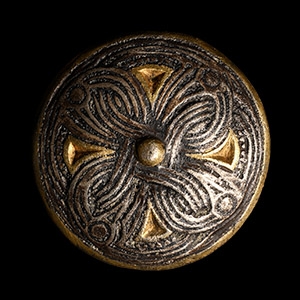
Viking Age Silver-Gilt Brooch with Interlaced Birds
Circa 9th-11th century A.D.Sold for (Inc. bp): £364
Slightly domed profile with boss to the centre, parcel-gilt rim and spandrels, niello-inlaid motif of four bird-heads on curved necks; pin-lugs, hinged pin, catch and loop to the reverse. 23.7 grams, 44 mm
Private collection formed in Europe in the 1980s. Westminster collection, central London, UK. -

Scandinavian Viking Bronze Ring-Headed Dress Pin
9th-12th century A.D.Sold for (Inc. bp): £20
Stem with roughly round-section lower body and rectangular-section upper body with penannular loop, a free-running ring suspended from the hoop with a biconvex outer wall and hatched decoration. 4.98 grams, 65 mm
Very fine condition.
UK gallery, acquired in the 2000s. Property of an English gentleman. -
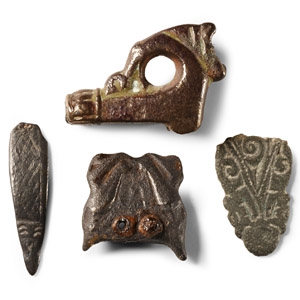
Viking and Saxon Artefact Group
8th-11th century A.D.Sold for (Inc. bp): £59
Including a narrow beast-head strap-end, a military strap-end fragment, a stirrup mount and looped fitting. 49.9 grams total, 26-40 mm
Acquired since the 1970s. From the private collection of a Surrey, UK, gentleman.
