
Loading, please wait...
LOT 1575
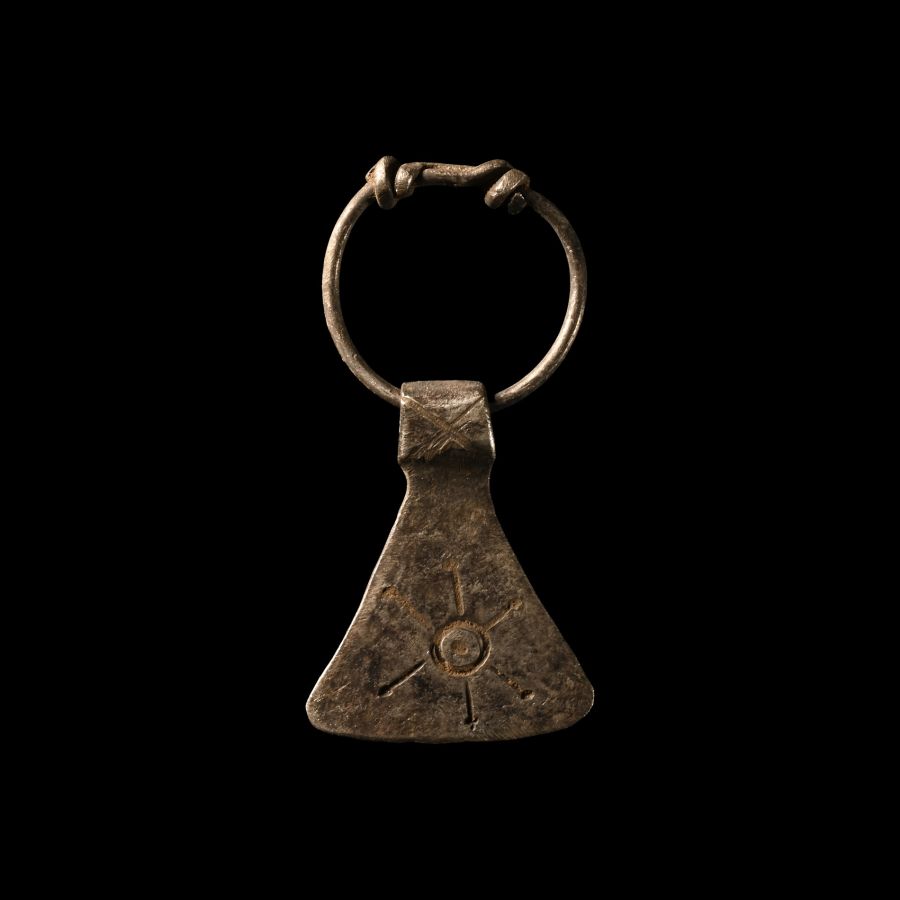
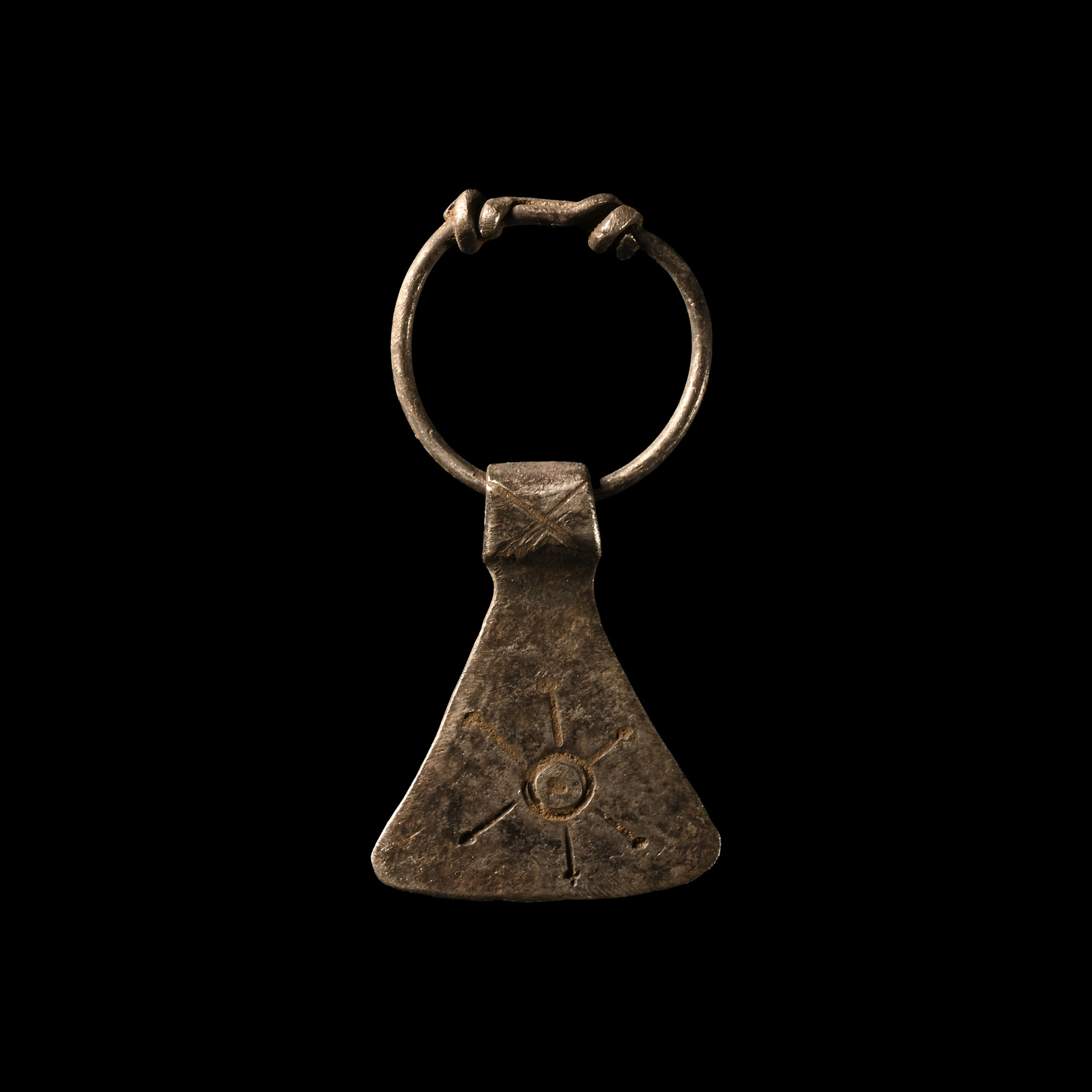
Viking Age Silver Broad Axe Pendant with Radiant Sun
CIRCA 9TH-11TH CENTURY A.D. OR EARLIER
1 1/4 in. (1.92 grams, 32 mm).
Axehead with sunburst motif to one face, on suspension loop with coiled ends.
ProvenanceEx German art market, 2000s.
Acquired from an EU collector living in London.
From the collection of Surrey, UK, gentleman.
TimeLine Auctions follows a vetting process to ensure the authenticity and legality of all items, reinforcing our commitment to integrity and responsible trading. Each antiquity, antique, and coin lot undergoes thorough examination by a vetting committee of at least ten external specialists, professional trade association members, scientists, and archaeologists: Our Vetting Process
AUCTIONS:
TimeLine is a leading auction house specialising in antiquities, ancient art, collectables, natural history, coins, medals, and books. Our auctions offer museums, collectors, historians, and enthusiasts the opportunity to acquire unique and historically significant pieces.
-
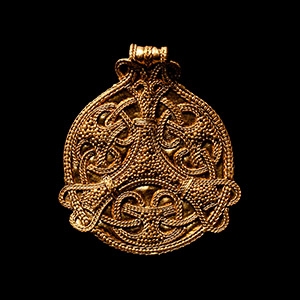
Viking Age Scandinavian Gold Filigree Pendant with Terslev Motif
Circa 9th-11th century A.D.Sold for (Inc. bp): £7,800
Disc with integral loop secured at the reverse; obverse with applied filigree Terslev ornament of three radiating looped knots and interstitial loops. 7.99 grams, 40 mm
Private collection formed in Europe in the 1980s. Westminster collection, central London, UK. This lot has been checked against the Interpol Database of stolen works of art and is accompanied by search certificate no.12113-212333. -

Viking Age Silver Shield-Maiden Pendant
Circa 9th-10th century A.D.Sold for (Inc. bp): £1,690
A female in floor-length robe holding a shield in her right hand and drawn knife in her left, stylised headdress and long plaited band of hair to the rear; pierced lug to the reverse. 8.08 grams, 40.68 mm
Acquired on the UK art market in the 1980s. Ex property of a Cambridgeshire, UK, gentleman.
This pendant resembles a find from Galgebakke, Denmark, a silver figure holding a short sword and clutching a shield by the boss (Vang Petersen, item 4). The Galgebakke figure is identified as female on the basis of the elaborate crested hairstyle, and an ankle-length dress with tiny feet beneath. The interpretation usually offered for this figure is that of a skjoldmø or 'shield-maiden', a female who takes up arms in pursuit of vengeance such as the legendary Hervor in Hervarar saga ok Heiðreks. Scholars used to interpret these armed females as valkyries - hand maidens of the god Oðinn - but the idea has been challenged recently (Gardeła, 2013). -

Viking Age Gold 'Elf Shot' Pendant
9th-11th century A.D. or earlierSold for (Inc. bp): £312
Gold cup with hoop and suspension loop, aqua glass insert. 0.55 grams, 16 mm
From a late Japanese specialist collector, 1970-2000s.
This amulet was believed to offer protection against 'Elfshot'. The attack of elves was believed responsible for mysterious suffering in men and livestock: sudden shooting pains localised to a particular area of the body, such as in rheumatism, arthritis or muscle stitches or cramps. Elves were thought to shoot darts or arrows where such pains had no obvious external cause. Belief in elfshot persisted into the 20th century in rural areas, and as proof country folk would sometimes find small arrowheads (the remains of Neolithic or Mesolithic flints, or naturally-occurring spear-shaped stones) that were believed to be the magical weapons that caused the afflictions. Belief in elfshot began in the Pagan Germanic period.
