Loading, please wait...

Use mousewheel to zoom in and out, click to enlarge

Details

LOT 1625

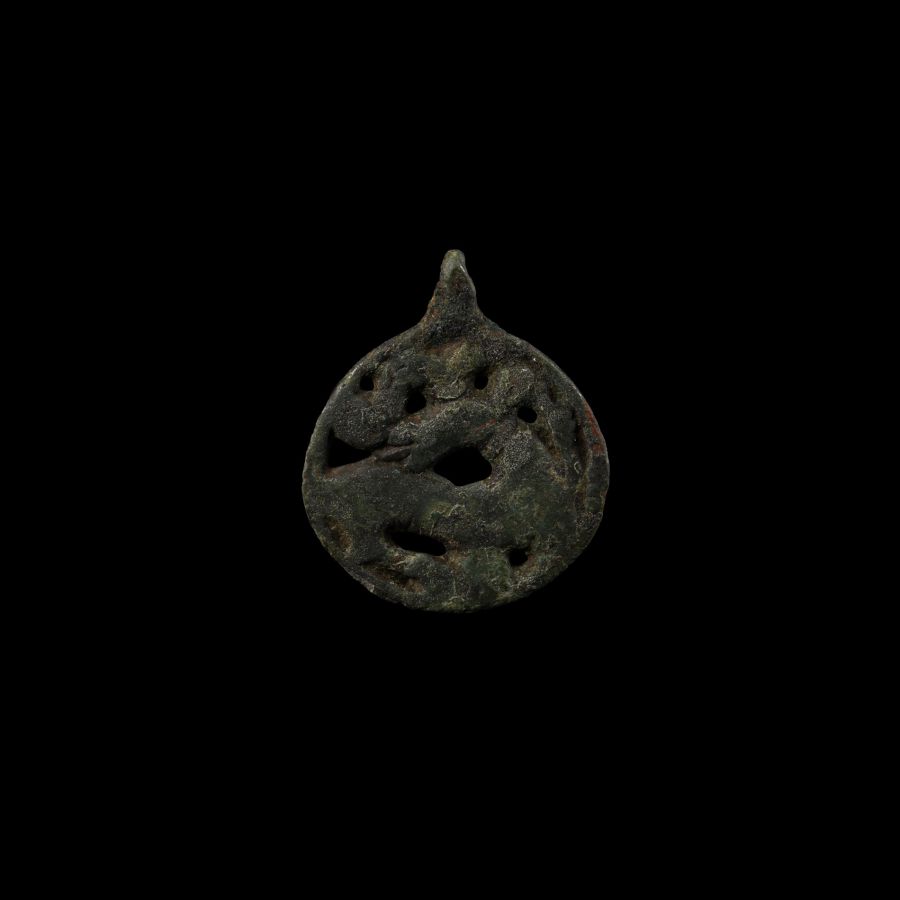
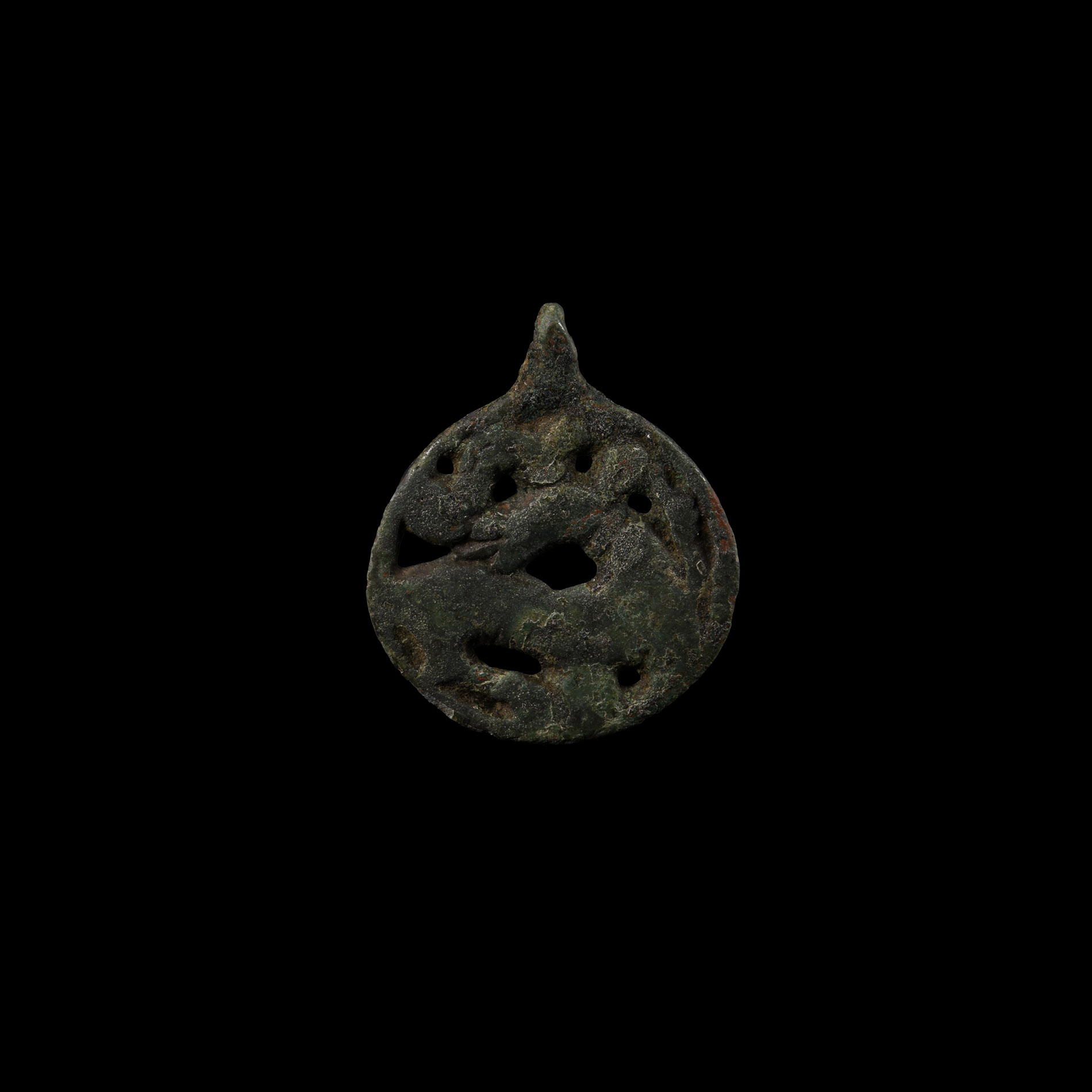
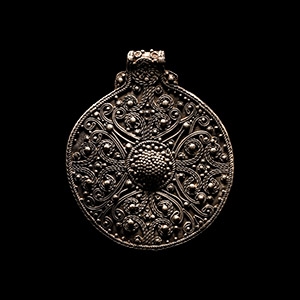
Viking Age Jellinge Style Bronze Regardant Beast Pendant

11TH-12TH CENTURY A.D.

1 1/8 in. (3.13 grams, 28 mm).

A Scandinavian pendant of Kipplingeberg type (also widespread in the historical Rus region), with regardant beast and foliage. [No Reserve]

Provenance

Acquired on the German art market before 2000.
From an old Munich collection.

Literature

Cf. Korshyn, V.E., Yazicheskiye Priveski Drevniye Rusi X-XIV Vekov, Moscow, 2013, item J.2.02.

CONDITION

VETTING:

TimeLine Auctions follows a vetting process to ensure the authenticity and legality of all items, reinforcing our commitment to integrity and responsible trading. Each antiquity, antique, and coin lot undergoes thorough examination by a vetting committee of at least ten external specialists, professional trade association members, scientists, and archaeologists: Our Vetting Process


AUCTIONS:

TimeLine is a leading auction house specialising in antiquities, ancient art, collectables, natural history, coins, medals, and books. Our auctions offer museums, collectors, historians, and enthusiasts the opportunity to acquire unique and historically significant pieces.

LOT 1625

Viking Age Jellinge Style Bronze Regardant Beast Pendant

Sold for (Inc. bp): £85

Print page

RELATED LOTS

  • Pre Viking Scandinavian Silver Aroma Bucket Pendant with garnets
    Pre Viking Scandinavian Silver Aroma Bucket Pendant with garnets
    Circa 4th-7th century A.D.

    Sold for (Inc. bp): £546

    With braided wire handle, applied wire bands to the rim, granulation to the sidewall and base, five cells each set with a cabochon garnet. 3.02 grams, 19 mm


    Private collection formed in Europe in the 1980s. Westminster collection, central London, UK.

    Pendants in the form of miniature buckets have been found in a number of pagan Anglo-Saxon and Viking contexts and are generally made of bronze or iron, with gold examples being rare; three gold examples were found with the hoard from Hoen, Norway. Bronze bucket amulets have been found at Driffield in Yorkshire, and Vimose bog in Denmark, among other places. In form they represent wooden buckets bound with bronze or iron bands which have been found in Anglo-Saxon and Viking graves and are believed to have held mead or ale and were used to replenish the cups from which warriors drank. As amulets they probably represent the ecstatic power of alcoholic drink and the role of women as the dispensers of these precious beverages.

    Lot Details

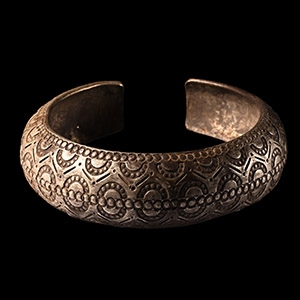
  • Viking Age Decorated Silver Bracelet
    Viking Age Decorated Silver Bracelet
    Circa 9th-11th century A.D.

    Sold for (Inc. bp): £845

    C-shaped in section with square butts, bands of punched linear, crescent and pellet ornament. 81 grams, 76 mm


    Private collection formed in Europe in the 1980s. Westminster collection, central London, UK.

    Lot Details

  • Viking Age Bronze Sword Scabbard Chape Collection
    Viking Age Bronze Sword Scabbard Chape Collection
    10th-12th century A.D.

    Estimate: £500 - 700 (‡+bp*)

    Opening Bid: £275

    Comprising: a small and narrow type (Paulsen's Gruppe I 2, Untergruppe d) with an openwork panel to each face filled by a cross-shaped motif with curved cross-bar, and a dentilled upper edge to the mouth; a tongue-shaped type (Paulsen's Gruppe I 1) with an openwork centre and Ringerike style bird formed with looped bands, pellets to the pinions, a triangular in plan head joined to the inner faces of the ropework border forming the upper edge of the chape, with a wolf's head at the apex and stepped knop finial (apex and lower end of the chape damaged); two of the same type (Gruppe I 1) with a pair of scrolls in the central void and a 'knot' to the apex', one with ropework detailing and a wolf's head; a broad D-shaped plaque with a plain reverse plate riveted in place, guilloche band to the outer edge and interlaced vines to the centre. 118 grams total, 46-75 mm


    From the collection of a North American gentleman, formed in the 1990s.

    The chape with the dentilled upper edge bears a cross motif on which only the curvature of the cross-piece indicates its origin in the raven/eagle figure found more commonly on this type; as its ornament has developed a long way from its original form, it should be dated to the 11 or 12th century. The D-shaped plaque with the plain reverse is not in Paulsen's typology but appears to be derived from the smaller types in his Gruppe VII.

    Lot Details

Stay up-to-date with the latest from TimeLine Auctions by joining our mailing list