
Loading, please wait...
LOT 1367
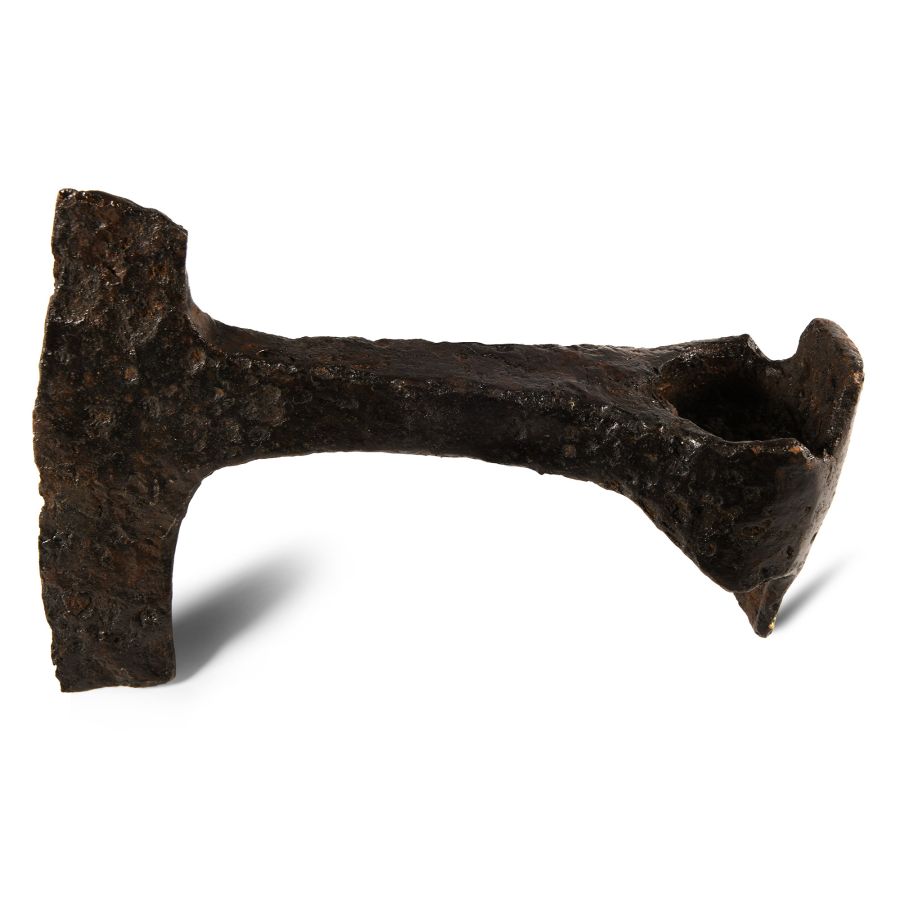
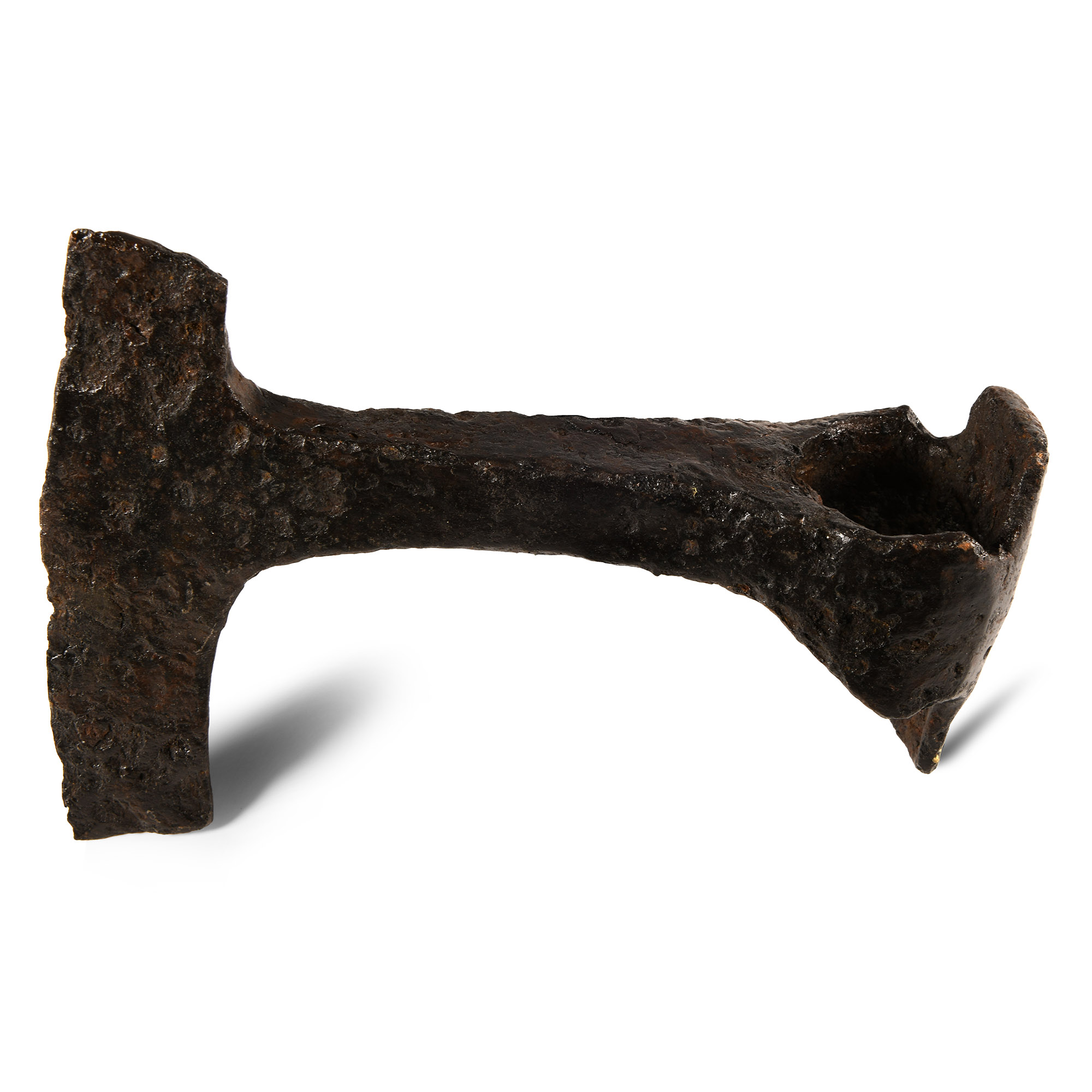
Viking Age Iron T-Shaped Axehead
10TH-12TH CENTURY A.D.
6 3/4 in. (588 grams, 17 cm).
Narrow T-shaped blade with curved edge, large D-shaped socket with lateral triangular flanges and rectangular extension to the rear. [No Reserve]
ProvenanceFrom the private collection of a London gentleman, from his grandfather's collection formed before the early 1970s.
PublishedExhibited at the Harwich Museum, Harwich, Essex, UK, 19th June-9th September 2024; accompanied by a copy of a photograph of the artefact on display.
LiteratureCf. Sedov, B.B., Finno-Ugri i Balti v Epokhi Srednevekovija, Moscow, 1987, pl.CX, items 41,43, for the type; see also Hjardar, K. & Vike, V., Vikings at war, Oxford-Philadelphia, 2016, p.163, for the typology of eastern axes.
FootnotesSlavic battle-axes also came into use in Scandinavia, especially in the Eastern part of Gotland, Denmark and Sweden. One of the types was a T-shaped axe with a broad blade. There were narrow-bladed types too, described as being very light. Another characteristic of some of the Eastern axes was an extra long hammer or more rarely a secondary blade protruding from the back of axehead.
CONDITIONTimeLine Auctions follows a vetting process to ensure the authenticity and legality of all items, reinforcing our commitment to integrity and responsible trading. Each antiquity, antique, and coin lot undergoes thorough examination by a vetting committee of at least ten external specialists, professional trade association members, scientists, and archaeologists: Our Vetting Process
AUCTIONS:
TimeLine is a leading auction house specialising in antiquities, ancient art, collectables, natural history, coins, medals, and books. Our auctions offer museums, collectors, historians, and enthusiasts the opportunity to acquire unique and historically significant pieces.
-
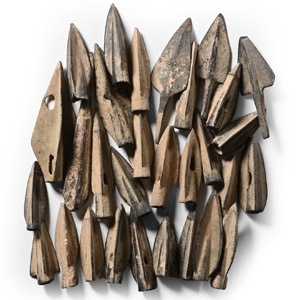
Greek Bronze Arrowhead Collection
Circa 5th-3rd century B.C.Sold for (Inc. bp): £221
Including triangular-section sockettedtype, triangular barbed type, tanged leaf-shaped type and others. 104 grams total, 23-58 mm
Ex London, UK, collection, 1990s. -
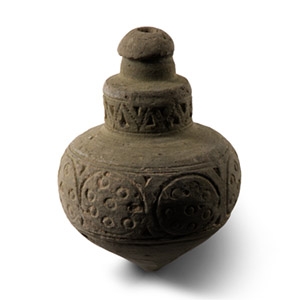
Arab 'Greek Fire' Ceramic Fire Bomb or Hand Grenade
13th century A.D.Sold for (Inc. bp): £598
Piriform body decorated with concentric circles inside a horizontal band, raised ornamental neck, with domed filler-hole, intended to be filled with explosive liquid and wick, used as a hand grenade. 430 grams, 12 cm
From a military inspired collection formed from the 1990s.
The Arabs made good use of these weapons. Their efficiency was described in the account of the siege of Akka in 1189, given by the contemporary historian Ibn al-Athir. He tells how the Christians exercised their engineering skills and built mighty siege towers. The situation was hopeless for the defending Arabs until a man from Damascus showed up, because he knew how to produce Greek Fire: ‘To trick the Christians he first threw some vessels with naphtha and other things, which were not set on fire, upon one of the siege towers, and it was without power. The Christians...climbed the top of the siege tower...the man from Damascus waited until the contents of the vessels were spread all over. When the moment came, he threw a new pot, which was set on fire. In a few moments the fire was spread all over, and the siege tower was eaten up by the flames. The fire was spread in such a hurry that the Christians could not manage to climb down from the siege tower. Men, weapons, everything was eaten up by the flames.’ -
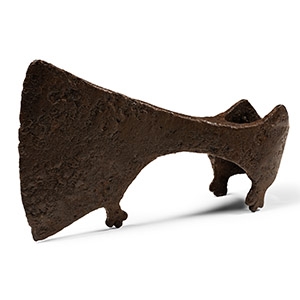
Viking Age Iron 'Gotland Type' Axe Head
Circa 9th-13th century A.D.Sold for (Inc. bp): £702
With curved blade and trefoil-shaped chin to the lower edge, round socket with triangular flanges to the upper edge and trefoil-shaped flanges to the lower face. 635 grams, 16.5 cm
From the private collection of a London gentleman, from his grandfather's collection formed before the early 1970s.
The axe head was made in a particular shape showing elements of plant ornamentation and it may have been used both as a battle axe and working axe. Most men were farmers or labourers on a farm and rarely carried a weapon other than a knife and an axe. Nevertheless, battle, the hunt and the ability to ride were important elements of what constituted the ideal Viking man.
