
Loading, please wait...
LOT 0261
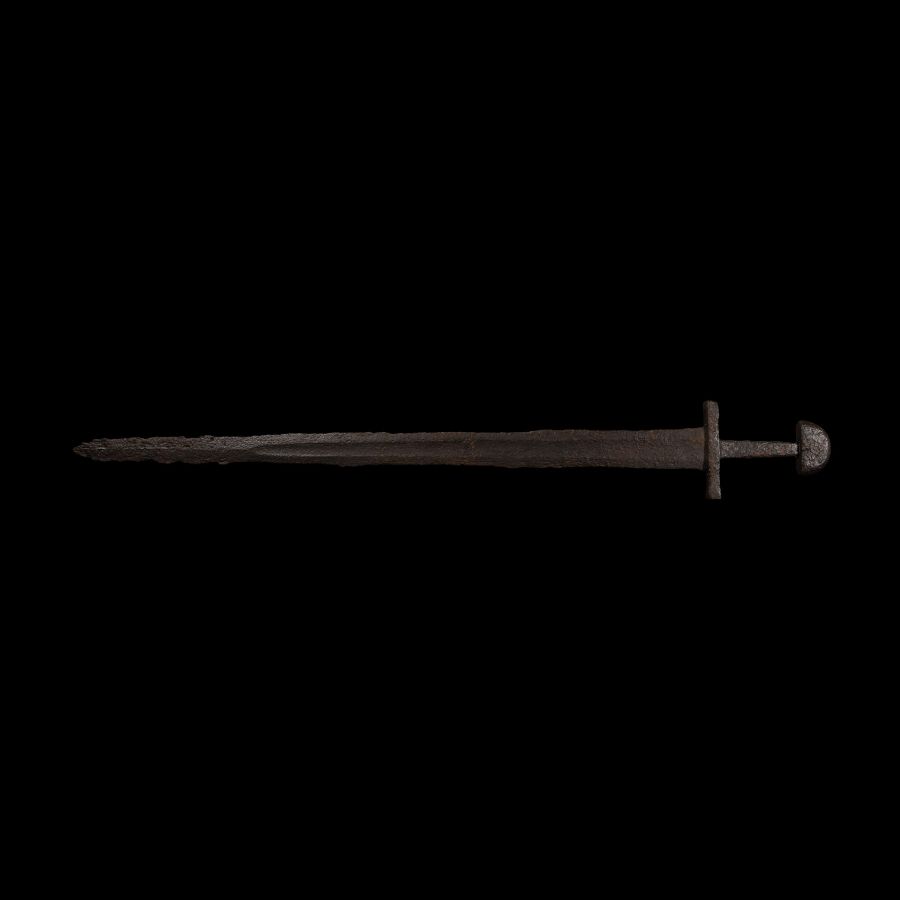
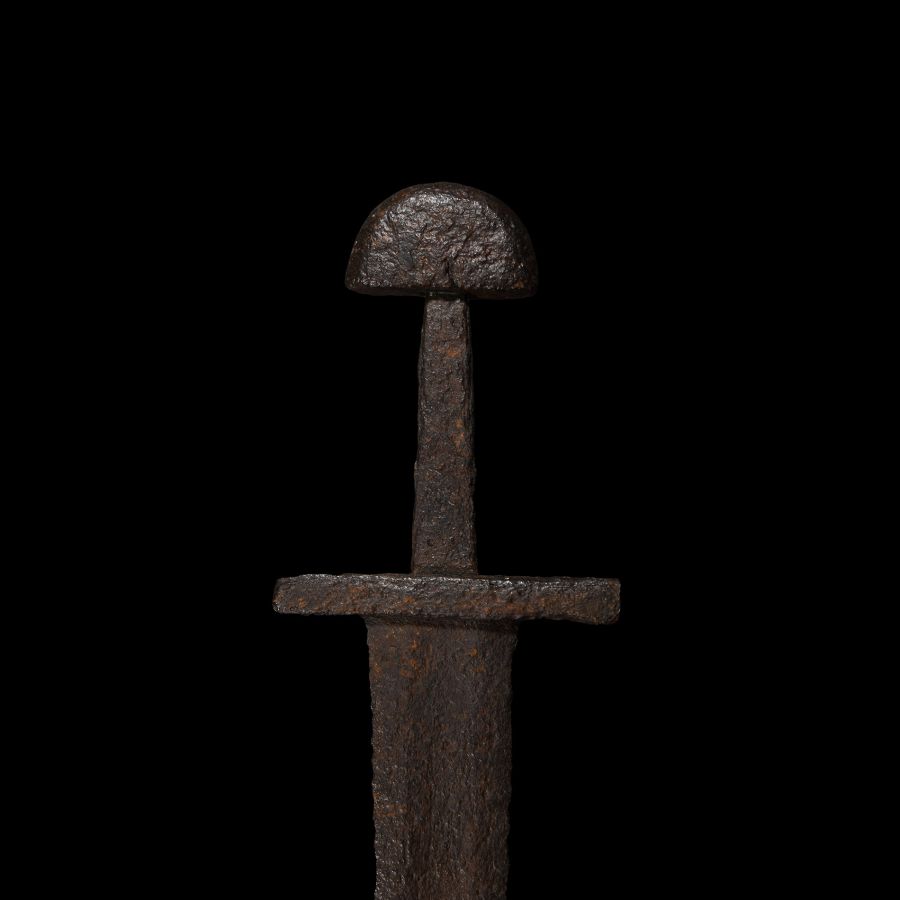
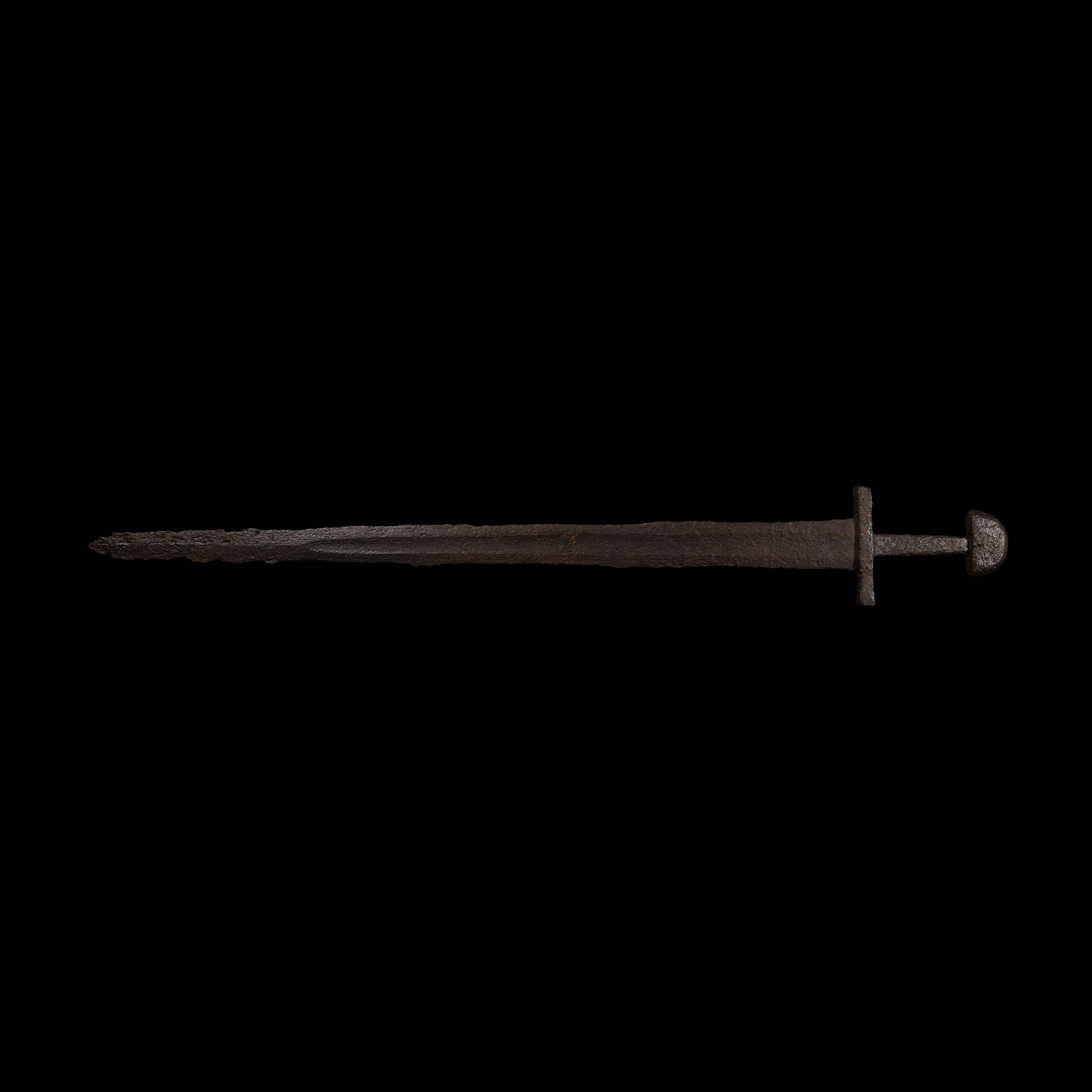
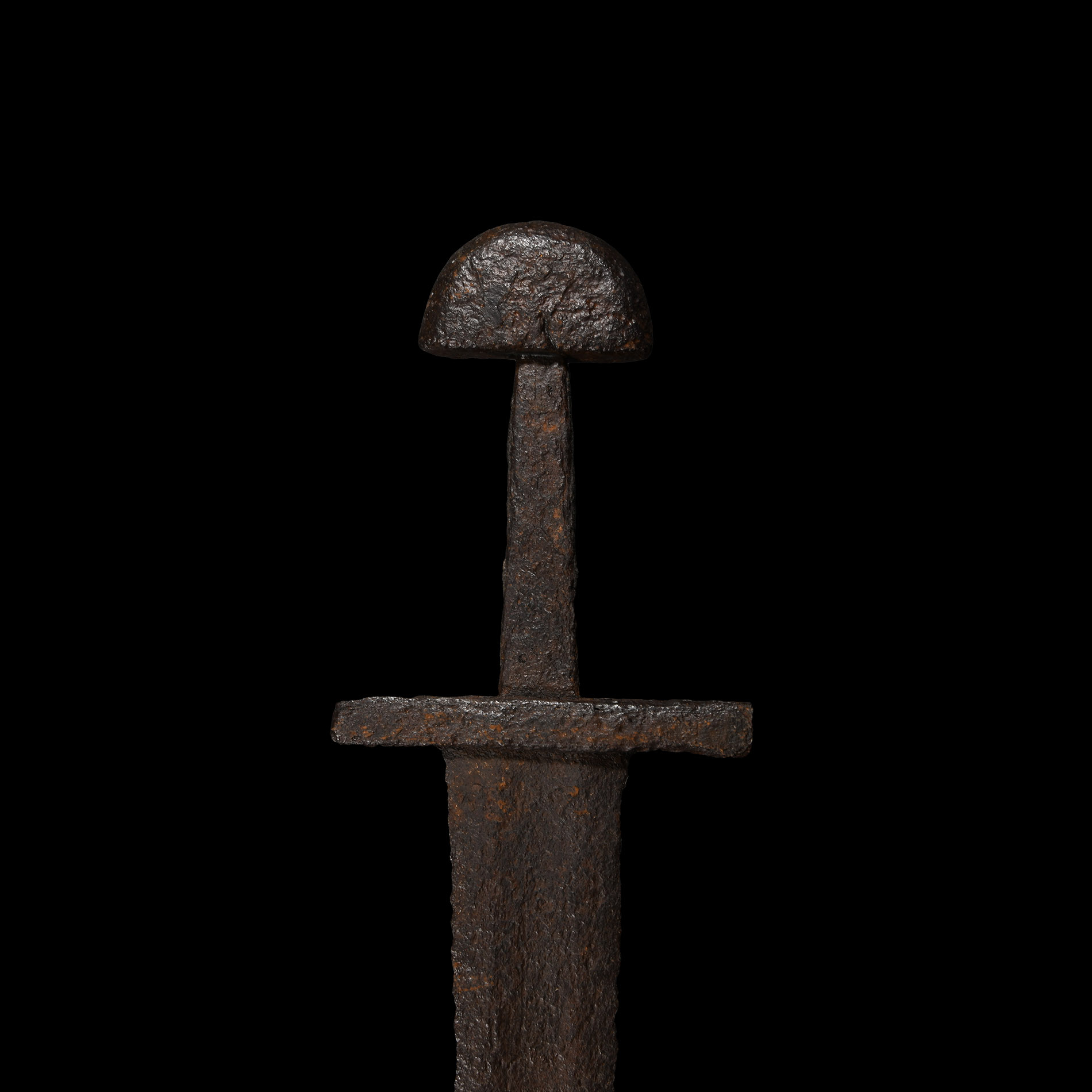
Viking Age Iron Sword of Petersen Type X
10TH-11TH CENTURY A.D.
36 1/2 in. (1.2 kg, 92.5 cm).
Comprising a fine double-edged tapering blade, shallow fullers and defined cutting edges showing traces of employment; short, rectangular-section lower guard and tapering tang, tea-cosy pommel of early type; some restoration.
ProvenanceAcquired 1990s-early 2000s.
East Anglian private collection.
Accompanied by an academic report by Dr Raffaele D'Amato.
Cf. Rudolph Lepke's Kunst-Auctions-Haus, 1384, Waffen-und Kunst-Sammlung Karl Gimbel, Baden-Baden, 1904, no.330; Petersen, J., De Norske Vikingsverd, Oslo, 1919; Oakeshott, E., Records of the Medieval Sword, Woodbridge, 1991; Renaud, J., Les Vikings en France, Rennes, 2000; Roesdahl, E., Wilson D.M., From Viking to Crusader: The Scandinavians and Europe 800 to 1200 (22nd Council of Europe Exhibition), Copenhagen, 1992; Peirce, I., Swords of the Viking Age, Suffolk, 2002.
FootnotesThe sword is Petersen type X (Petersen, 1919, pp.158ff) and Oakeshott type XI (1991, pp.53ff.), finding good parallels in various similar Viking and Norman age specimens (Peirce, 2002, pp.115 ff.). The overall proportions of our specimen are eye-catching and it is strikingly similar to a pattern-welded sword found with a large number of other objects, at Camp de Péran, Côtes-d'Armor, France, in a 10th century context, probably linked with the early Norman settlers in Normandy or Norman raids in Brittany (Roesdhal, Wilson, 1992, p.321, cat. n.359; Renaud, 2000, p.100).
CONDITIONTimeLine Auctions follows a vetting process to ensure the authenticity and legality of all items, reinforcing our commitment to integrity and responsible trading. Each antiquity, antique, and coin lot undergoes thorough examination by a vetting committee of at least ten external specialists, professional trade association members, scientists, and archaeologists: Our Vetting Process
AUCTIONS:
TimeLine is a leading auction house specialising in antiquities, ancient art, collectables, natural history, coins, medals, and books. Our auctions offer museums, collectors, historians, and enthusiasts the opportunity to acquire unique and historically significant pieces.
-
Roman Iron Gladius
1st-2nd century A.D.Estimate: £1,800 - 2,400 (+bp*)
Opening Bid: £722
Or semi-spatha blade with parallel-sided lentoid-section body and a long rectangular-section tang; Mainz type, Wederath-Canterbury-Kopki variant; repaired and surface treated. 557 grams, 83 cm
Ex South London collection, acquired 1970-1990. The Kusmirek Collection, UK. Accompanied by an academic report by Dr Raffaele D'Amato.
In contrast to the average length of the Roman Pompeii type gladius, some Roman swords, continuing the typology of the Mainz gladius, tend to be longer and transform themselves into a semi-spatha. Both the weapon from Eich (Miks, 2001, AI43), and especially a gladius from Korytnica with approximate blade length of 548mm (total length 762mm) is very close to the length limit of a semi-spatha. The same can be said of a blade from Godmanchester (Miks, 2001, no.A824) for its dimensions and proportions, where the tip of the blade already gives a significantly shorter impression, showing a certain relationship to 'Lauriacum-Hrornöwka', 'Mainz-Canterbury' variant type spathae. -
Colt .41 Rimfire Derringer Pistol and Book Case
19th century A.D.Sold for (Inc. bp): £572
Comprising a Colt .41 calibre single action rimfire single-shot derringer pocket pistol, the barrel top marked 'COLT' and the left frame '41 CAL'; with nickel-plated brass frame and steel rifled barrel (swivel to load) and bird's beak butt with plain wood grips; the pistol contained in an original case formed from a hollowed out leather-bound book Pratique du Sacrament de Penitence ou Methode pour L'Administrer Utilement, published Paris, 1714, the compartment lined with marbled paper with section for spare bullets; action in working order. 450 grams total, book 17 x 10 cm
Acquired from Holts Auction, 2020, lot 899. Formerly with a Kent collector. With TimeLine Auctions, lot 1086. Property of an Australian collector. Accompanied by Holts lot ticket.
Sold as an exempt item under Section 58 (2) of the Firearms Act, 1968, to be held as a curiosity or ornament. No license required but buyer must be over 18 years of age. Overseas bidders should note that, due to UK regulations governing export of all firearms, overseas buyers will need to make arrangements for shipping this lot out of the UK directly, by air freight, with a specialist company or agent. -
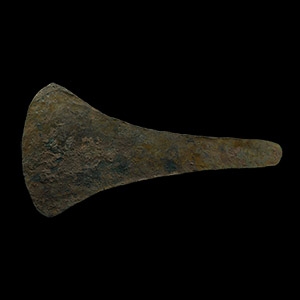
Western Asiatic Bronze Flat Axe
Circa 2nd millennium B.C.Sold for (Inc. bp): £78
Featuring wedge-shaped cheeks, a convex cutting edge and rounded terminal. 106 grams, 18.6 cm
UK private collection formed before 2000. Ex North London, UK, gallery.
The flat axe belongs to Type 1, sub-type a.4 of the Çetin-Bilgi classification of flat axes. They have concave-sided blade, rectangular in section, a splayed cutting edge and a narrow butt. The first examples of axe-type weapons appear in the last phase of the Late Chalcolithic Age in the Middle East and Anatolia.
