
Loading, please wait...
LOT 1383
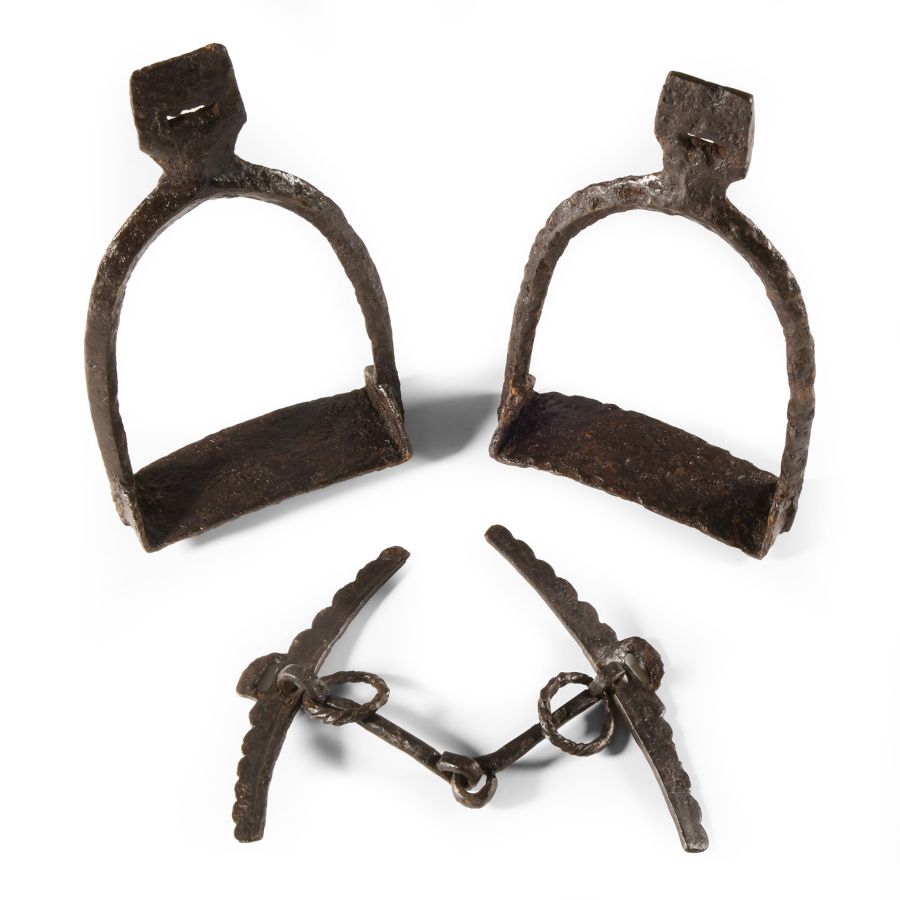
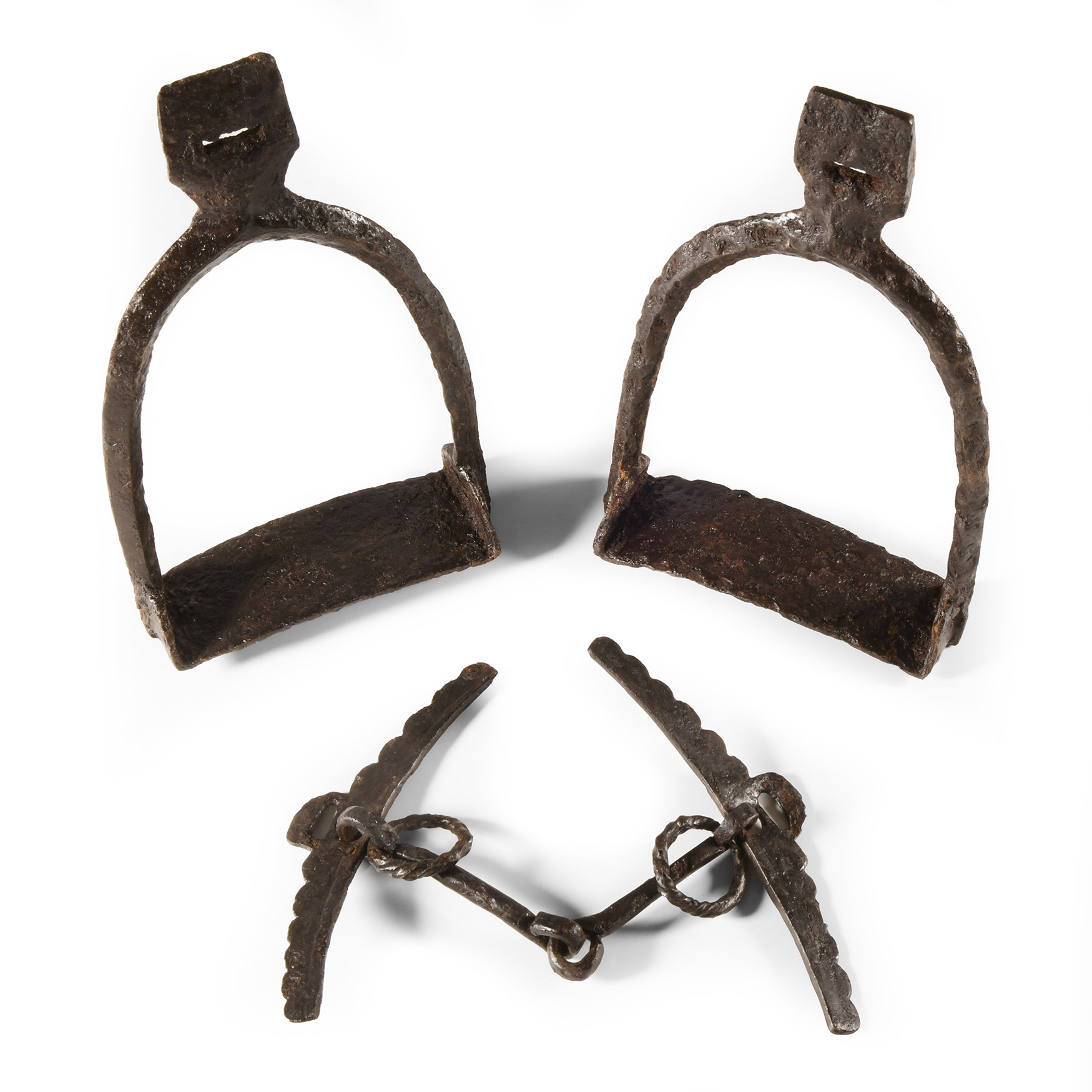
Viking Age Iron Stirrup Pair with Horse Bit
9TH-11TH CENTURY A.D.
7 3/4 - 7 7/8 in. (821 grams total, 19.5-20 cm).
Comprising: two hand-forged iron stirrups each with a reinforcing strap beneath the footplate, slotted suspension plate; snaffle-bit with hooked outer ends each with a twisted-rod ring and a curved transverse bar with dentilled lower edge. [3, No Reserve]
ProvenanceFrom the private collection of a London gentleman, from his grandfather's collection formed before the early 1970s.
LiteratureCf. Arbman, H., Birka I: Die Gräber, Uppsala, 1940, pl.33(2), for type.
CONDITIONTimeLine Auctions follows a vetting process to ensure the authenticity and legality of all items, reinforcing our commitment to integrity and responsible trading. Each antiquity, antique, and coin lot undergoes thorough examination by a vetting committee of at least ten external specialists, professional trade association members, scientists, and archaeologists: Our Vetting Process
AUCTIONS:
TimeLine is a leading auction house specialising in antiquities, ancient art, collectables, natural history, coins, medals, and books. Our auctions offer museums, collectors, historians, and enthusiasts the opportunity to acquire unique and historically significant pieces.
-
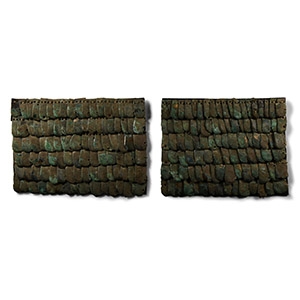
Scythian Scale Armour Sections
6th-5th century B.C.Sold for (Inc. bp): £2,340
Two panels from a scale armour coat composed of more than two hundred overlapping bronze scales, each mounted onto a custom-made leather panel for purposes of display; the scales formed in different series, some having holes only in the upper part, some with three holes in the upper part and two holes to the left, and others showing three upper holes and one side hole. 255 grams total, 15.2-16.5 cm
From the private collection of a London gentleman, from his grandfather's collection formed before the early 1970s. Accompanied by an academic report by Dr Raffaele D’Amato. This lot has been checked against the Interpol Database of stolen works of art and is accompanied by a search certificate number no.12044-216404.
The favourite armour of the Scythian noblemen was composed of scales, usually protecting the torso, sometimes the entire body (kataphraktoi). The Scythians found that the most efficient method was to arrange the overlapping ‘fish-scales’ as a corselet made of a number of bronze and iron plates, which then protected the wearer against sword and spear thrusts. Our scales correspond well to bronze scales found in May 1961 in an accidentally destroyed burial in a barrow, near the village of Nadezhda Sovetsky district. They were discovered together with iron scales, a Greek Corinthian helmet, fragments of an amphora, five arrowheads and fragments of an iron sword. Most of these bronze scales were oblong in shape, with a sub-rectangular upper end and a rounded lower end, but slightly bigger than our scales. -
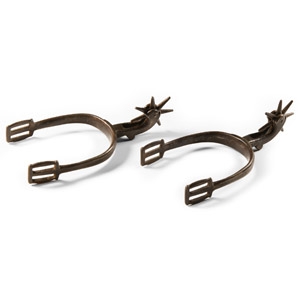
Iron Rowel Spur Pair
18th-19th century A.D.Sold for (Inc. bp): £78
Matched pair each with strap-slots to each end of the yoke, curved neck with seven-pointed rowel. 178 grams total, 13.5 cm each
Property of an Essex, UK, gentleman. -
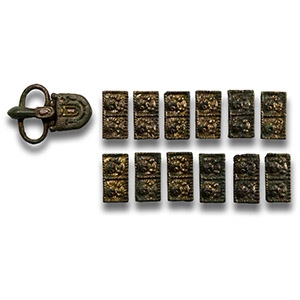
Byzantine Bronze Belt Fitting Set
6th-7th century A.D.Sold for (Inc. bp): £585
Comprising twelve rectangular plaques and a garnet inlaid buckle, each of the plaques with a pair of low-relief emperor's busts within a pelletted frame. 150 grams total, 35-61 mm
From the private collection of a London gentleman, from his grandfather's collection formed before the early 1970s.
