
Loading, please wait...


LOT 0309
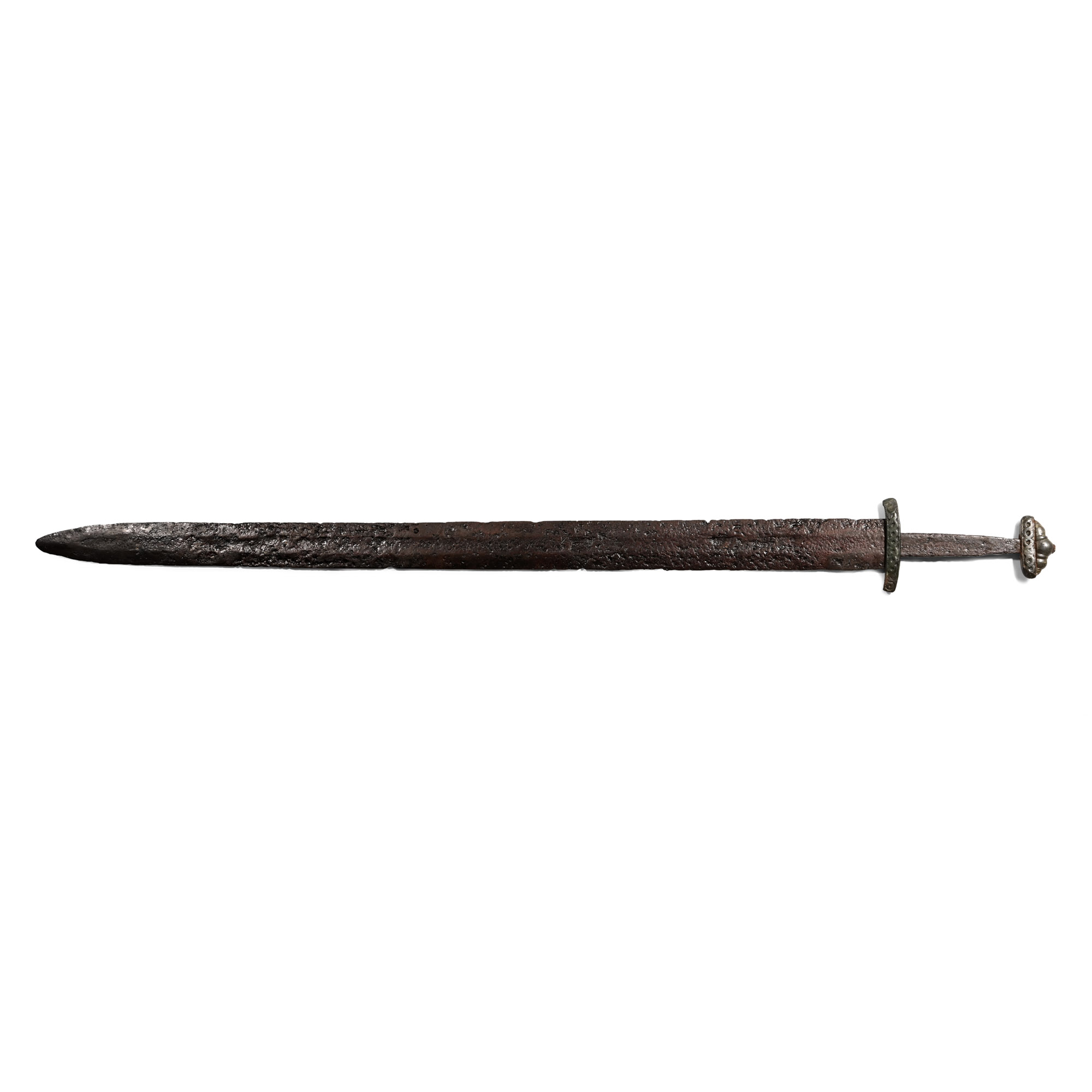
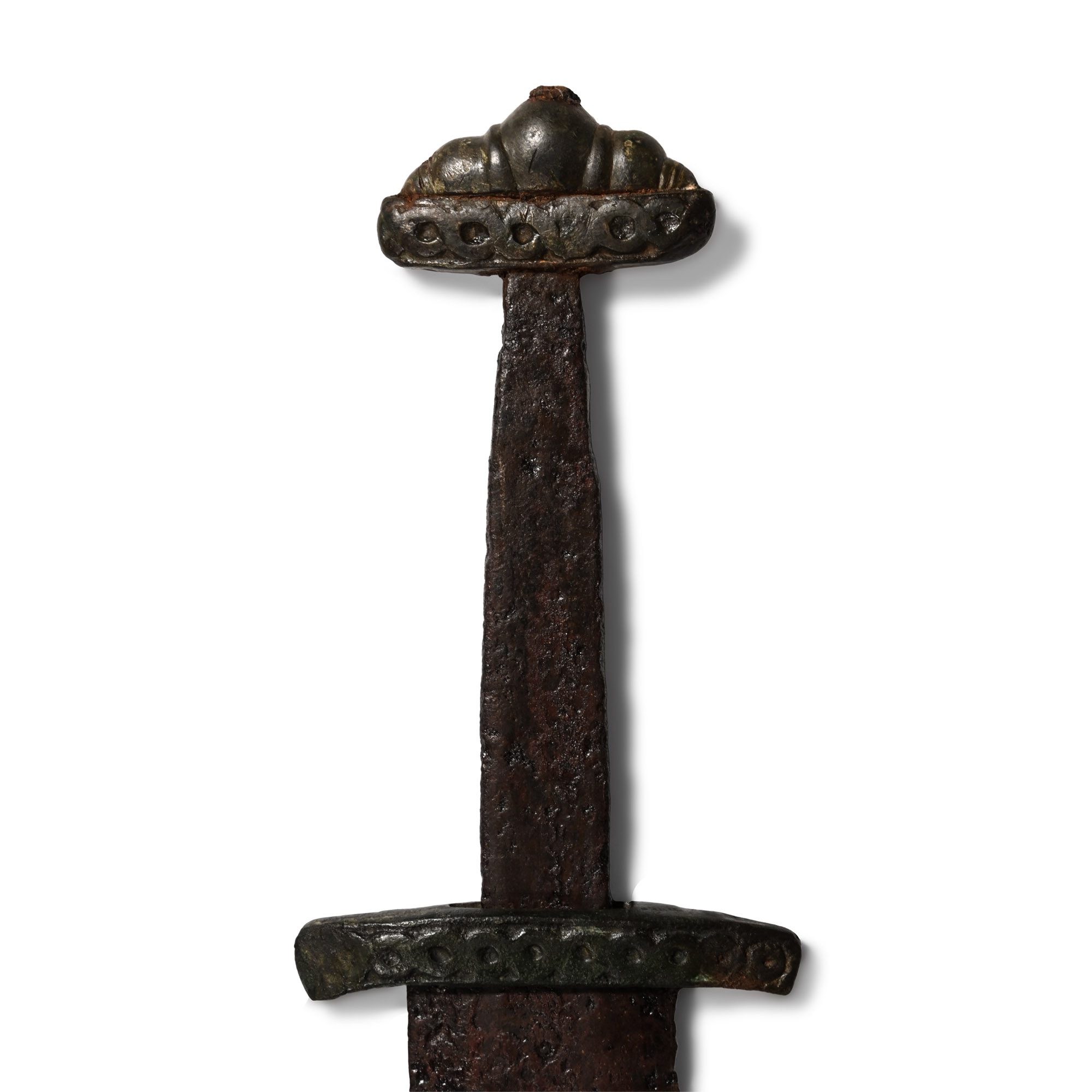
Viking Age Iron Pattern-Welded Sword with Bronze Jellinge Hilt
11TH-13TH CENTURY A.D.
36 5/8 in. (918 grams, 92.5 cm).
Double-edged cutting sword of Curonian Type with tapering fullers and showing battle scars; boat-shaped bronze cross-guard with Jellinge Style decoration, the seven-lobed pommel with similar decoration.
ProvenanceFrom the private collection of a London gentleman, from his grandfather's collection formed before the early 1970s.
Accompanied by an academic report by Dr Raffaele D’Amato.
This lot has been checked against the Interpol Database of stolen works of art and is accompanied by search certificate number no.12175-221434.
See Kazakevičius, Балтские мечи IX-XIII вв. (Baltic Swords, 9th-13th century AD), Vilnius, 1996; Peirce, I., Swords of the Viking Age, Suffolk, 2002.
FootnotesThe Curonian swords of this type, sometimes with animal head decoration on the lower guard, were widespread and used in the Eastern Baltic lands from 10th to 13th century. Curonian swords possessed both plastic hilt details (ends of the lower guards in the form of animal heads) of animal style, a clear influence from the Germanic style of Scandinavians, as well as a regular geometric ornament, a decoration motif derived from the Romanesque art.
CONDITIONTimeLine Auctions follows a vetting process to ensure the authenticity and legality of all items, reinforcing our commitment to integrity and responsible trading. Each antiquity, antique, and coin lot undergoes thorough examination by a vetting committee of at least ten external specialists, professional trade association members, scientists, and archaeologists: Our Vetting Process
AUCTIONS:
TimeLine is a leading auction house specialising in antiquities, ancient art, collectables, natural history, coins, medals, and books. Our auctions offer museums, collectors, historians, and enthusiasts the opportunity to acquire unique and historically significant pieces.
LOT 0309
Viking Age Iron Pattern-Welded Sword with Bronze Jellinge Hilt
Estimate £3,000 - 4,000€3,480 - 4,640 (for guidance only)$4,050 - 5,400 (for guidance only)
-
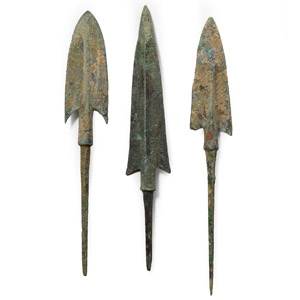
Luristan Bronze Arrowhead Group
Circa 14th-10th century B.C.Sold for (Inc. bp): £130
Each with a sturdy square-section tang, narrow barbed head with midrib. 98 grams total, 15.5-16 cm
Ex London, UK, collection, 1990s.
These arrowheads seem to belong to the type V, subcategory types A and C according to the classification of Khorasani and Negahban. In the four categories of triangular bronze arrowheads from Luristan, Marlik and Northern Iran individuated by Negahban, subtypes A and C of type V are larger arrow heads with barbed shoulders and triangular heads. These types of arrowheads were commonly used in Anatolia and Mesopotamia from the 2nd millennium B.C., but apparently their employment began earlier in this area, where types like these occur alongside the non-barbed, predominantly ribbed and tanged types. -
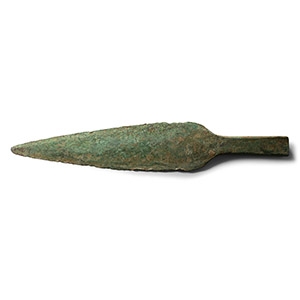
Luristan Bronze Sword with Handle
13th-7th century B.C.Estimate: £300 - 400 (+bp*)
Opening Bid: £150
Substantial with leaf-shaped blade, lentoid in section and with rounded tip, rectangular-section tang; blade with nicked and chipped edge. 890 grams, 42 cm
Acquired on the UK art market before 2000. Property of an Essex, UK, gentleman. -
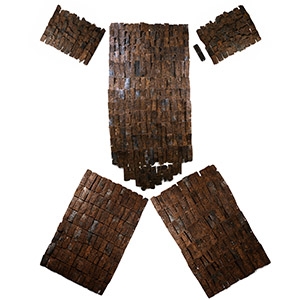
Jin Jurchen Warrior Signed Suit of Iron Plate Armor
Jin Dynasty, early 13th century A.D.Estimate: £6,000 - 8,000 (+bp*)
Opening Bid: £3,380
A complete suite of rectangular iron plates to form a protective coat; the plates provided with a series of holes close to the long edges by which they were laced together into articulating panels; one plate with inscription in Chinese script recording: 'first month of the Datong era / control of the propagation of Armour. Yanhui'. 8.5 kg total, 3-11.1 cm
From the private collection of a London gentleman, from his grandfather's collection formed before the early 1970s. Accompanied by an academic report by Dr Raffaele D’Amato. This lot has been checked against the Interpol Database of stolen works of art and is accompanied by a search certificate number no.12051-216403.
The Datong Era (大同, 1224–1233) is a name used for the reign of Puxian Wannu, a Jurchen warlord who established the Eastern Xia Dynasty in 13th century China. However, the war with the Jurchen states took more than 30 years: having first invaded the Jurchen borders in 1211, the Mongols finally defeated the Jin Empire only in 1234, while the Eastern Xia fell in 1246.
