Loading, please wait...

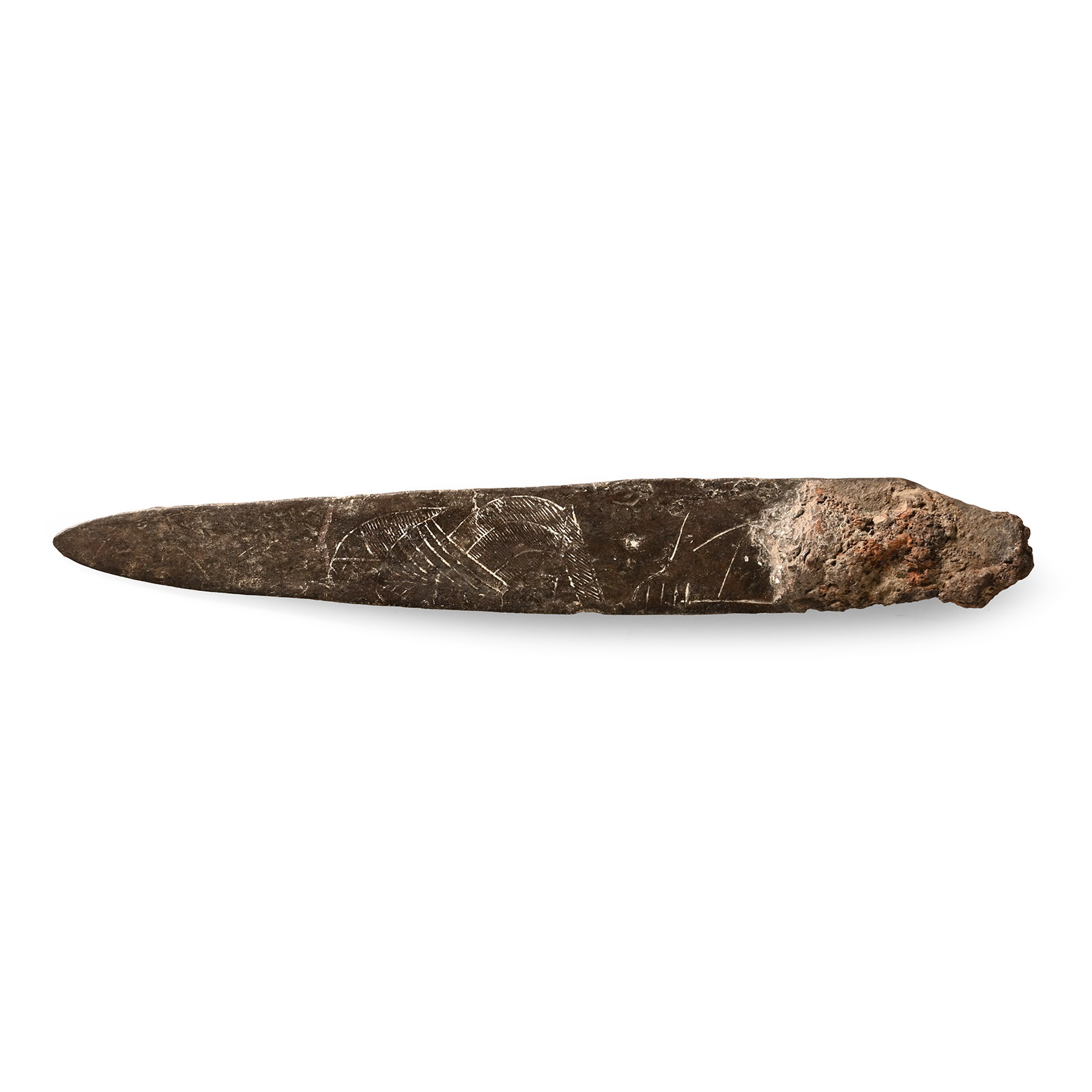
Viking Age Iron Knife with Decoration Viking Age Iron Knife with Decoration Viking Age Iron Knife with Decoration
Use mousewheel to zoom in and out, click to enlarge
Details

LOT 1720

Viking Age Iron Knife with Decoration

9TH-11TH CENTURY A.D.

5 3/4 in. (27 grams, 14.5 cm).

Two-edged blade with low-relief hatched zoomorphic ornament. [No Reserve]

Provenance

From a collection acquired on the UK art market from various auction houses and collections mostly before 2000.
From an important Cambridgeshire estate; thence by descent.

CONDITION
VETTING:

TimeLine Auctions follows a vetting process to ensure the authenticity and legality of all items, reinforcing our commitment to integrity and responsible trading. Each antiquity, antique, and coin lot undergoes thorough examination by a vetting committee of at least ten external specialists, professional trade association members, scientists, and archaeologists: Our Vetting Process


AUCTIONS:

TimeLine is a leading auction house specialising in antiquities, ancient art, collectables, natural history, coins, medals, and books. Our auctions offer museums, collectors, historians, and enthusiasts the opportunity to acquire unique and historically significant pieces.

LOT 1720

Viking Age Iron Knife with Decoration

Sold for (Inc. bp): £104

Print page

RELATED LOTS
  • Anglo-Scandinavian Viking Bronze Key with Openwork Handle
    Anglo-Scandinavian Viking Bronze Key with Openwork Handle
    9th-11th century A.D.

    Sold for (Inc. bp): £2,860

    With large discoid bow, barrel shank and hooked bit, trefoil slot to the rear edge; the large circular bow with openwork tree motif, pointillé detailing. 39 grams total, 58 mm


    From the collection of the famous author, writer and speaker, Gordon Bailey, Essex, UK; formed since 1968.

    In the Viking Age, keys were a symbol of power worn prominently attached to the belt or chatelaine of the lady of the household. Handing over the set of keys may have formed part of the marriage ceremony, when the bride accepted her new role as the leading female of the community. In Anglo-Saxon England, the contents of the locked areas (cupboards and chests) were the specific responsibility of the lady, the key-holder.

    Lot Details

  • Viking Age Iron Long Bearded Axe Head
    Viking Age Iron Long Bearded Axe Head
    Circa 10th-12th century A.D.

    Sold for (Inc. bp): £208

    With broad curved blade and short spur beneath the chin, narrow neck, deep socket with extended edge to the reverse. 603 grams, 14.5 cm


    From the private collection of a London gentleman, from his grandfather's collection formed before the early 1970s.

    The axe seems to be a variation of type IV of the Kirpichnikov classification of the Eastern Rus Axes typology. These axes appeared in the 10th century, and continued in the 10th-11th century.

    Lot Details

  • Large Viking Age Silver Bucket with Animal Figures
    Large Viking Age Silver Bucket with Animal Figures
    8th-9th century A.D.

    Estimate: £30,000 - 40,000 (+bp*)

    Opening Bid: £15,000

    A spectacular Sogdian sheet-silver bucket with drum-shaped body, narrow discoid repoussé base, bands of repoussé foliage to the body beneath a raised collar and fluted neck and rim; handle held by two securing hoops formed as miniature rams. 1.2 kg, 26.5 cm wide


    From an old private collection. with Oxus Fine Arts Pte. Ltd, Singapore. Acquired by the current owner in London, 2012. This lot has been checked against the Interpol Database of stolen works of art and is accompanied by a search certificate number no.12288-220840.

    Dr. Grigoriev, in his studies on Sogdian silver artworks, has traced specific Sogdian features of metalwork prototypes on the basis of the ceramic replicas. Some of these features were distinguished on gold and silver vessels which possess many other characteristics bringing them together. In our bucket, the style and the decoration of the flowers resemble those of the bucket with deer from Shirokovskoe (Perm, see Marshak, 1971, T,35), while the bands of repoussé foliage to the body beneath the raised collar and fluted neck and rim recall the decoration of the dish with deer from Rep’evka, in Samara Province (Darkevich, 1976, n.12).

    Lot Details

Stay up-to-date with the latest from TimeLine Auctions by joining our mailing list