
Loading, please wait...
_900x900.jpg "Viking Age Iron Kirghiz Type Broad Axehead")
_200x200.jpg "Viking Age Iron Kirghiz Type Broad Axehead")
.jpg "Viking Age Iron Kirghiz Type Broad Axehead")
LOT 1481
Viking Age Iron Kirghiz Type Broad Axehead
8TH-11TH CENTURY A.D.
6 1/2 in. (366 grams, 16.6 cm).
With a wide blade, lower lateral flanges to the socket, and a circular hammer extension to the rear. [No Reserve]
ProvenanceFrom a North American collection formed in the 1970s-1990s.
This lot is accompanied by an illustrated lot declaration signed by the Head of the Antiquities Department, Dr Raffaele D'Amato.
See Nicolle, D., Arms and Armour of the Crusading Era, 1050-1350 AD, volume II, London, 1999, pp.290ff, figs.752-753.
CONDITIONTimeLine Auctions follows a vetting process to ensure the authenticity and legality of all items, reinforcing our commitment to integrity and responsible trading. Each antiquity, antique, and coin lot undergoes thorough examination by a vetting committee of at least ten external specialists, professional trade association members, scientists, and archaeologists: Our Vetting Process
AUCTIONS:
TimeLine is a leading auction house specialising in antiquities, ancient art, collectables, natural history, coins, medals, and books. Our auctions offer museums, collectors, historians, and enthusiasts the opportunity to acquire unique and historically significant pieces.
-
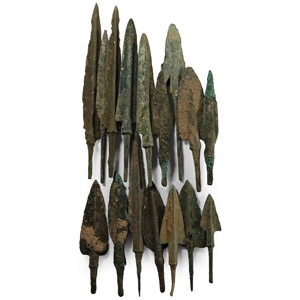
Luristan Bronze Arrowhead Collection
13th-6th century B.C.Sold for (Inc. bp): £182
Comprising a variety of tanged triangular and leaf-shaped arrowheads with thick mid-rib, one barbed-and-tanged example. 375 grams total, 7.7-16 cm
Ex London art market, 1980-1990s. This lot is accompanied by an illustrated lot declaration signed by the Head of the Antiquities Department, Dr Raffaele D'Amato.
One category of the represented arrowheads has a sharp, flat blade, the ends of which extend to form wings or barbs, and a prominent midrib extending into a long tang that often has a stop; the blade shape varies from deltoid to more triangular. Another form has no barbs, but it has a prominent midrib extending to the tang, and a narrow leaf-shaped blade. -
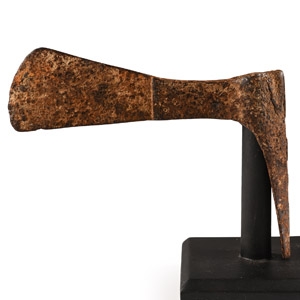
Luristan Iron Socketted Axehead
1st millennium B.C.Sold for (Inc. bp): £52
Narrow blade with rounded cutting edge, rectangular-section neck and round socket with extension below; mounted on a custom-made display stand. 259 grams, 17.5 cm (435 grams total, 20.5 cm wide including stand)
Ex London, UK, gallery, 1990s. This lot is accompanied by an illustrated lot declaration signed by the Head of the Antiquities Department, Dr Raffaele D'Amato. -
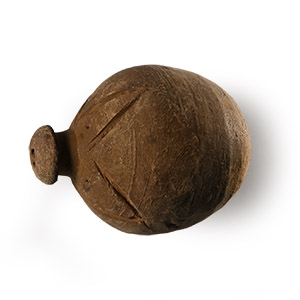
Byzantine 'Greek Fire' Ceramic Fire Bomb or Hand Grenade
9th-11th century A.D.Sold for (Inc. bp): £111
Bulbous in profile with domed mouth; radiating lines beneath the neck; intended to be filled with explosive liquid and wick, used as a hand grenade. 395 grams, 11.3 cm
From an important specialist collection, London, UK, 1990s onwards. Accompanied by an academic paper by military specialist Dr Raffaele D'Amato, dated 15 July 2019 and titled 'Eastern Roman Empire - Greek Fire Bomb or Hand Grenade (μεσαίον kακάβιον) 9th-11th century AD'. This lot is accompanied by an illustrated lot declaration signed by the Head of the Antiquities Department, Dr Raffaele D'Amato.
Apart from the use of siphons or manual flame-throwers called cheirosiphona, special corps of Roman soldiers employed terracotta grenades, in the form of small jars, abundantly evidenced in archaeological excavations. They were called μεσαία kακαβιά or κυτροκακάβια where the former had a bulbous shape and the latter a more cylindrical form.
