
Loading, please wait...
LOT 1157
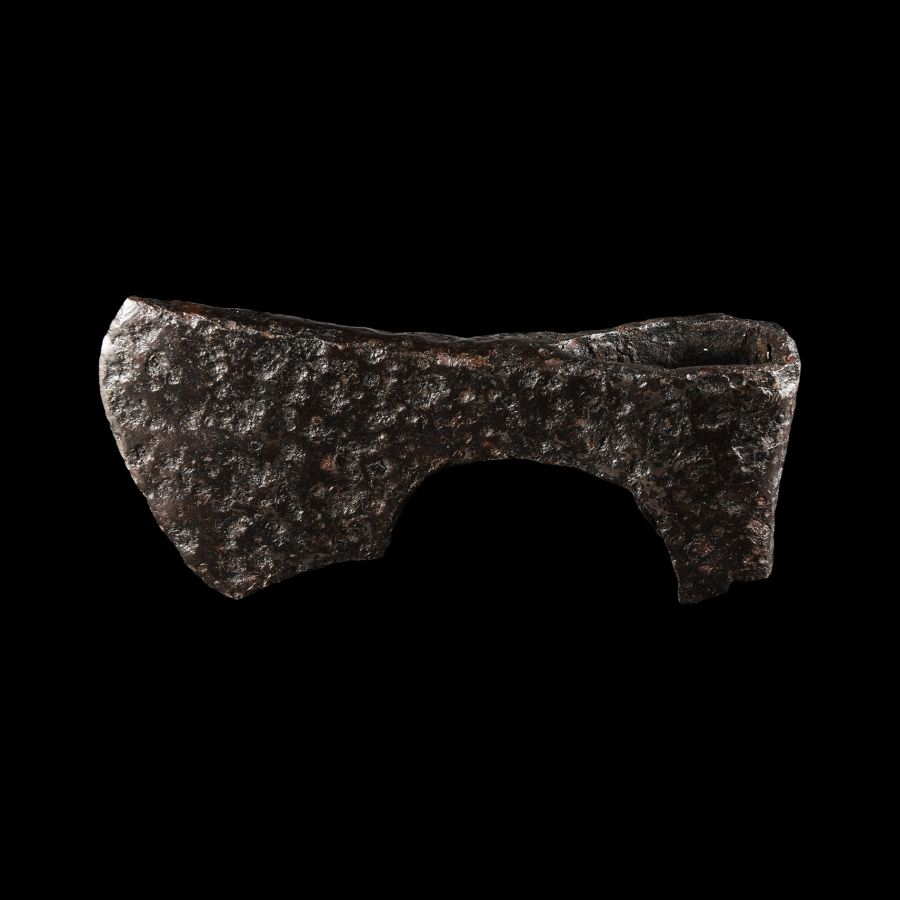
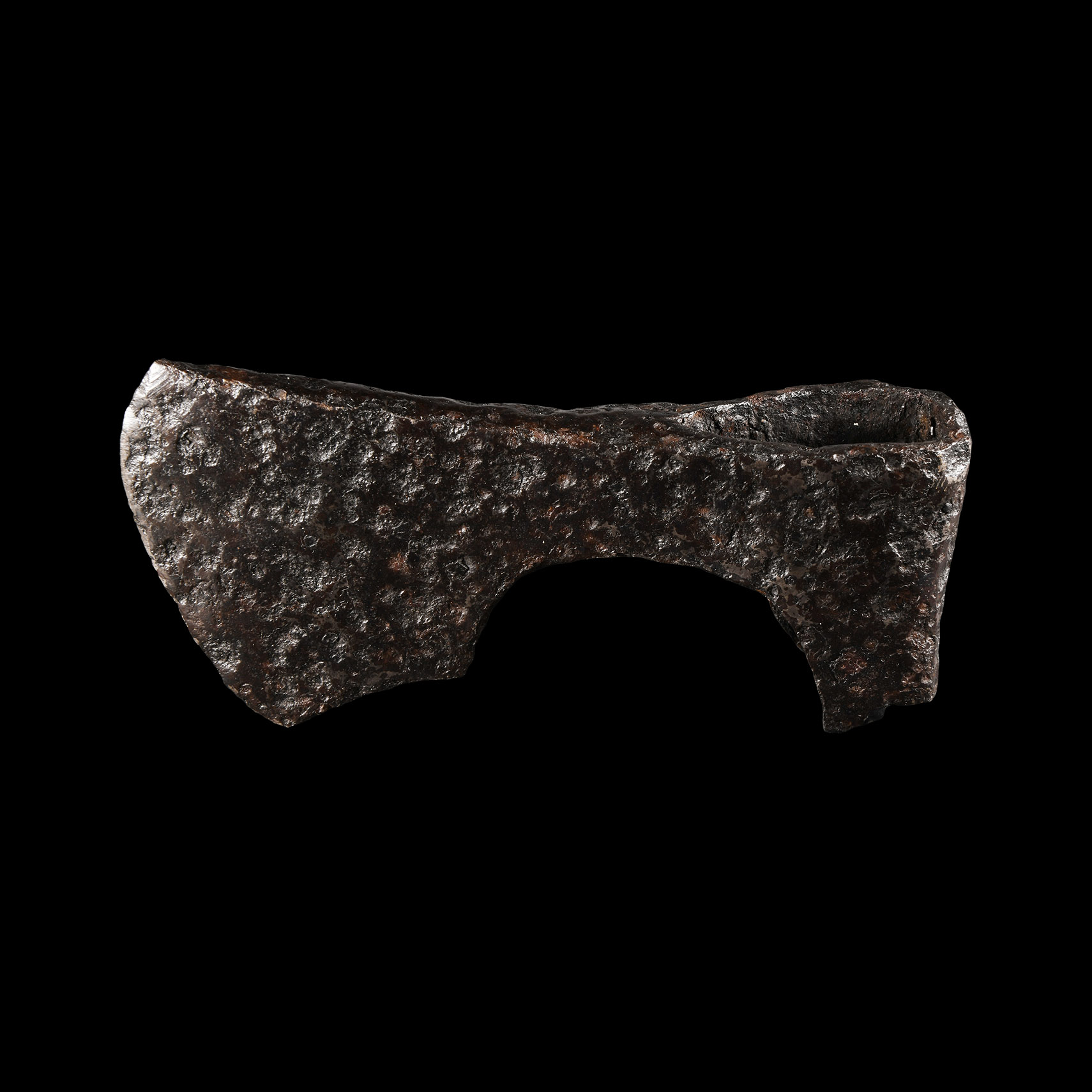
Viking Age Iron Bearded Axehead
9TH-13TH CENTURY A.D.
6 7/8 in. (779 grams, 17.5 cm).
Finno-Ugrian with triangular-section blade widening to a broad bevelled edge with spur to the underside, socket with extended lower sleeve. [No Reserve]
ProvenanceAcquired 1971-1972.
From the collection of the vendor's father.
Property of a London, UK, collector.
Cf. Nicolle, D., 'Raiders of the Ice War' in Military Illustrated, March, 1996, no.94, pp.26-29, fig.p.28, for similar axes; Sedov, B.B., Finno-Ugri i Balti v Epokhi Srednevekovija, Moscow, 1987, pl.I, no.23.
FootnotesDuring their struggles against Germans and Teutonic Knights, deceased pagans were often cremated along with damaged or ceremonially sacrificed weaponry. If swords were generally reserved for the military elite, the side axe was one of the most commonly used weapons.
CONDITIONTimeLine Auctions follows a vetting process to ensure the authenticity and legality of all items, reinforcing our commitment to integrity and responsible trading. Each antiquity, antique, and coin lot undergoes thorough examination by a vetting committee of at least ten external specialists, professional trade association members, scientists, and archaeologists: Our Vetting Process
AUCTIONS:
TimeLine is a leading auction house specialising in antiquities, ancient art, collectables, natural history, coins, medals, and books. Our auctions offer museums, collectors, historians, and enthusiasts the opportunity to acquire unique and historically significant pieces.
-
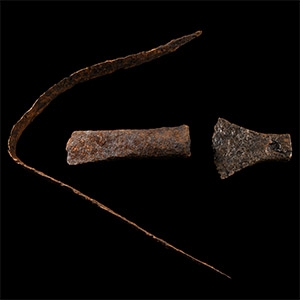
Iron Age Celtic Sacrificed Sword and Axehead Group
2nd century B.C.-1st century A.D.Sold for (Inc. bp): £312
Ritualistically bent in the middle of the blade; together with two socketted axeheads, one Roman, one Celtic. 1.25 kg total, 10-60 cm
Acquired 1990s-early 2000s. East Anglian private collection. -
.jpg)
Georgian Flintlock Brass Blunderbuss with Spring Bayonet
18th century A.D.Sold for (Inc. bp): £2,340
Featuring steel flintlock action and spring-hinged triangular section bayonet with sliding retaining catch; the wood stock fitted with brass butt plate, side plate, trigger guard, ramrod mounts and escutcheon; a wood ramrod with brass ram tip and steel screw extractor fitted to underside of barrel; the barrel numbered 'A098' to right side near lock and the bayonet with number '86' at hinge; traces of original blued finish to lock; the lock and bayonet mechanisms in working order. 2.64 kg, 97 cm overall
Acquired 1960s-1990s. Late Alison Barker collection, a retired London barrister.
Sold as an exempt item under Section 58 (2) of the Firearms Act, 1968, to be held as a curiosity or ornament. No license required but buyer must be over 18 years of age. Overseas bidders should note that, due to UK regulations governing export of all firearms, overseas buyers will need to make arrangements for shipping this lot out of the UK directly, by air freight, with a specialist company or agent. -
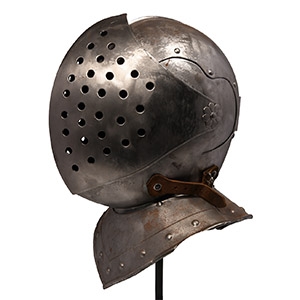
Italian Foot-Combat Helm
21st century A.D.Sold for (Inc. bp): £169
Comprising a pivoting visor, one piece skull raising to a small medial comb and fitted at the nape with a plume holder, flower-shaped pivots, front and rear gorget formed of a single plate. 3.9 kg, 37 cm high
The Kusmirek Collection, UK.
The helmet is a reproduction of a foot-combat helm, or great bascinet, used between the end of 15th and the first half of 16th century in the battles and tournaments. A similar helmet is that of Sir Giles Capel (1485-1556), a prominent figure at Henry VIII's court. These helmets were characterised by a unique rounded pierced visor with (here 60) slots for sight and ventilation. Helmets of this massive size and distinctive type were intended for foot-combat, a sporting contest fought by two fully armoured warriors armed with poleaxes, spears or swords. However, in this reproduction the visor has been mounted upon a separated collar.
