
Loading, please wait...
LOT 1088
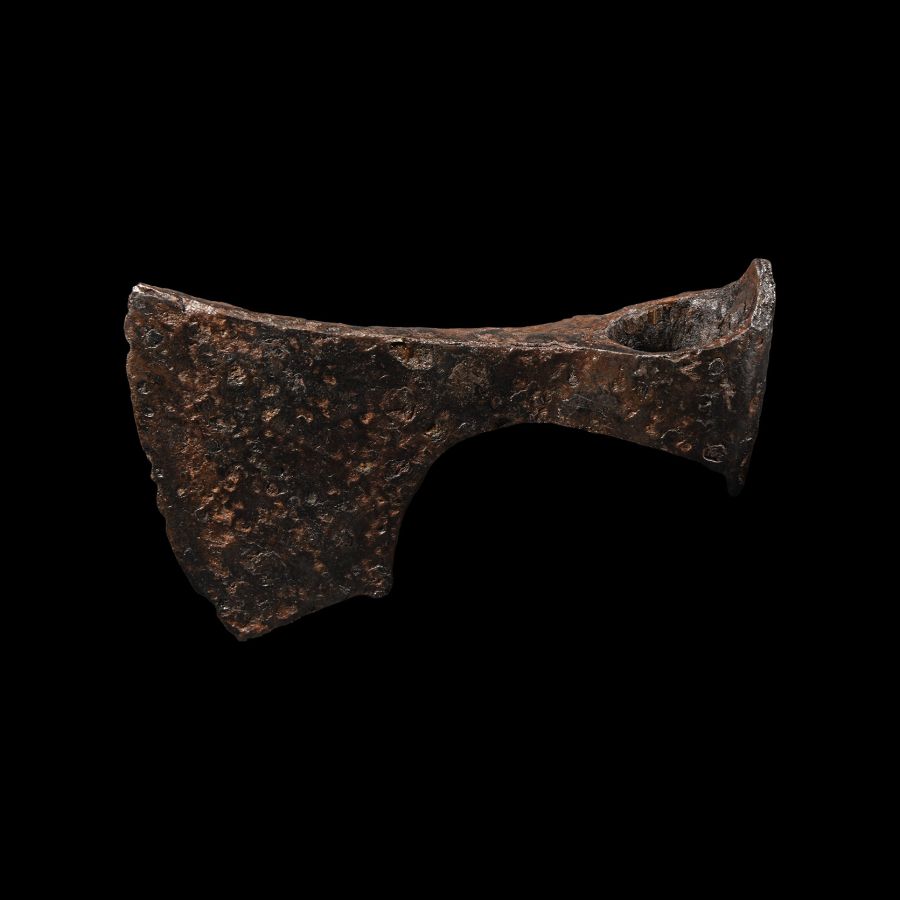
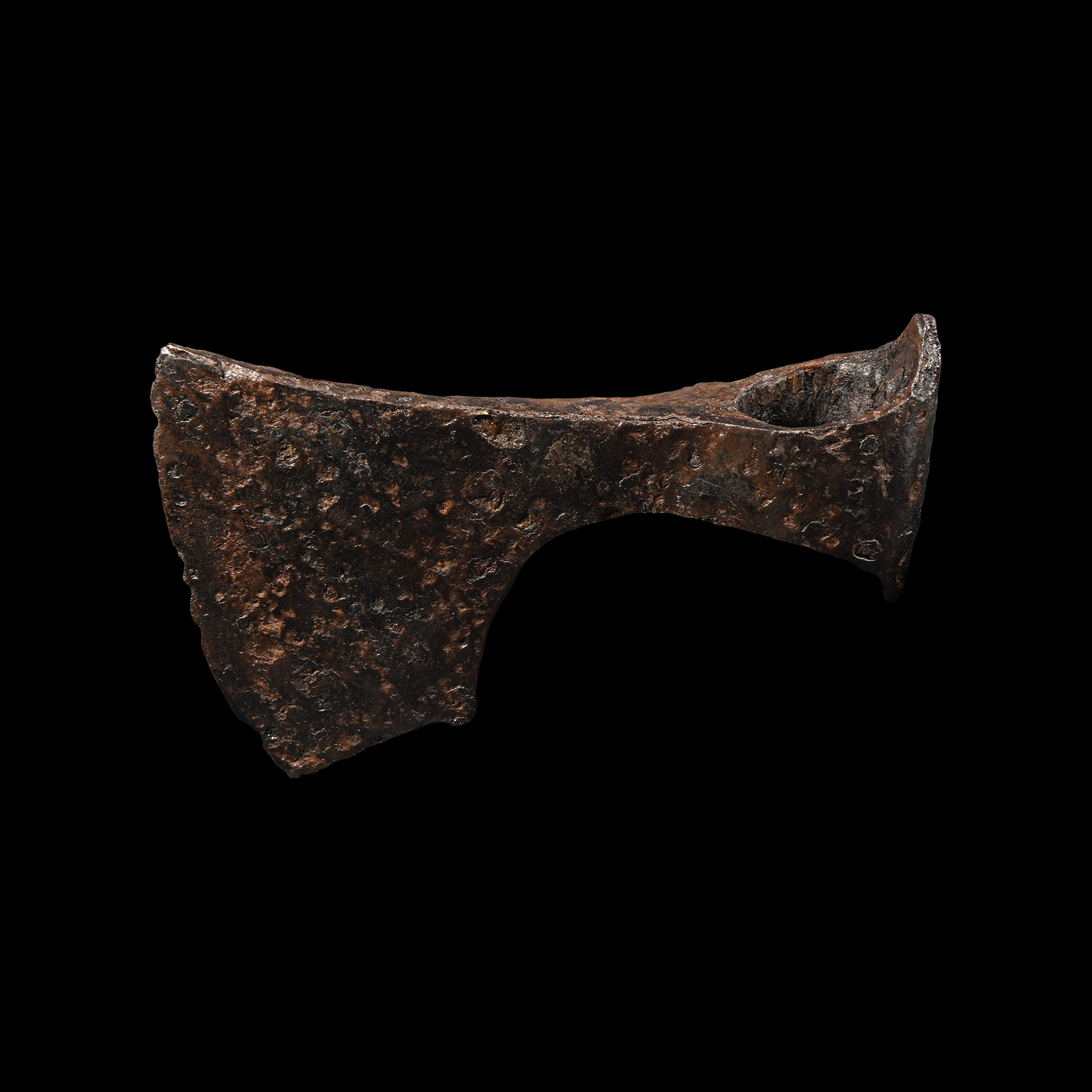
Viking Age Iron Bearded Axehead
9TH-13TH CENTURY A.D.
6 3/8 in. (498 grams, 16.2 cm).
Finno-Ugrian with scooped socket, broad blade with extension to the lower edge, hole to the blade, possibly of Baltic workmanship. [No Reserve]
ProvenanceAcquired 1971-1972.
From the collection of the vendor's father.
Property of a London, UK, collector.
Cf. Nicolle, D., 'Raiders of the Ice War' in Military Illustrated, March, 1996, no.94, pp.26-29, fig.p.28, for similar axes; Sedov, B.B., Finno-Ugri i Balti v Epokhi Srednevekovija, Moscow, 1987, pl.V, item 16.
FootnotesDuring their struggles against Germans and Teutonic Knights, deceased pagans were often cremated along with damaged or ceremonially sacrificed weaponry. If swords were generally reserved for the military elite, the side axe was one of the most commonly used weapons.
CONDITIONTimeLine Auctions follows a vetting process to ensure the authenticity and legality of all items, reinforcing our commitment to integrity and responsible trading. Each antiquity, antique, and coin lot undergoes thorough examination by a vetting committee of at least ten external specialists, professional trade association members, scientists, and archaeologists: Our Vetting Process
AUCTIONS:
TimeLine is a leading auction house specialising in antiquities, ancient art, collectables, natural history, coins, medals, and books. Our auctions offer museums, collectors, historians, and enthusiasts the opportunity to acquire unique and historically significant pieces.
-
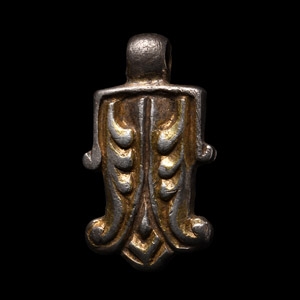
Khazar Silver-Gilt Sword Belt Hanger
7th-8th century A.D.Sold for (Inc. bp): £140
Formed as leaves or a flower bud with volutes emerging from a rectangular frame at the upper end, also with volutes, integral loop above; two mounting lugs to the reverse. 6.03 grams, 27 mm
Fine condition.
Acquired in the 1980s-1990s. Ex an important central London gallery, London W1.
In the development of the Seversky Donets basin, together with the Alans and other bearers of the cremation rite, archaeology confirms the presence of tribes who practiced inhumation funeral rite with the eastern orientation of the dead (Netailovsky ground burial). Elements of belt sets, typical for this period, were found in these graves. Elements of the belt set similar to those found in the burials of the Netailovsky burial ground mainly come from the so-called ‘under-barrow burials with ditches’ of the 7th - first half of the 8th centuries, identified with the Khazars proper. Floral decoration of the belt elements, like this one, can be regarded as evidence of intensive contacts between the Khazars and Byzantium. -
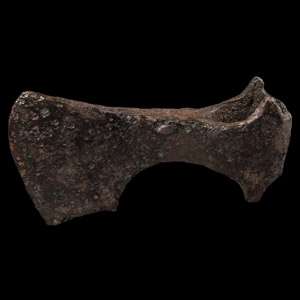
Viking Age Iron Bearded Axehead
10th-13th century A.D.Sold for (Inc. bp): £208
Finno-Ugrian iron forged with triangular-section narrow blade widening to a broad bevelled edge with square chin and spur to the rear, socket with flanges to the rear. 821 grams, 17 cm
Acquired 1971-1972. From the collection of the vendor's father. Property of a London, UK, collector.
During the mid 13th century, the axes were favourite weapons among Baltic people. For instance the Curonian army included lightly armed soldiers who fought with spears, shields, fighting knives and axes. A heavily armed soldier could also carry a sword, a helmet, a shield and a wide bladed axe. -
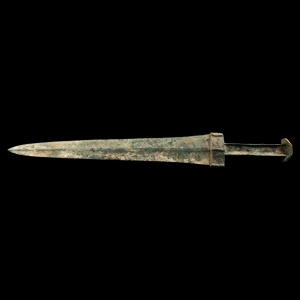
Luristan Bronze Dagger
2nd-1st millennium B.C.Estimate: £300 - 400 (+bp*)
Opening Bid: £160
Comprising a narrow double-edged blade, triangular in profile with raised midrib, rectangular guard with flanges, rectangular grip with lateral flanges to accept an organic grip, curved integral finial. 312 grams, 43 cm
Ex German collection, Cologne, 1980-1990s.
This weapon is typical of the cemeteries dating to the local Late Bronze Age (1300-1000 B.C.). The blade is still triangular but the crescentic pommel is reduced and flanged to be filled with organic material such as bone or wood.
