
Loading, please wait...
LOT 0400
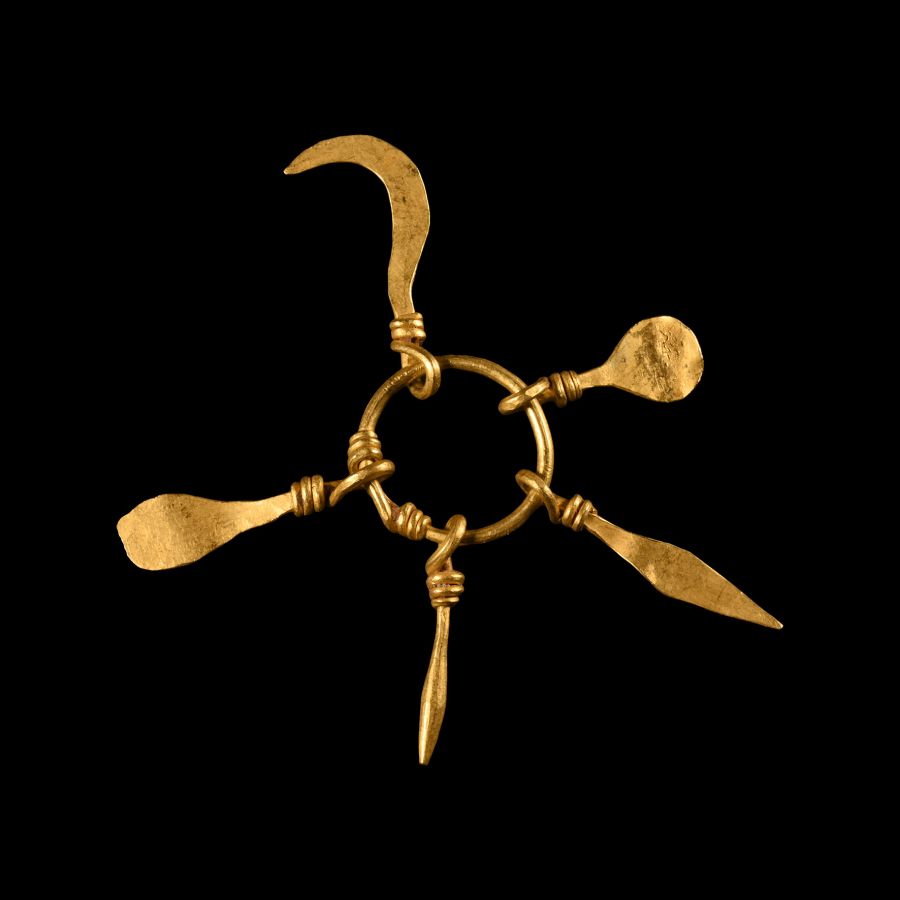
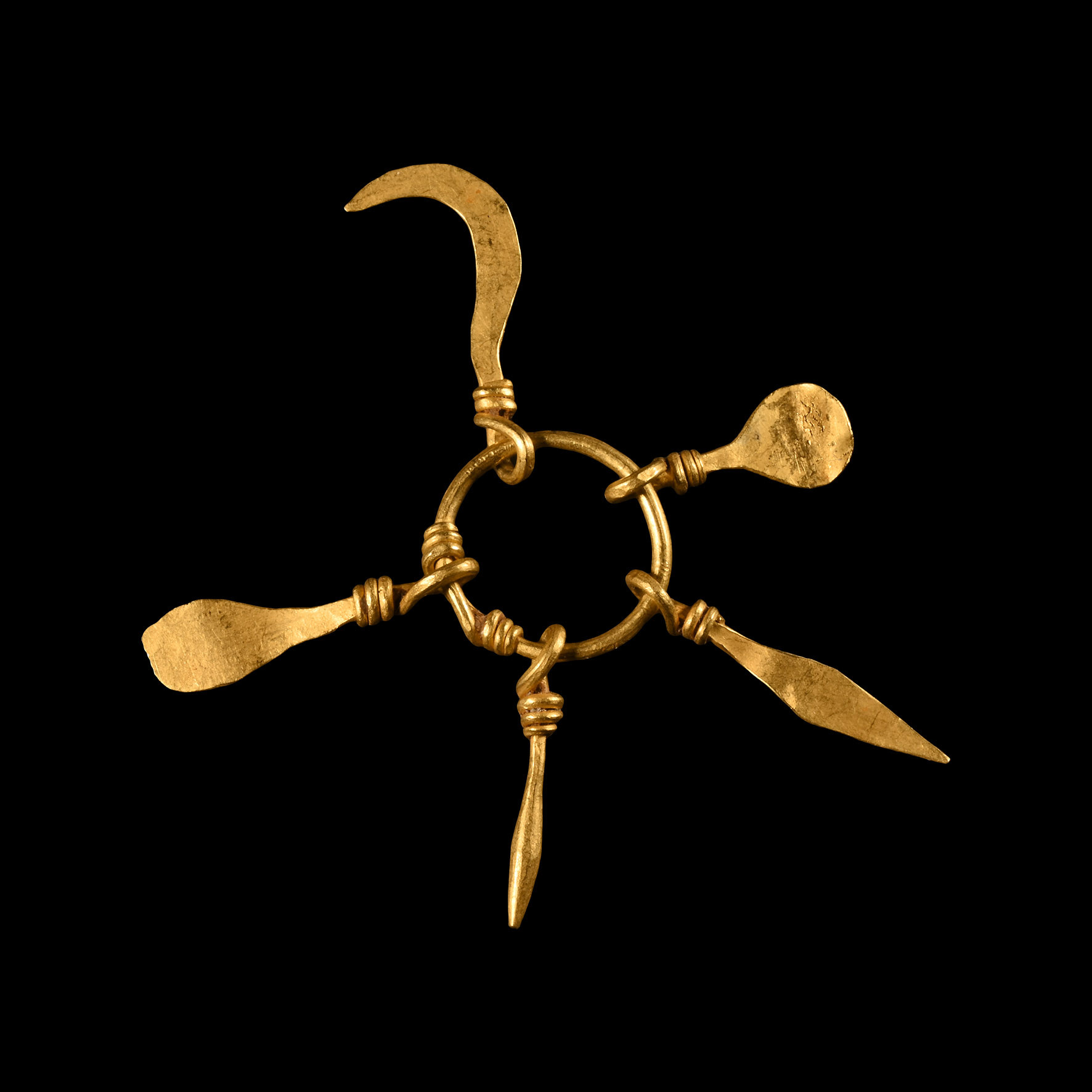
Viking Age Gold Ring with Five Pendants
CIRCA 8TH-10TH CENTURY A.D.
1 1/4 in. (2.81 grams, 30 mm).
Wire ring with ends wound around the shank; miniature tool pendants including a sickle, mirror, dagger, spike and skillet.
ProvenanceAcquired on the London art market in the late 1980s-1990s.
From the family collection of an East London, UK, gentleman.
Cf. Graham-Campbell, J., The Viking World, London, 1980, p.183, for type.
CONDITIONTimeLine Auctions follows a vetting process to ensure the authenticity and legality of all items, reinforcing our commitment to integrity and responsible trading. Each antiquity, antique, and coin lot undergoes thorough examination by a vetting committee of at least ten external specialists, professional trade association members, scientists, and archaeologists: Our Vetting Process
AUCTIONS:
TimeLine is a leading auction house specialising in antiquities, ancient art, collectables, natural history, coins, medals, and books. Our auctions offer museums, collectors, historians, and enthusiasts the opportunity to acquire unique and historically significant pieces.
-

Viking Age Gold 'Elf Shot' Pendant
9th-10th century A.D. or earlierSold for (Inc. bp): £1,105
Bell-shaped cup with suspension loop, inset irregular amethyst. 0.73 grams, 15 mm
From a late Japanese specialist collector, 1970-2000s.
This amulet was believed to offer protection against 'Elfshot'. The attack of elves was believed responsible for mysterious suffering in men and livestock. 'Elfshot' described sudden shooting pains localised to a particular area of the body, such as in rheumatism, arthritis or muscle stitches or cramps. Elves were thought to shoot darts or arrows where such pains had no obvious external cause. Belief in elfshot persisted into the 20th century in rural areas, and as proof country folk would sometimes find small arrowheads (the remains of Neolithic or Mesolithic flints, or naturally-occurring spear-shaped stones) that were believed to be the magical weapons that caused the afflictions. Belief in elfshot began in the Pagan Germanic period. -
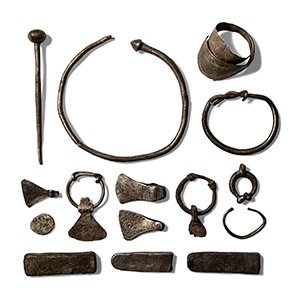
Viking Age Silver 'Hoard' Group
Circa 10th-12th century A.D.Estimate: £800 - 1,000 (+bp*)
Opening Bid: £400
Comprising: two dome-headed dress pins; three pieces of hack-silver ingot; five miniature axeheads; a mitre-shaped finger ring; and other items. 42.8 grams total, 9-53 mm
Acquired on the London art market in the late 1980s-1990s. From the family collection of an East London, UK, gentleman. -

Viking Age Bronze Sword Scabbard Chape Collection
10th-12th century A.D.Estimate: £500 - 700 (‡+bp*)
Opening Bid: £275
Comprising: a small and narrow type (Paulsen's Gruppe I 2, Untergruppe d) with an openwork panel to each face filled by a cross-shaped motif with curved cross-bar, and a dentilled upper edge to the mouth; a tongue-shaped type (Paulsen's Gruppe I 1) with an openwork centre and Ringerike style bird formed with looped bands, pellets to the pinions, a triangular in plan head joined to the inner faces of the ropework border forming the upper edge of the chape, with a wolf's head at the apex and stepped knop finial (apex and lower end of the chape damaged); two of the same type (Gruppe I 1) with a pair of scrolls in the central void and a 'knot' to the apex', one with ropework detailing and a wolf's head; a broad D-shaped plaque with a plain reverse plate riveted in place, guilloche band to the outer edge and interlaced vines to the centre. 118 grams total, 46-75 mm
From the collection of a North American gentleman, formed in the 1990s.
The chape with the dentilled upper edge bears a cross motif on which only the curvature of the cross-piece indicates its origin in the raven/eagle figure found more commonly on this type; as its ornament has developed a long way from its original form, it should be dated to the 11 or 12th century. The D-shaped plaque with the plain reverse is not in Paulsen's typology but appears to be derived from the smaller types in his Gruppe VII.
