
Loading, please wait...
_900x900.jpg "Viking Age Gilt Bronze Boar's Head Brooch")
_200x200.jpg "Viking Age Gilt Bronze Boar's Head Brooch")
_900x900.jpg "Viking Age Gilt Bronze Boar's Head Brooch")
_200x200.jpg "Viking Age Gilt Bronze Boar's Head Brooch")
.jpg "Viking Age Gilt Bronze Boar's Head Brooch")
.jpg "Viking Age Gilt Bronze Boar's Head Brooch")
LOT 0327
Viking Age Gilt Bronze Boar's Head Brooch
10TH-11TH CENTURY A.D.
1 7/8 in. (37 grams, 48 mm).
Retaining an articulate pin to reverse and geometric detailing to each face.
ProvenanceFrom the collection of a North American gentleman, formed in the 1990s.
LiteratureCf. MacGregor, A. et al., A Summary Catalogue of the Continental Archaeological Collections, Oxford, 1997, items 3.17, 318.
CONDITIONTimeLine Auctions follows a vetting process to ensure the authenticity and legality of all items, reinforcing our commitment to integrity and responsible trading. Each antiquity, antique, and coin lot undergoes thorough examination by a vetting committee of at least ten external specialists, professional trade association members, scientists, and archaeologists: Our Vetting Process
AUCTIONS:
TimeLine is a leading auction house specialising in antiquities, ancient art, collectables, natural history, coins, medals, and books. Our auctions offer museums, collectors, historians, and enthusiasts the opportunity to acquire unique and historically significant pieces.
LOT 0327
Viking Age Gilt Bronze Boar's Head Brooch
Estimate £600 - 800€700 - 930 (for guidance only)$810 - 1,080 (for guidance only)
-
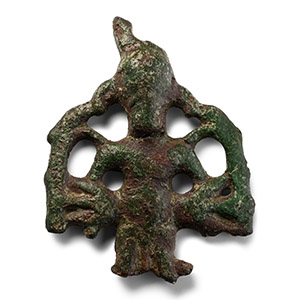
Anglo-Scandinavian Viking Bronze Bound Odin Openwork Stirrup Apex Mount Upper Section
11th century A.D.Sold for (Inc. bp): £208
Of an excessively rare example of Williams Class A, Type 3 showing a standing nude man with beard and long moustache, an animal-like form around the man's waist extending towards the flanking serpents on each side. 14.8 grams, 41 mm
Found Gloucestershire, UK.
Based on comparable examples, when complete the serpents' tails wrapped around the man's legs, and their open jaws gaped on either side of his head. -
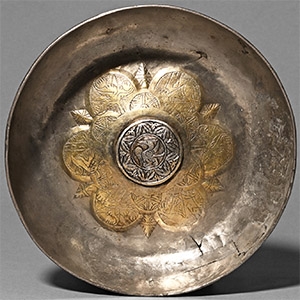
Scandinavian Silver Bowl with Embossed Centre
Circa 13th century A.D.Estimate: £4,000 - 6,000 (+bp*)
Opening Bid: £2,000
Dipping bowl, raised from a single sheet of silver, decorated with an incised rosette to the underside with central omphalos; rolled and everted rim; inner face with repoussé rosette, each petal with a stylised beast reserved on a pounced field; later applied central rosette with acanthus border, tondo with repoussé wyvern rampant. 134 grams, 15.5 cm
Acquired on the UK art market. Private collection, London. This lot has been checked against the Interpol Database of stolen works of art and is accompanied by search certificate number no.12978-244536. -
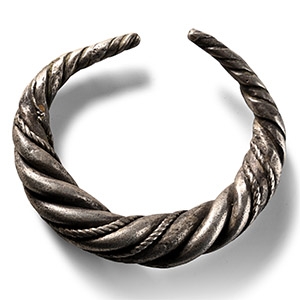
Heavy Viking Twisted Silver Bracelet
Circa 10th century A.D.Sold for (Inc. bp): £442
Penannular in form with tapering ends, ropework wire applied between the rounded rods. 128 grams, 76 mm
From the private collection of a London gentleman, from his grandfather's collection formed before the early 1970s.
