
Loading, please wait...


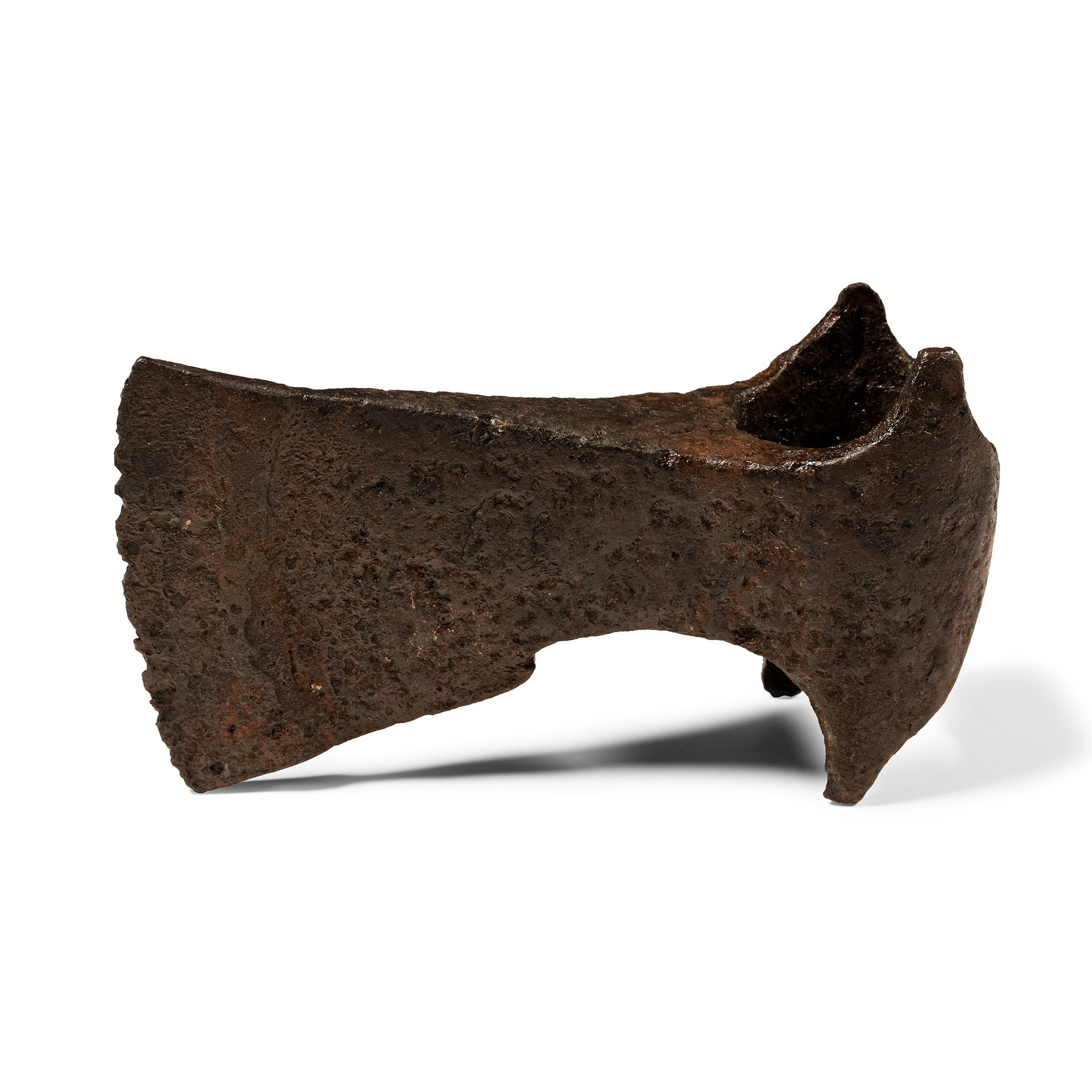
LOT 1734
Viking Age Finno-Ugrian Socketted Axe Head
10TH-13TH CENTURY A.D.
5 5/8 in. (694 grams, 14.2 cm).
A Finno-Ugrian or Baltic hand-forged iron axehead with triangular-section narrow blade widening to a broad bevelled edge with square chin and spur to the rear, socket with flanges to the rear. [No Reserve]
ProvenanceFrom the private collection of a London gentleman, from his grandfather's collection formed before the early 1970s.
LiteratureCf. for similar axes Nicolle, D., 'Raiders of the Ice War' in Military Illustrated, March 1996, no.94, pp.26-29, fig.p.28; Sedov, B.B., Finno-Ugri i Balti v Epokhi Srednevekovija, Moscow, 1987, pl.CX, item 44.
FootnotesDuring the mid 13th century, the axes were favourited by Baltic people. For instance, the Curonian army included lightly armed soldiers who fought with spears, shields, fighting knives and axes. A heavily armed soldier could also carry a sword, a helmet, a shield and a wide bladed axe.
CONDITIONTimeLine Auctions follows a vetting process to ensure the authenticity and legality of all items, reinforcing our commitment to integrity and responsible trading. Each antiquity, antique, and coin lot undergoes thorough examination by a vetting committee of at least ten external specialists, professional trade association members, scientists, and archaeologists: Our Vetting Process
AUCTIONS:
TimeLine is a leading auction house specialising in antiquities, ancient art, collectables, natural history, coins, medals, and books. Our auctions offer museums, collectors, historians, and enthusiasts the opportunity to acquire unique and historically significant pieces.
-

Viking Age Silver Broad Axe Pendant with Radiant Sun
Circa 9th-11th century A.D. or earlierSold for (Inc. bp): £390
Axehead with sunburst motif to one face; suspension loop with coiled ends. 1.92 grams, 32 mm
Ex German art market, 2000s. Acquired from an EU collector living in London. From the collection of Surrey, UK, gentleman. -
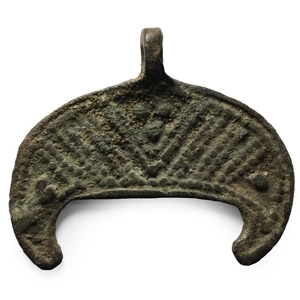
Viking Age Bronze Lunar Pendant
9th-11th century A.D.Sold for (Inc. bp): £72
Crescentic in profile with imitation filigree and granulation to the obverse, pierced suspension lug. 2.09 grams, 28 mm
From an old English collection, 1990s. Property of an Essex, UK, gentleman. -

Viking Age Gold 'Elf Shot' Pendant
9th-11th century A.D. or earlierSold for (Inc. bp): £650
Sheet gold sleeve and wire dangle, crystal lobed bead mounted in the socket. 0.83 grams, 23 mm
Ex property of a late Japanese collector, 1970-2000s.
This amulet was believed to offer protection against 'Elfshot'. The attack of elves was believed responsible for mysterious suffering in men and livestock: sudden shooting pains localised to a particular area of the body, such as in rheumatism, arthritis or muscle stitches or cramps. Elves were thought to shoot darts or arrows where such pains had no obvious external cause. Belief in elfshot persisted into the 20th century in rural areas, and as proof country folk would sometimes find small arrowheads (the remains of Neolithic or Mesolithic flints, or naturally-occurring spear-shaped stones) that were believed to be the magical weapons that caused the afflictions. Belief in elfshot began in the Pagan Germanic period.
