
Loading, please wait...
_900x900.jpg "Viking Age Bronze Twisted Bracelet with Hatched Terminals")
_200x200.jpg "Viking Age Bronze Twisted Bracelet with Hatched Terminals")
.jpg "Viking Age Bronze Twisted Bracelet with Hatched Terminals")
LOT 1703
Viking Age Bronze Twisted Bracelet with Hatched Terminals
9TH-12TH CENTURY A.D.
(80 grams, 80 mm).
Two rods tightly twisted and curved into a penannular shape, hammered flat towards the ends, each terminal with heavily hatched design to the outer edge. [No Reserve]
ProvenanceFrom a Sussex, UK, private collection; acquired 1980s-1990s.
This lot is accompanied by an illustrated lot declaration signed by the Head of the Antiquities Department, Dr Raffaele D'Amato.
Cf. Sedov, B.B., Finno-Ugri i Balti v Epokhi Srednevekovija, Moscow, 1987, pl.XCI (18), for type; also see Shetelig, H. (ed), Viking Antiquities in Great Britain and Ireland, Part VI, Oslo, 1954, figs.84-85 (hoards from Croydon and Cuerdale).
CONDITIONTimeLine Auctions follows a vetting process to ensure the authenticity and legality of all items, reinforcing our commitment to integrity and responsible trading. Each antiquity, antique, and coin lot undergoes thorough examination by a vetting committee of at least ten external specialists, professional trade association members, scientists, and archaeologists: Our Vetting Process
AUCTIONS:
TimeLine is a leading auction house specialising in antiquities, ancient art, collectables, natural history, coins, medals, and books. Our auctions offer museums, collectors, historians, and enthusiasts the opportunity to acquire unique and historically significant pieces.
LOT 1703
Viking Age Bronze Twisted Bracelet with Hatched Terminals
Sold for (Inc. bp): £117
-
.jpg)
Viking Age Gold 'Hack Money' Section
Circa 9th-11th century A.D.Sold for (Inc. bp): £286
A hacked irregular piece of gold ingot, probably melted down loot creating a monetised piece of 'Hack' for Viking trade. 3.33 grams, 20 mm
Property of a Cambridgeshire, UK, collector. From his private collection since the 1970s; thence by descent circa 2000. Ex private collection of a Bedfordshire gentleman. This lot is accompanied by an illustrated lot declaration signed by the Head of the Antiquities Department, Dr Raffaele D'Amato. -
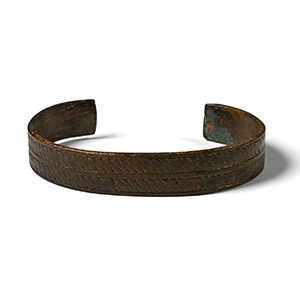
Viking Age Decorated Bronze Bracelet
9th-12th century A.D.Sold for (Inc. bp): £338
A flat-section penannular bracelet with two decorative bands to the upper face separated by a median line, both finials with two bands of similar decoration flanking decorative X-motif. 27 grams, 67 mm
Acquired on the UK art market before 2000. Property of an Essex, UK, gentleman. This lot is accompanied by an illustrated lot declaration signed by the Head of the Antiquities Department, Dr Raffaele D'Amato. -
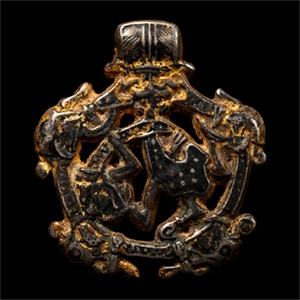
Scandinavian Viking Silver-Gilt Oseberg Style Gripping Beast Pendant
Late 10th-early 11th century A.D.Sold for (Inc. bp): £1,560
Borre-style beast and integral suspension loop with linear detailing; the openwork plaque with pelletted border and scrolled florid niello-filled panels, beast with pelletted band to the body and gripping hands on the border, facing mask below the loop. 21.1 grams, 40 mm
Private collection formed in Europe in the 1980s. Westminster collection, central London, UK. This lot has been cleared against the Art Loss Register database, and is accompanied by an illustrated lot declaration signed by the Head of the Antiquities Department, Dr Raffaele D'Amato.
There is a class of discoid pendants with banded borders and contorted figures found in the hinterland of the Baltic region, associated with the influence of Scandinavian settlers. The design of these items recalls specific elements of Scandinavian art - for example, the 'gripping hands' motif is a feature of the Oseberg Style named after the famous Norwegian ship-burial. Oseberg Style is associated with the beginnings of the Viking age, and was current in the 9th century when Scandinavian settlers began to establish centres of trade and political control in the area of the rivers Dnieper and Volga. The motif has been interpreted as a horse and linked with various legends and mythic figures.
